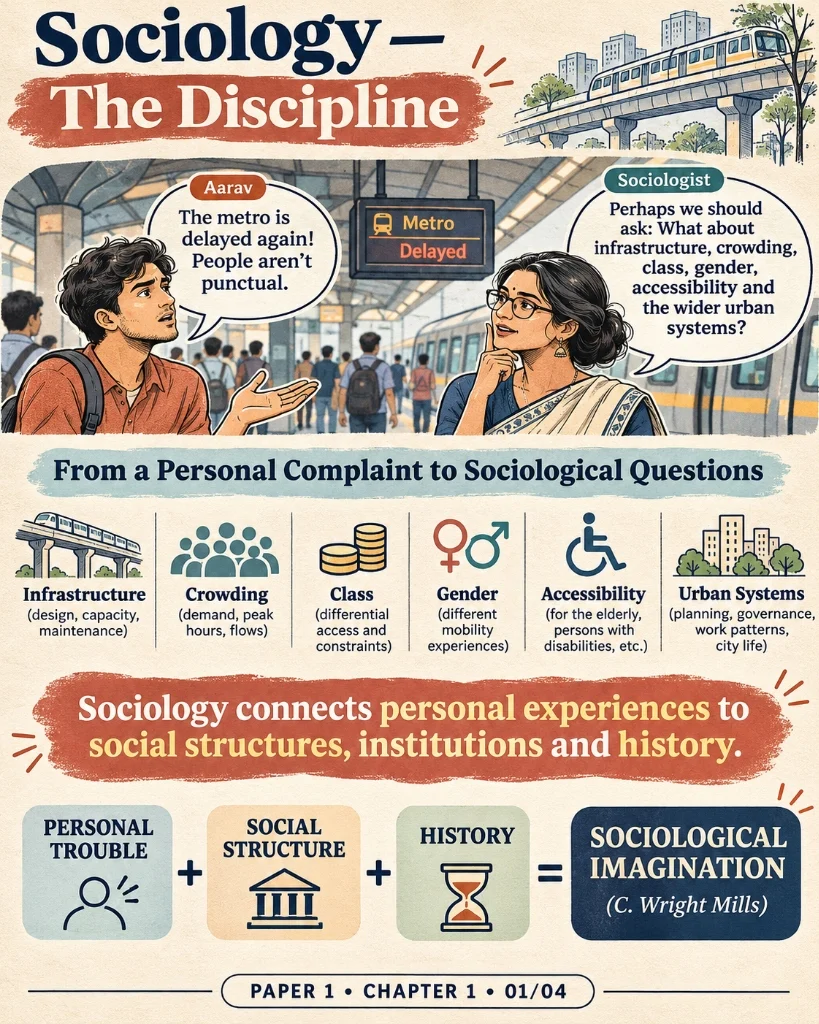
C. Wright Mills & Sociological Imagination: Personal Troubles vs Public Issues
C. Wright Mills ke lens se Kota coaching suicides, graduate unemployment aur agrarian debt ko sirf “personal failure” nahi, balki structural crisis samjho. PLFS 2023-24, NFHS-5 aur NCRB data is debate ko sharper banate hain.
📑 Quick Jump: Contents (4) & Syllabus Chapters
C. Wright Mills aur Indian Reality: Personal Trouble ya Public Issue?
C. Wright Mills ne The Sociological Imagination (1959) mein ek foundational distinction diya: personal troubles of milieu aur public issues of social structure. Personal trouble woh hoti hai jo individual biography ke level par dikhai deti hai—jaise exam failure, depression, debt, ya joblessness. Public issue woh hota hai jo mass scale par repeat ho, aur jiska root cause kisi wider institutional arrangement mein ho—jaise education system ka commodification, labour market stagnation, ya agrarian crisis. UPSC Sociology Optional ke liye yeh distinction sirf theory nahi, balki India ke lived realities ko interpret karne ka powerful tool hai.
Kota coaching suicides ko dekhiye. Media aksar ise “student pressure”, “weak mental health”, ya “family expectations” ke frame mein present karta hai. Ye factors real hain, lekin Mills ke lens se poora phenomenon coaching economy, credentialism, parental aspiration, competitive labour market, aur urban isolation ka result bhi hai. Yani ek individual tragedy ke peeche structural pressures chhupe hote hain.
Graduate unemployment bhi isi tarah ka case hai. PLFS 2023-24 ke labour market trends dikhate hain ki education ka expansion automatic employment mein convert nahi ho raha. Degree inflation, skill mismatch, informalisation, aur shrinking quality jobs—ye sab public issues hain. Jab ek graduate job nahi paata, toh problem ko “lack of effort” bolna sociologically inadequate hai.
Agrarian debt aur farmer suicides bhi Millsian analysis se clearer hote hain. Debt sirf reckless borrowing ka nateeja nahi; input costs, price volatility, fragmented holdings, climate risk, credit dependence, aur market power asymmetry ka outcome bhi hai. NCRB ke farmer suicide patterns aur different state-level agrarian distress studies batate hain ki individual self-harm often systemic agrarian insecurity ka endpoint hota hai.
Indian sociology mein yeh approach highly relevant hai kyunki India mein poverty, unemployment, caste, gender, region, aur education ek dusre se intertwined hain. Mills ka central lesson yeh hai: agar hum sirf private pain dekhte rahenge, toh public structure invisible reh jayega. Aur sociologist ka kaam precisely wahi structure ko visible banana hai.
Thinkers: Mills se Beyond, Indian Context tak
C. Wright Mills ka central contribution hai sociological imagination—private life aur public history ko connect karna. Unki book The Sociological Imagination (1959) sociologist ko warn karti hai against abstracted empiricism aur grand theory ka mechanical use. Mills ke liye unemployment, divorce, depression, ya suicide tab sociological issues bante hain jab unka mass pattern institutional order se linked ho. India mein this is extremely useful for analysing Kota suicides, graduate unemployment, and farmer indebtedness.
Emile Durkheim is contrast ko deepen karte hain. Suicide (1897) mein Durkheim ne suicide rates ko social integration aur regulation se link kiya. Unke liye anomic suicide tab badhta hai jab norms weak ho jaate hain. Kota mein exam anxiety aur uncertainty ko Durkheimian anomie se bhi samjha ja sakta hai. Lekin Mills isko aur wider political economy mein place karta hai—coaching industry, competition, and job scarcity.
Robert K. Merton ka strain theory bhi relevant hai. Social Theory and Social Structure mein Merton ne bataya ki culturally prescribed goals aur institutional means mein gap strain create karta hai. India mein “success through degree” ek dominant cultural goal ban gaya hai, but formal jobs limited hain. Kota student ya unemployed graduate ki frustration ko Mertonian strain se explain kiya ja sakta hai. Mills yahan structural biography ko broader historical power relations se jodta hai.
Pierre Bourdieu ka symbolic capital, cultural capital, aur habitus concept Indian education ko unpack karta hai. Distinction aur education-related works mein Bourdieu dikhate hain ki upper-class habitus, coaching access, English proficiency, and social networks success ko reproduce karte hain. Kota system mein middle-class families coaching ko mobility ladder samajhti hain, but unequal cultural capital success ko uneven banata hai. Mills aur Bourdieu dono individual merit myth ko challenge karte hain, though Bourdieu more reproduction-oriented hai.
Amartya Sen ka capability approach sociological imagination ko normative depth deta hai. Development as Freedom mein Sen argue karte hain ki actual freedom, not just income, matters. Graduate unemployment ya agrarian debt ko Sirf income issue nahi, capability deprivation ke roop mein bhi dekhna chahiye—education, dignity, health, voice, aur choice sab affected hote hain.
Indian sociology mein A.R. Desai ki political economy approach bhi important hai. Rural Sociology in India aur agrarian writings mein Desai class exploitation, land relations, aur state policy ko central rakhte hain. Mills se milkar yeh perspective personal distress ko structural exploitation mein locate karta hai. Similarly, D.N. Dhanagare aur M.N. Srinivas ke rural studies ne dikhaya ki agrarian change, dominant caste power, aur patron-client relations village distress ko shape karte hain. Isliye best answer Mills ko isolated theory nahi, balki Durkheim, Merton, Bourdieu, Sen aur Indian political economy ke saath dialogue mein present karega.
| Aspect | Private Troubles | Public Issues |
|---|---|---|
| Level of analysis | Individual biography, family stress, immediate emotion | Social structure, institutions, labour market, policy |
| Typical example | A student failing an exam or a farmer feeling ashamed | Mass coaching suicides, graduate unemployment, agrarian debt crisis |
| Main explanation | Personal choices, character, resilience, coping | Credentialism, inequality, informalisation, price volatility, debt traps |
| Policy implication | Counselling, self-help, individual correction | Structural reform in education, jobs, credit, agriculture, welfare |
Indian Evidence: Data, Reports aur Case Studies
Mills ko India mein ground par validate karne ke liye robust empirical material zaroori hai. PLFS 2023-24 labour market ko samajhne ke liye key source hai. Iske trends repeatedly yeh dikhate hain ki education levels badhne ke baad bhi quality employment automatic nahi mil raha. Youth unemployment aur underemployment especially urban educated youth mein visible hai. Iska implication yeh hai ki graduate joblessness ko “individual laziness” ke lens se dekhna misleading hai; problem labour absorption, skill mismatch, aur informalisation ki hai.
NFHS-5 social distress ko indirectly illuminate karti hai. Although primary focus health and demographics hai, data se nutrition stress, anaemia, gendered disadvantage, and household vulnerability samajh aati hai. Education aur household well-being ke between strong link milta hai, but schooling alone welfare guarantee nahi karti. This matters when students in coaching hubs experience distress despite “educational success” narratives.
NCRB data farmer suicides aur accidental death statistics ke through structural distress ke signposts deti hai. Various annual reports consistently show that a substantial share of suicides in agrarian regions are linked to debt, crop failure, and economic hardship. In Maharashtra, Karnataka, Telangana, and other states, field reports and journalistic ethnographies reveal that debt often comes from informal credit, medical expenses, and agricultural input costs. Yeh clearly public issue hai, not merely a private misfortune.
Kota coaching suicides are a contemporary ethnographic case of institutional pressure. Coaching city model—hostel living, test-based ranking, 24x7 competition, parental loan burdens, and social isolation—creates an environment where individual stress is socially produced. Here Mills helps us see that suicide is not reducible to “weak mindset”; it is embedded in a commercialization of aspiration.
Sachar Committee Report (2006) aur NITI Aayog’s Multidimensional Poverty Index (MPI) useful background provide karte hain. Sachar showed how educational and employment exclusion can be community-specific and structural, while NITI MPI demonstrates persistent deprivation in health, education, and living standards. Jab graduate unemployment and agrarian distress ko intersectionally dekhenge, toh poverty, caste, gender, and region ka compound effect clear hota hai.
Xaxa Committee Report (2014) tribal deprivation aur land alienation ko foreground karti hai. For Adivasi communities, debt and unemployment often connect with displacement, forest access issues, and weak development outcomes. Similarly, Oxfam inequality reports and World Inequality Lab findings repeatedly show that inequality in income and opportunity has widened in India. This strengthens Millsian reading: personal suffering often sits atop unequal structures.
Relevant case studies include Vidarbha farmer suicides, Bihar and eastern UP youth migration, and Kota’s student distress pattern. Together these show a common sociological pattern: when institutions fail to absorb risk, individuals internalize systemic failure as personal inadequacy. UPSC answer mein data ka use hamesha analytical hona chahiye—sirf facts dump nahi, balki facts ko Mills ke framework se connect karo.
🔑 Sociological Imagination
Private troubles ko public issues se jodkar dekhne ki ability; biography aur history ka structural connection samajhna.
Critique: Mills ki Limits aur Nuanced Synthesis
C. Wright Mills ka framework powerful hai, but it is not sufficient on its own. Pehli limitation yeh hai ki Mills often broad structural diagnosis deta hai, lekin micro-level psychological processes ko detailed explain nahi karta. Kota suicides mein depression, loneliness, family conflict, and personality vulnerabilities bhi matter karte hain. Sirf structure bol dene se lived mental suffering vanish nahi hoti.
Doosri limitation yeh hai ki Mills ka style kabhi-kabhi dichotomous lagta hai—private versus public. Real life mein yeh boundary porous hoti hai. For example, agrarian debt ek structural issue hai, but debt decision-making mein caste hierarchy, local moneylender relations, masculinity, and household consumption patterns bhi role play karte hain. Isliye better approach is interactional and multi-causal.
Counter-thinkers useful hain. Durkheim social integration aur anomie ko highlight karte hain, jo suicide analysis mein essential hai. Bourdieu habitus aur symbolic violence ke through explain karte hain ki individuals structural inequalities ko kaise internalize karte hain. Sen reminds us that capability deprivation is not only economic but also social and political. Indian scholars like A.R. Desai and rural sociologists add political economy depth, especially for agrarian debt.
Another nuance: not every distress can be fully collapsed into structure. Sociology should avoid turning individuals into mere victims. Some people negotiate constraints with agency, resilience, and collective action. For example, farmer producer organizations, student collectives, and social movements show that agency exists inside structure, not outside it.
Best synthesis yeh hai: Mills ko starting point banao, end point nahi. Personal trouble ko trivialize mat karo, but usko depoliticize bhi mat karo. UPSC ke liye mature answer wahi hai jo structural explanation, lived experience, and policy response ko ek saath hold kare. Mills ka real value yahi hai ki woh aspirants ko moral blaming se sociological reasoning tak le jaata hai.
Answer kaise likhein
- Mills (1959) ke अनुसार personal troubles ko public issues se jodkar dekhna sociological imagination hai.
- Kota suicides ko exam pressure se beyond coaching industry, competition, urban isolation aur labour-market anxiety se explain karo.
- PLFS 2023-24 se graduate unemployment ko education-job mismatch, informalisation aur quality jobs ki scarcity se link karo.
- Agrarian debt aur farmer suicides ko NCRB, crop risk, price volatility, institutional credit gaps aur structural inequality se analyse karo.
Is Blog Se Jude Syllabus Chapters
Every Unit Note + Topic-Wise PYQ Mapped (English + Hinglish)
Paper 1 (10 Units) aur Paper 2 (15 Units) — Complete structured notes, thinkers, mind maps & 597 solved PYQs ek saath.
Khud ko test karo
Is post se 3 sawal
0 / 3 attempted
1. C. Wright Mills ke अनुसार sociological imagination ka main function kya hai?
2. Kota coaching suicides ko Millsian lens se kaise dekha jayega?
3. PLFS 2023-24 ka sociology optional mein sabse relevant use kya hai?
FAQ
Aksar poochhe jaane wale sawaal
- Mills ki sociological imagination ka core idea kya hai?
- Personal biography aur social history ko connect karke private troubles ke behind hidden public issues ko identify karna.
- Kota suicides Mills ke framework mein kaise fit hote hain?
- Ye individual distress se zyada coaching commercialization, competition, family aspiration aur institutional pressure ka outcome dikhte hain.
- Graduate unemployment ko structural issue kyun mana jata hai?
- Kyuki degree expansion ke baad bhi quality jobs, labour absorption aur employability ke structural gaps बने रहते हैं.
UPSC PYQs
Is topic ke Previous Year Questions
- 2025 · P1
What is common sense? How are common knowledge and sociology related to each other? Explain. (10 marks)
- 2024 · P1
Sociology is the product of European enlightenment and renaissance. Critically examine this statement. (10 marks)
- 2023 · P1
Do you think that common sense is the starting point of social research? What are its advantages and limitations? Explain. (10 marks)
- 2022 · P1
What aspects of Enlightenment do you think paved way for the emergence of sociology? Elaborate. (10 marks)
Roz ke Sociology notes Telegram pe paao
Daily current affairs, PYQ linkages aur direct mentorship support Telegram par.
Related
Aur padho
- ThinkersOWL BLOGP1
Karl Marx for UPSC Sociology: Historical Materialism, Alienation & Mode of Production (Notes + PYQs)
4 min readKarl Marx for UPSC Sociology: Historical Materialism, Alienation & Mode of Production (Notes + PYQs)
Karl Marx remains the single highest-yielding thinker in UPSC CSE Sociology Optional, appearing almost every year in Paper 1 and shaping critical perspectives in Paper 2. Yet, most aspirants lose marks by writing generic political...
Padho → - ThinkersOWL BLOGP1
Emile Durkheim UPSC Sociology Notes: Social Facts, Division of Labour & Suicide (With Mapped PYQs)
4 min readEmile Durkheim UPSC Sociology Notes: Social Facts, Division of Labour & Suicide (With Mapped PYQs)
In UPSC Sociology Optional, Emile Durkheim stands as the foundational architect who carved out sociology as an autonomous science distinct from psychology and philosophy. For serious aspirants, mastering Emile Durkheim social facts...
Padho → - ThinkersOWL BLOGP1
Max Weber UPSC Sociology: Bureaucracy, Ideal Types, Verstehen & Protestant Ethic (Unit Notes + PYQs)
4 min readMax Weber UPSC Sociology: Bureaucracy, Ideal Types, Verstehen & Protestant Ethic (Unit Notes + PYQs)
Max Weber stands as a foundational pillar of interpretive sociology, offering a powerful methodological counterpoint to Durkheimian positivism and Marxian economic determinism. Whether you are decoding rational-legal authority or...
Padho →