Colonialism, Social Reforms & Dalit-Anti-Caste Mobilisation in 19th-Century India
Colonialism ne caste ko partly “fix” bhi kiya aur anti-caste resistance ko bhi fuel kiya. NFHS-5, PLFS aur NCRB data dikhate hain ki discrimination ab bhi structural hai.
📑 Quick Jump: Contents (4) & Syllabus Chapters
Colonialism, Social Reform aur Anti-Caste Mobilisation: ek conceptual puzzle
19th-century India mein ek paradox tha: colonial rule ne traditional social order ko destabilise kiya, par saath hi caste ko “enumerate”, “codify” aur bureaucratise bhi kiya. Isliye question yeh nahi hai ki colonialism ne caste ko khatam kiya ya nahi; asli sociological puzzle yeh hai ki colonial modernity ne caste oppression ko kaise reconfigure kiya, aur uske against naye reformist aur anti-caste movements kaise ubhre.
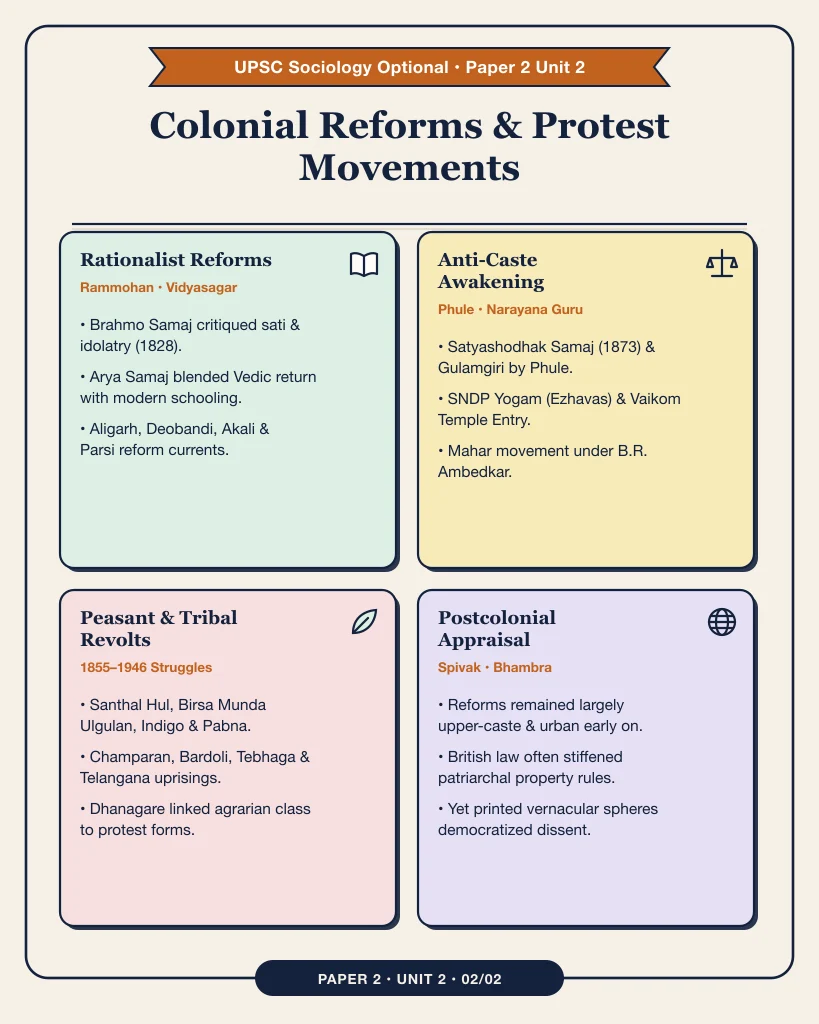
Rammohan Roy, Brahmo Samaj aur Dayanand Saraswati/Arya Samaj jaise reformers ne social reform ko scripture-based purification, monotheism aur widow remarriage, female education, anti-sati jaise issues se joda. Lekin inka frame largely “reform from above” raha—varna hierarchy ko reform karna, annihilate karna nahi. Iske contrast mein Jyotirao Phule ne Satyashodhak Samaj ke through Brahmanism, shudra-atishudra exploitation aur gender oppression ko radical critique diya. Phule ne “Gulamgiri” aur “Shetkaryacha Asud” mein caste ko power aur labour exploitation ke structure ke roop mein dekha.
20th century mein Periyar ki Self-Respect Movement ne caste, patriarchy aur religious authority ko open revolt se challenge kiya. Sri Narayana Guru ne “One caste, one religion, one God for man” ke through spiritual egalitarianism ko social dignity se joda. Gail Omvedt ne is entire trajectory ko subaltern cultural revolt ke lens se interpret kiya—jahan lower castes ne sirf social uplift nahi, balki knowledge, ritual, sexuality aur public culture par bhi right claim kiya.
Aaj bhi yeh debate relevant hai kyunki caste khatam nahi hua. NFHS-5 mein education, nutrition aur health outcomes mein caste gaps dikhte hain; PLFS labour market mein caste-based segmentation ko signal karta hai; NCRB data atrocity pattern ko expose karta hai. Isliye colonial reform aur anti-caste mobilisation ko padhna sirf history nahi, contemporary inequality ko samajhne ka tool hai.
Thinkers aur analytical contrast
1) Jyotirao Phule: Phule sociology ke liye foundational anti-caste thinker hain. Unka work Gulamgiri (1873) aur Shetkaryacha Asud oppression ko merely religious issue nahi, balki socio-economic exploitation ke roop mein dekhta hai. Phule ne caste ko aisi system maana jahan Shudra-Atishudra labour produce karta hai par cultural dignity aur political voice se wanchit rehta hai. Unka Satyashodhak Samaj truth-seeking, non-Brahmanical social organisation aur education par based tha. Phule ne reform ko upper-caste moral correction nahi, balki power reversal ke roop mein imagine kiya.
2) B.R. Ambedkar: Although 19th-century ke baad prominently emerge hue, Ambedkar ko is theme mein include karna zaroori hai because unhone Phule ki radical tradition ko constitutional frame diya. Annihilation of Caste mein Ambedkar ne clear kiya ki caste reform nahi, structural abolition demand karta hai. Unki concepts of graded inequality, endogamy, aur social democracy UPSC answer ko theoretical depth dete hain. Ambedkar ka contribution dikhata hai ki colonial-era reform se lekar anti-caste politics ek linear story nahi, balki escalating critique ka continuum hai.
3) E.V. Ramasamy ‘Periyar’: Periyar ki Self-Respect Movement ne caste aur patriarchy dono par attack kiya. Unka emphasis rationalism, inter-caste marriage, widow remarriage aur anti-ritualism par tha. Periyar ne religion ko social domination ka instrument mana, aur Tamil public sphere mein Dravidian identity ko mobilise kiya. Unki strength yeh thi ki unhone “respectability” ko Brahmanical authority ke against redefine kiya. Agar Phule agrarian lower-caste oppression ko highlight karte hain, Periyar social humiliation aur symbolic domination ko central banate hain.
4) Sri Narayana Guru: Guru ka famous message “One Caste, One Religion, One God for man” lower-caste dignity aur spiritual equality ka compressed statement tha. Unhone Kerala mein temples, schools aur community institutions ko reform ke instruments ki tarah use kiya. Guru ka approach confrontational bhi tha aur constructive bhi—he created parallel institutions rather than only criticising existing ones. Isliye unka movement social reform aur community self-respect ka blend tha.
5) Gail Omvedt: Omvedt ne Indian anti-caste politics ko subaltern cultural revolt ke naam se analyse kiya. Unke liye caste oppression ke khilaf struggle sirf economic redistribution nahi, balki culture, ideology aur everyday life ki contestation thi. Dalits and the Democratic Revolution aur Buddhism in India mein unhone dikhaya ki anti-caste movements ne knowledge production ko democratise kiya. Omvedt ka key insight yeh hai ki colonial modernity ne lower castes ko limited openings di, par true emancipation tab aayi jab oppressed groups ne apni cultural autonomy claim ki.
Analytical contrast: Rammohan Roy aur Arya Samaj ne reform ko largely scriptural purification ke form mein dekha; Phule-Periyar-Guru tradition ne reform ko anti-hierarchy aur dignity politics banaya. Isliye first stream “social reform within order” hai, second “anti-caste transformation of order” hai.
| Aspect | Reformist Social Movements | Radical Anti-Caste Movements |
|---|---|---|
| Core aim | Social evils ko correct karna; society ko moralise karna | Caste hierarchy ko challenge/transform karna; dignity restore karna |
| Key method | Scriptural reinterpretation, education, petitioning, reform clubs | Organised mobilisation, non-Brahmanical institutions, satire, protest |
| Representative thinkers | Rammohan Roy, Arya Samaj, Dayanand Saraswati | Jyotirao Phule, Periyar, Sri Narayana Guru, Ambedkar, Omvedt |
| View of caste | Caste abuses ko correctible social defect maana | Caste ko structural oppression aur graded inequality maana |
Indian data, reports aur empirical evidence
Sociological answer ko evidence-based banane ke liye contemporary Indian data bahut important hai. NFHS-5 (2019-21) castes ke health aur nutrition differentials ko indirectly but clearly show karta hai. Scheduled Caste aur Scheduled Tribe households mein anemia, stunting aur undernutrition ka burden generally higher milta hai, jo intergenerational disadvantage ko indicate karta hai. Iska matlab anti-caste politics sirf symbolic equality ka issue nahi, bodily inequality ka bhi question hai.
PLFS labour market structure par caste segmentation ko reflect karta hai. Regular wage employment, stable non-farm jobs aur higher skill occupations mein historically disadvantaged groups ka access uneven hai. Informalisation ki wajah se caste disadvantage aur reproduce hota hai, especially construction, casual labour aur low-paid service work mein. Isko explain karte waqt aap “occupational segregation” aur “social closure” terms use kar sakte ho.
NCRB Crime in India reports atrocities pattern ko quantify karti hain. SC/ST communities ke against crimes ke registered cases social hostility aur power asymmetry ka legal evidence dete hain. Atrocity reporting ko underreporting issue ke saath read karna chahiye, lekin trends still structural discrimination ko indicate karte hain.
Historical-ethnographic angle se Louis Dumont ke Homo Hierarchicus ne caste ko hierarchy-based social order ke roop mein conceptualise kiya, though uski criticism bhi hui ki woh domination aur resistance ko underplay karta hai. M.N. Srinivas ke Sanskritisation and dominant caste framework se samajh aata hai ki lower castes sirf passive victims nahi the; woh status mobility strategies bhi adopt karte the. But anti-caste movements ne dikhaya ki mobility se zyada important structural dignity hai.
Xaxa Committee aur Sachar Committee directly caste-reform history ke baad ke phase se related hain, par yeh dikhate hain ki social exclusion multiple axes par operate karta hai—tribal deprivation, minority disadvantage aur state access gaps. NITI Aayog’s MPI deprivation ko multidimensional frame mein place karta hai, jahan poverty education, health aur living standards tak limited nahi rehti. Oxfam India / WIL reports repeatedly indicate karti hain ki inequality wealth, education aur employment mein highly concentrated hai, aur caste location in disparities ko deepen karti hai.
Real case studies: Kerala mein Sri Narayana Dharma Paripalana legacy ne education-led mobility ko support kiya; Maharashtra mein Satyashodhak tradition ne anti-Brahmanical public sphere create kiya; Tamil Nadu mein Self-Respect movement ne inter-caste marriage aur rationalist politics ko mainstream kiya. Yeh case studies prove karti hain ki anti-caste mobilisation tab durable hoti hai jab woh institution-building ke saath cultural challenge bhi kare.
🔑 Subaltern cultural revolt
Lower castes ka aisa collective resistance jahan woh sirf material rights nahi, balki dignity, knowledge, ritual authority aur public culture par bhi claim karte hain.
Critique aur nuanced synthesis
Is topic ka ek common limitation yeh hai ki aspirants colonialism ko ya to “modernising force” bana dete hain ya pure oppression. Dono simplistic hai. Colonial rule ne missionary education, print capitalism, census, law courts aur public debate ke through reform ke opportunities diye, lekin caste ko classify karke rigid bhi banaya. Isliye colonialism ko ambivalent force samajhna chahiye.
Second limitation: social reformers ko ek hi bucket mein daal dena. Rammohan Roy aur Arya Samaj ne important reforms push kiye, par unka frame often upper-caste moral reform tak limited raha. Phule-Periyar-Guru tradition comparatively more radical tha because it attacked the legitimacy of Brahmanical authority itself. UPSC answer mein yeh distinction clear honi chahiye.
Third, anti-caste mobilisation ko sirf ideology ka issue maan lena galat hoga. Caste ka survival marriage, land, labour markets, ritual hierarchy aur state institutions ke through hota hai. Isliye anti-caste politics ko legal, economic aur cultural all three levels par read karna chahiye. Ambedkar yahan bridge thinker hain because unhone constitutionalism, democracy aur social reform ko connect kiya.
Finally, a nuanced synthesis yeh hogi ki 19th-century social reform ne public sphere open kiya, par radical anti-caste mobilisation ne us public sphere ko democratise kiya. Gail Omvedt ka point useful hai: oppressed groups ne resistance ko cultural self-definition mein badla. Thus, history ka takeaway yeh hai ki equality charity se nahi, collective struggle aur institutional change se aati hai.
Answer kaise likhein
- Rammohan Roy/Arya Samaj ne social reform ko scriptural reinterpretation aur moral सुधार tak rakha; Phule ne caste ko power hierarchy aur labour exploitation ki tarah expose kiya.
- Satyashodhak Samaj, Self-Respect Movement aur Sri Narayana Guru ke initiatives ne dignity, education aur non-Brahmanical institutions build kiye.
- Gail Omvedt ke अनुसार yeh movements subaltern cultural revolt the, jahan oppressed castes ne ritual, knowledge aur public sphere par claim kiya.
- NFHS-5, PLFS aur NCRB se aaj bhi structural inequality, occupational segregation aur atrocity patterns visible hain; isliye anti-caste politics contemporary relevance रखती है.
Is Blog Se Jude Syllabus Chapters
Every Unit Note + Topic-Wise PYQ Mapped (English + Hinglish)
Paper 1 (10 Units) aur Paper 2 (15 Units) — Complete structured notes, thinkers, mind maps & 597 solved PYQs ek saath.
Khud ko test karo
Is post se 3 sawal
0 / 3 attempted
1. 1. Jyotirao Phule ki *Gulamgiri* ka core theme kya tha?
2. 2. Sri Narayana Guru ka famous message kya tha?
3. 3. Gail Omvedt ne anti-caste struggle ko kis term se interpret kiya?
FAQ
Aksar poochhe jaane wale sawaal
- Q1. Kya colonialism ne caste ko weaken kiya?
- Partly yes, because education, print aur law ne debate open ki. But census, administration aur land relations ne caste ko aur rigid bhi kiya.
- Q2. Phule aur Periyar mein main difference kya tha?
- Phule ne Shudra-Atishudra exploitation aur Brahmanism ko expose kiya; Periyar ne caste ke saath patriarchy aur ritual authority par direct attack kiya.
- Q3. Gail Omvedt ka key contribution kya hai?
- Unhone anti-caste politics ko subaltern cultural revolt ke roop mein read kiya, jahan dignity aur culture bhi central claims the.
UPSC PYQs
Is topic ke Previous Year Questions
- 2021 · P2
Assess the sociological limitations and achievements of nineteenth-century socio-religious reform movements in India. (10 marks)
- 2019 · P2
Examine how colonial agrarian policies and tribal exclusions triggered organized peasant and Adivasi uprisings. (20 marks)
- 2018 · P2
Compare upper-caste liberal reforms (Brahmo Samaj) with anti-caste radical movements (Satyashodhak Samaj and SNDP). (20 marks)
- 2018 · P2
Examine the sociological dynamics of the Champaran Peasant Movement in colonial India. (20 marks)
Roz ke Sociology notes Telegram pe paao
Daily current affairs, PYQ linkages aur direct mentorship support Telegram par.
Related
Aur padho
- Paper 2 IndiaOWL BLOGP2
Perspectives on Indian Society (Paper 2 Unit 1): G.S. Ghurye, M.N. Srinivas & A.R. Desai (PYQ Mapped)
4 min readPerspectives on Indian Society (Paper 2 Unit 1): G.S. Ghurye, M.N. Srinivas & A.R. Desai (PYQ Mapped)
Paper 2 of UPSC Sociology Optional tests your ability to apply sociological theories to India’s complex social reality. Mastering the perspectives on Indian society Ghurye Srinivas AR Desai UPSC expects in Unit 1 is non-negotiable...
Padho → - Paper 2 IndiaOWL BLOGP2
Caste System in India for UPSC Sociology: Purity-Pollution, Dominant Caste, Sanskritisation & Dalit Capitalism
4 min readCaste System in India for UPSC Sociology: Purity-Pollution, Dominant Caste, Sanskritisation & Dalit Capitalism
If you are aiming for 300+ in UPSC Sociology Optional, mastering Paper 2 — Unit 4 (Caste System) is non-negotiable. Every year, UPSC tests your ability to connect classical Indological theories with contemporary realities like...
Padho → - ThinkersOWL BLOGP2
M.N. Srinivas Complete UPSC Sociology Notes: Sanskritisation, Westernisation & Dominant Caste (With PYQs)
4 min readM.N. Srinivas Complete UPSC Sociology Notes: Sanskritisation, Westernisation & Dominant Caste (With PYQs)
Mysore Narasimhachar (M.N.) Srinivas is arguably the most frequently tested Indian thinker in UPSC Mains. For aspirants targeting a top rank, mastering MN Srinivas Sanskritisation dominant caste UPSC sociology frameworks is...
Padho →