Enlightenment, French & Industrial Revolution: How Modernity Birthed Sociology
Enlightenment, French aur Industrial Revolutions ne tradition se modern society tak ka bridge banaya. NFHS-5, PLFS aur NCRB data dikhate hain ki Indian modernity bhi unequal hai.
📑 Quick Jump: Contents (4) & Syllabus Chapters
Modernity ka Puzzle: Sociology kyun bani?
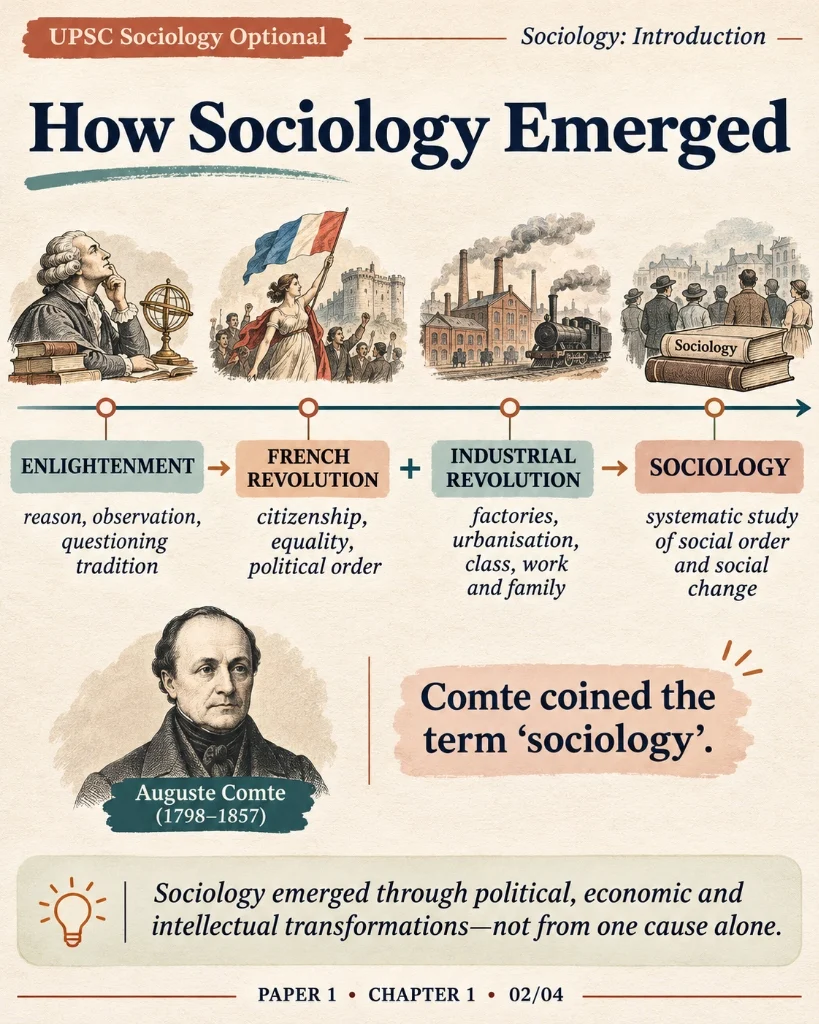
Sociology ka janm kisi ek thinker ke dimaag se nahi, balki ek historical crisis se hua. Enlightenment ne reason, science aur human progress ko central banaya; French Revolution ne authority, religion aur monarchy ko challenge kiya; aur Industrial Revolution ne production, urbanization, wage labor, class conflict aur family life ko fundamentally transform kar diya. In teeno upheavals ne European society ko itna unstable bana diya ki scholars ko naya discipline chahiye tha jo social order aur social change dono ko samjhe. Isi background mein sociology emerge hui as the science of modern society.
Is process ko samajhne ke liye Auguste Comte, Saint-Simon, Durkheim, Tönnies aur Marx jaise thinkers crucial hain. Comte ne sociology ko “social physics” kaha aur order plus progress ko reconcile karne ki koshish ki. Saint-Simon ne industrial society ko organized cooperation ke roop mein dekha. Durkheim ne mechanical solidarity se organic solidarity ki shift ko modern division of labour ka result bataya. Tönnies ne Gemeinschaft aur Gesellschaft ke through traditional community aur modern contractual society ka contrast diya. Marx ne industrial capitalism ko exploitation, class conflict aur alienation ke angle se decode kiya.
Par conservative reaction bhi utni hi important thi. Bonald aur Maistre ne revolution ki chaos aur moral breakdown par emphasis karke order, religion aur tradition ka defense kiya. Isliye sociology sirf progress ka celebration nahi, balki modernity ke contradictions ka diagnosis hai.
Indian context mein yeh debate aur relevant ho jaati hai. Colonial rule ne Indian society ko bhi market, railways, census, law, bureaucracy aur new education systems ke through restructure kiya. Yet India ka modernity path Europe jaisa linear nahi tha. NFHS-5 show karti hai ki health transition uneven hai; PLFS labour informality ko highlight karti hai; NCRB gendered violence aur social stress ka signal deta hai; ASER learning gaps ko; aur NITI MPI, Sachar aur Xaxa reports social inequalities ko expose karte hain. Isliye modernity ko India mein samajhna matlab hai imported institutions aur indigenous hierarchies ke complex interaction ko samajhna.
Thinkers: Modernity ko samajhne ke liye kaun kya bola?
Saint-Simon ko often sociology ka proto-founder maana jaata hai. Unhone French Revolution ke baad society ko reconstruct karne ke liye industrial production, science aur expertise par emphasis kiya. Unki vision mein society ko clergy aur aristocracy nahi, balki productive classes aur administrators should guide karen. Unka stress social organization and planning par tha, jo later positivist sociology ki foundation bana.
Auguste Comte ne term “sociology” ko formal shape di. Unki famous book Course of Positive Philosophy mein unhone law of three stages diya: theological, metaphysical, aur positive. Comte ke liye modern society ko scientific method ke through study karna chahiye. Unka concern order and progress tha. Yeh point important hai: Comte modernity ko blind chaos nahi, balki scientific coordination ke through manageable disorder maanta tha. Par unka approach overly consensus-oriented tha; class conflict aur power asymmetry ko relatively underplay karta hai.
Ferdinand Tönnies ne Gemeinschaft und Gesellschaft mein traditional aur modern social order ka classic distinction diya. Gemeinschaft mein intimate, face-to-face, emotionally integrated relations hote hain; Gesellschaft mein impersonal, contractual, calculative relations dominate karte hain. Industrial capitalism aur urban life ne society ko community se association ki taraf push kiya. Yeh conceptual tool aaj bhi village-urban transition, migration, gig work aur digital relations ko explain karne mein useful hai.
Émile Durkheim ne The Division of Labour in Society mein modernity ke moral consequences par focus kiya. Mechanical solidarity kinship, similarity aur collective conscience par based hoti hai; organic solidarity differentiation, interdependence aur specialized roles par. Durkheim ke liye modern division of labour sirf economic change nahi, balki moral integration ka naya basis tha. Par anomie ka risk hamesha rehta hai jab norms weak ho jaati hain. Durkheim isliye modernization ko neither pure liberation nor pure decline samajhte hain—rather a new moral order in need of regulation.
Karl Marx ne Capital aur Economic and Philosophic Manuscripts mein capitalist modernity ka sabse sharp critique diya. Industrial revolution ne labour ko commodity bana diya, worker ko means of production se alag kiya, aur alienation पैदा की. Marx ke liye modernity ka core contradiction progress aur exploitation ke beech hai. Bourgeois society wealth generate karti hai, par uska distribution unequal hota hai; class conflict system ka engine बन जाता है. If Comte asks how to preserve order, Marx asks: whose order?
In teenon perspectives ko compare karein to clear dikhta hai: Saint-Simon aur Comte modernity ko reorganize karna chahte hain; Tönnies aur Durkheim uske social forms ko map karte hain; Marx uske exploitative structure ko expose karte hain. Conservative thinkers Bonald aur Maistre, by contrast, revolution ko moral decay aur disorder ka source maante the, isliye unka focus restoration on religion, hierarchy and tradition tha. Sociology isi crossfire mein born hui—between fear of disorder and hope for progress.
| Aspect | Modernity as Progress | Modernity as Crisis |
|---|---|---|
| Key emphasis | Science, industry, rational planning | Disorder, exploitation, moral breakdown |
| Major thinkers | Saint-Simon, Comte, Durkheim | Marx, Bonald, Maistre, Tönnies |
| Social change seen as | Differentiation and cooperation | Alienation, anomie, loss of community |
| Policy implication | Social reform, coordination, regulation | Critique of capitalism, restoration of order or radical change |
Indian Data & Colonial Parallel: Europe se India tak modernity ka route
India mein modernity ka experience colonial mediation ke through आया. British rule ne railways, telegraph, census, courts, English education aur revenue systems ke zariye a new public order create kiya, but yeh order egalitarian nahi tha. Isliye European modernization theory ko India par mechanically apply nahi kiya ja sakta. Colonial modernity ek uneven and hierarchical process thi.
NFHS-5 se pata chalta hai ki modern institutions ke bawajood social outcomes highly unequal hain. Women’s nutritional deficits, child stunting, anaemia, aur unequal access to health services batate hain ki economic and administrative modernization ≠ social equality. Modernity ka promise universal tha, par outcome stratified.
PLFS repeatedly shows India’s labour market ke centre mein informality hai. Majority workforce informal sector mein hai, jahan job security, social protection aur stable wages limited hain. Yeh Marx ke capitalist insecurity aur Durkheim ke normlessness ke arguments ko contemporary India mein relevant banata hai. Urban growth hone ke baad bhi decent work ka shortage modernity ke incomplete character ko दिखाता है.
NCRB data violence, crime reporting, custodial issues aur gender-based vulnerabilities ko foreground karta hai. Modern state ka expansion social discipline to create karta hai, but protection always equal nahi hoti. This is crucial for understanding that modernity is not simply law and order; it also produces new forms of surveillance and violence.
ASER reports learning outcomes ki crisis ko point out karti hain. School access badha hone ke baad bhi basic reading aur arithmetic gaps persist karte hain. This resonates with sociology’s concern that institutional expansion does not automatically translate into social capability. Comte-style progress is partial when learning quality is uneven.
Committee and policy literature bhi same story batati hai. Sachar Committee ne Indian Muslims ki educational, employment and asset deprivation ko document kiya. Xaxa Committee ne Adivasi displacement, land alienation aur state neglect par focus kiya. NITI MPI multidimensional poverty ko reveal karta hai, showing that deprivation is not only income-based but also health, education aur living standards se जुड़ी है. Oxfam reports inequality ke extreme concentration ko highlight karti hain, while World Inequality Lab studies show that wealth concentration top percentiles mein highly skewed hai.
Case studies bhi revealing hain: Kerala ka social development model modern welfare institutions aur better human development outcomes dikhata hai; while Bihar/Jharkhand belt mein migration, low learning and precarious work rural-urban transition ki incompleteness ko show karte hain. This is why colonial and postcolonial India mein sociology ka task sirf industrialization ko celebrate karna nahi, balki caste, tribe, religion, gender aur class ke intersection mein modernity ke unequal effects ko decode karna hai.
🔑 Anomie
Durkheim ka term for normlessness ya weak social regulation, jab rapid social change se moral guidance disturb ho jaati hai.
Critique: Kahan yeh theories limit ho jaati hain?
Modernity aur sociology ke classical theories bahut powerful hain, but unki limitations bhi clear hain. First, Eurocentrism: Comte, Durkheim aur Tönnies largely European experience se draw karte hain. Agar inhe India par directly apply kiya jaaye, to caste, kinship, religion, colonial power aur agrarian hierarchy ko under-theorize karne ka risk hota hai. Indian modernity sirf industrial capitalism ka result nahi thi; yeh colonial state, caste reform, nationalist mobilization aur postcolonial development projects ka mixed outcome bhi thi.
Second, consensus bias. Durkheim aur Comte social order ko central rakhte hain, lekin power aur domination ko relatively soft terms mein treat karte hain. Marx is gap ko fill karta hai, par unka class lens kabhi-kabhi caste, gender aur ethnicity ki relative autonomy ko fully capture nahi karta. India mein exploitation sirf factory mein nahi, home, field, school aur marriage market mein bhi hota hai.
Third, linear progress assumption. Enlightenment narratives aksar assume karti hain ki reason ki victory se society steadily better ho jaayegi. But Indian evidence, like PLFS informality, NFHS-5 inequality, ASER learning deficits, and NITI MPI deprivation, shows mixed modernity—some sectors modernize, others remain structurally excluded.
Isliye better synthesis yeh hai ki modernity ko ek ambivalent process maana jaaye: it creates individual freedom, specialization, bureaucracy and rights, but also surveillance, alienation, inequality and cultural displacement. Bonald aur Maistre ki conservative critique hume remind karti hai ki rapid change social anxiety produce karta hai; Marx batata hai ki market expansion power relations ko intensify karta hai; Durkheim warns that regulation without moral integration leads to anomie. For UPSC sociology, best answer wahi hoga jo progress aur crisis dono ko ek saath hold kare.
Answer kaise likhein
- Enlightenment ne reason, science aur progress ko legitimize kiya; sociology ne society ko rationally study karne ka project uthaya.
- French Revolution ne authority, church aur monarchy ke crisis ko expose kiya; isi se order vs change ka sociological question bada.
- Industrial Revolution ne class, urbanization, labor division aur alienation ko janm diya; Durkheim, Tönnies aur Marx ke core ideas yahin se nikle.
- India mein colonial modernity unequal thi: NFHS-5, PLFS, ASER aur NITI MPI दिखाते हैं ki institutions modern hue, par inequality persistent rahi.
Is Blog Se Jude Syllabus Chapters
Every Unit Note + Topic-Wise PYQ Mapped (English + Hinglish)
Paper 1 (10 Units) aur Paper 2 (15 Units) — Complete structured notes, thinkers, mind maps & 597 solved PYQs ek saath.
Khud ko test karo
Is post se 3 sawal
0 / 3 attempted
1. Kaun se thinker ne Gemeinschaft aur Gesellschaft ka distinction diya?
2. Durkheim ke according modern society ki dominant solidarity kya hoti hai?
3. Indian modernity ke uneven character ko kaunsa data best support karta hai?
FAQ
Aksar poochhe jaane wale sawaal
- Sociology ka janm modernity se hi kyun joda jaata hai?
- Kyuki Enlightenment, French Revolution aur Industrial Revolution ne traditional society ko destabilize kiya aur society ko scientifically samajhne ki need create ki.
- Comte aur Marx mein main difference kya hai?
- Comte order and progress ke through social integration dekhte hain; Marx capitalism ko exploitation aur class conflict ke lens se critique karte hain.
- India mein modernity ka unique feature kya hai?
- India mein modernity colonial aur postcolonial institutions se bani, lekin caste, tribe, gender aur informality ke कारण yeh uneven aur incomplete rahi.
UPSC PYQs
Is topic ke Previous Year Questions
- 2025 · P1
In what way is the scope of sociology unique? Explain. (10 marks)
- 2025 · P1
What is the relationship (similarities and differences) between sociology and history in terms of their area of study and methodology? Discuss. (10 marks)
- 2024 · P1
Sociology is the product of European enlightenment and renaissance. Critically examine this statement. (10 marks)
- 2024 · P1
Discuss the nature of Sociology. Highlight its relationship with Social Anthropology. (10 marks)
Roz ke Sociology notes Telegram pe paao
Daily current affairs, PYQ linkages aur direct mentorship support Telegram par.
Related
Aur padho
- ThinkersOWL BLOGP1
Karl Marx for UPSC Sociology: Historical Materialism, Alienation & Mode of Production (Notes + PYQs)
4 min readKarl Marx for UPSC Sociology: Historical Materialism, Alienation & Mode of Production (Notes + PYQs)
Karl Marx remains the single highest-yielding thinker in UPSC CSE Sociology Optional, appearing almost every year in Paper 1 and shaping critical perspectives in Paper 2. Yet, most aspirants lose marks by writing generic political...
Padho → - ThinkersOWL BLOGP1
Emile Durkheim UPSC Sociology Notes: Social Facts, Division of Labour & Suicide (With Mapped PYQs)
4 min readEmile Durkheim UPSC Sociology Notes: Social Facts, Division of Labour & Suicide (With Mapped PYQs)
In UPSC Sociology Optional, Emile Durkheim stands as the foundational architect who carved out sociology as an autonomous science distinct from psychology and philosophy. For serious aspirants, mastering Emile Durkheim social facts...
Padho → - ThinkersOWL BLOGP1
Max Weber UPSC Sociology: Bureaucracy, Ideal Types, Verstehen & Protestant Ethic (Unit Notes + PYQs)
4 min readMax Weber UPSC Sociology: Bureaucracy, Ideal Types, Verstehen & Protestant Ethic (Unit Notes + PYQs)
Max Weber stands as a foundational pillar of interpretive sociology, offering a powerful methodological counterpoint to Durkheimian positivism and Marxian economic determinism. Whether you are decoding rational-legal authority or...
Padho →