Fact, Value & Objectivity: Weber, Gouldner aur Gunnar Myrdal in UPSC Answers
Weber se Myrdal tak debate sirf theory nahi, UPSC answers ka game-changer hai. NFHS-5, PLFS aur NCRB data दिखाते हैं ki bias disclosure aur value neutrality ka Indian relevance ab bhi sharp hai.
📑 Quick Jump: Contents (9) & Syllabus Chapters
- Fact, Value aur Objectivity: UPSC Sociology ka core puzzle
- Thinkers aur unke core positions
- 1) Max Weber: Value relevance, not value-free life
- 2) Alvin W. Gouldner: Myth of value-free sociology
- 3) Gunnar Myrdal: Bias disclosure and the Asian problem
- 4) M. N. Srinivas: Field-view, caste and reflexivity
- 5) Andre Beteille as a balancing voice
- Indian data aur empirical relevance
- Limitations, counter-thinkers aur nuanced synthesis
Fact, Value aur Objectivity: UPSC Sociology ka core puzzle
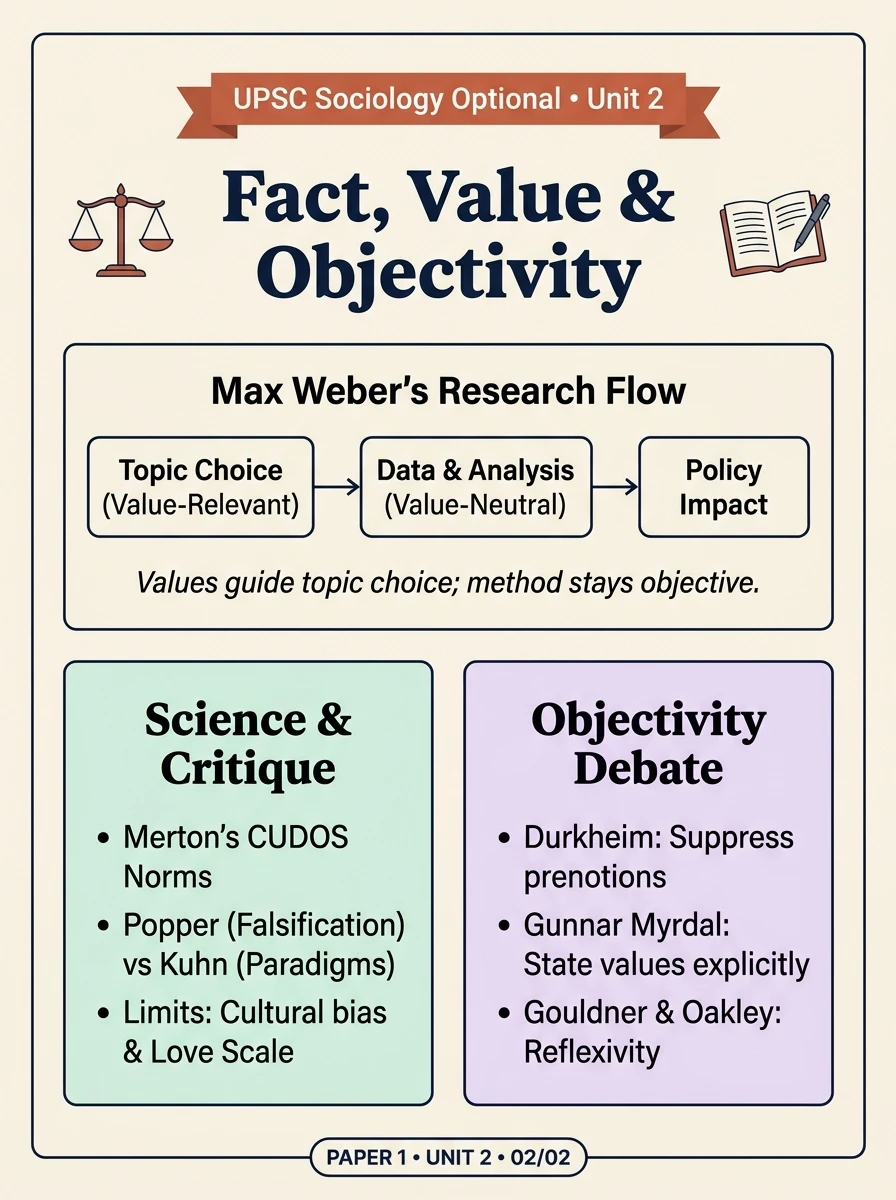
Sociology Optional mein ek classic sawal baar-baar aata hai: kya social science truly objective ho sakti hai, ya har observation kisi na kisi value framework se shaped hota hai? Max Weber ne is debate ko disciplined language di through the distinction between value relevance (Wertbeziehung) aur value neutrality (Wertfreiheit). Unke liye sociologist ka topic selection values se influenced ho sakta hai, but analysis ko disciplined, evidence-based aur logically consistent rakhna chahiye. Yaani researcher ka concern social reality ko “as it is” samajhna hai, not preach karna.
Lekin isi claim ko Alvin Gouldner ne challenge kiya. Unki famous critique, especially The Coming Crisis of Western Sociology, mein “value-free sociology” ko myth bataya gaya. Gouldner ka point tha ki sociologists apni class position, institutional location aur ideological commitments ko often hide kar dete hain. Agar researcher bias ko admit nahi karta, to objectivity ka claim itself suspect ban jata hai. Is debate ko aur complex banaya Gunnar Myrdal ne Asian Drama mein. Myrdal ne kaha ki social research mein value assumptions ko openly disclose karna chahiye; otherwise hidden biases policy outcomes ko distort kar dete hain.
Indian context mein yeh debate aur sharp ho jati hai. D. P. Mukerji, M. N. Srinivas, Andre Beteille, Yogendra Singh aur later feminist/tribal scholarship ne repeatedly दिखाया ki fieldwork mein researcher ki caste, class, gender aur institutional location observation ko affect karti hai. Srinivas ka field-view debate—especially when studying caste, Sanskritization, dominance and village society—ne yeh sawal उठाया ki kya outsider anthropologist pure neutrality se “native” society ko capture kar sakta hai? Ya field empathy aur reflexivity zyada honest route hai?
UPSC answers mein yeh topic sirf theory narration nahi hai. Better answers woh hote hain jo Weber ki methodological discipline, Gouldner ki reflexive critique, Myrdal ki value disclosure, aur Srinivas ke field-based ambivalence ko connect karte hain. Indian empirical evidence—NFHS-5, PLFS, NCRB, ASER, Xaxa Committee, Sachar Committee, NITI MPI aur Oxfam/WIL reports—show karta hai ki social facts kabhi neutral canvas nahi hote; unke interpretation mein value frames crucial role play karte hain. Isliye objectivity ka best modern meaning absolute detachment nahi, balki transparent, self-aware, and methodologically rigorous sociology hai.
Thinkers aur unke core positions
1) Max Weber: Value relevance, not value-free life
Weber ko UPSC mein often “value neutrality” ke father ke roop mein quote kiya jata hai, but nuanced reading zaroori hai. Weber ne kaha ki social scientist ka research topic value relevance se select hota hai—hum kya study karenge, yeh society, culture aur researcher ke interests se influenced hota hai. Lekin once topic chosen, analysis ko value neutrality ki taraf strive karna chahiye. Unka method ideal-typical comparison, causal adequacy aur interpretive understanding (Verstehen) par based tha. Classic works: Economy and Society, The Protestant Ethic and the Spirit of Capitalism, aur methodological essays. Weber ka contribution yeh hai ki values ko deny nahi kiya, bas unhe analysis ke andar disciplined boundaries di.
2) Alvin W. Gouldner: Myth of value-free sociology
Gouldner ne Weberian neutrality ko suspicious lens se dekha. Unke according sociologists often apni values ko “scientific objectivity” ki language mein camouflage karte hain. The Coming Crisis of Western Sociology mein unhone sociology ki hidden ideological commitments, academic power structures aur class biases ko expose kiya. Gouldner ki idea of “reflexive sociology” ke hisaab se sociologist ko apni positionality openly state karni chahiye. Objectivity ka matlab detached observer banna nahi, balki apne bias ko visible banana hai. Yeh especially important hai jab sociology state, market ya dominant groups ke interests ke close ho.
3) Gunnar Myrdal: Bias disclosure and the Asian problem
Myrdal, especially Asian Drama: An Inquiry into the Poverty of Nations, ne economic-sociological research mein ek crucial methodological demand रखी: value premises should be explicitly stated. Unke liye total value neutrality impossible thi, because concepts, indicators and policy recommendations sab values se loaded hote hain. But hidden bias se better hai disclosed bias. Myrdal ka “explicit value premise” approach development studies mein bahut influential raha, especially poverty, inequality, and welfare policy analysis mein. UPSC mein unka use karte waqt yeh दिखाओ ki Myrdal Weber se aage jaakar methodological honesty ko central place dete hain.
4) M. N. Srinivas: Field-view, caste and reflexivity
Indian sociology mein Srinivas ka contribution empirical fieldwork ke through came. Religion and Society among the Coorgs of South India, The Remembered Village, aur dominant caste, Sanskritization, Westernization jaise concepts foundational hain. But unki fieldwork method par yeh criticism aaya ki village studies mein researcher kabhi-kabhi “field-view” se over-influenced ho jata hai—yaani close immersion ke despite partiality, romanticization, ya over-generalization ka risk रहता है. Srinivas ne itna जरूर imply kiya ki sociology ko India ko “from within” samajhna chahiye. Isliye unka work objectivity ko reject nahi karta, balki contextual objectivity ki taraf le jata hai.
5) Andre Beteille as a balancing voice
Andre Beteille, especially Caste, Class and Power, ne Weberian restraint aur empirical sobriety ko Indian sociology mein strengthen kiya. Unhone repeatedly stress kiya ki sociology ko normative activism aur descriptive analysis ko mix nahi karna chahiye. However, Beteille bhi yeh मानते hain ki pure detachment unrealistic hai. Unka contribution comparative, measured and institutionally grounded sociology ka hai. Isse UPSC answer mein ek balanced conclusion milta hai: Weber provides discipline, Gouldner provides critique, Myrdal provides disclosure, aur Srinivas/Beteille provide Indian methodological realism.
In sab thinkers ka contrast ek hi point par converge karta hai: sociology mein objectivity ka matlab “value-less mind” nahi, balki “value-aware method” hai. Yehi modern, exam-friendly synthesis hai.
| Aspect | Weberian Position | Gouldner-Myrdal Critique |
|---|---|---|
| Core idea | Value relevance in topic selection; neutrality in analysis | Hidden values always present; disclose them openly |
| Objectivity meaning | Methodological discipline and controlled judgment | Reflexivity and transparency about bias |
| Role of sociologist | Analyst, not moral preacher | Situated intellectual with social location |
| Best fit | Comparative-historical and interpretive sociology | Development studies, policy sociology, critical inquiry |
Indian data aur empirical relevance
India mein objectivity ka debate tab zinda hota hai jab hum hard data aur field realities ko saath mein dekhen. NFHS-5 ne nutrition, health, gender and household inequality ke sharp patterns dikhaye—stunting, anaemia aur unequal access to services sirf biomedical issues nahi, balki caste, class, gender aur regional disparities ke markers hain. Agar sociologist in inequalities ko study karta hai, to uska theoretical lens values se empty nahi ho sakta; choice of indicators itself policy value reflect karti hai.
PLFS data labor market objectivity ko test karta hai. Female labour force participation, informal employment aur unemployment rates ko interpret karte waqt researcher ko gender ideology, family norms aur structural constraints sab consider karne padte hain. Aap answer mein dikha sakte hain ki “numbers speak for themselves” ek illusion hai; interpretation matters. Likewise NCRB data on crimes against women, Dalits and Adivasis shows that official statistics are mediated by reporting, policing and social stigma. Underreporting ka issue yeh batata hai ki social facts are socially produced.
Education inequality ke context mein ASER reports reading and arithmetic learning gaps ko expose karti hain. Rural schooling outcomes par caste, digital divide aur household resources ka strong effect hai. This is relevant for Weberian objectivity because even “simple” learning metrics carry embedded assumptions about what counts as achievement. Similarly, NITI MPI multidimensional poverty measures poverty ko income se beyond define karti hain—education, health aur living standards ke dimensions add karke. Yeh very act of measuring poverty is value-laden, because it reflects a moral stance that poverty is multidimensional, not just monetary.
Policy-commission reports bhi important hain. Sachar Committee ne Muslim deprivation ko multidimensional perspective se map kiya—education, employment aur access to state institutions. Xaxa Committee ne Adivasi displacement, livelihood insecurity aur rights deprivation ko highlight kiya. Dono reports empirically rich hain but also normative: they ask the state to correct historical injustice. Yeh Myrdal-type explicit value premise ka Indian example hai.
Ethnographically, Srinivas ke village studies, McKim Marriott’s fieldwork debates, and later feminist interventions showed that field-view is always partially situated. For real case studies, think of Bhil and Gond displacement in central India, manual scavenging documented across states, and farm distress/suicide narratives in Maharashtra, Karnataka and Telangana. These realities prove that sociological objectivity means rigorous observation with transparent positionality, not false detachment. In UPSC answers, a line like “NFHS-5 and PLFS show measurable outcomes, but their sociological meaning depends on the researcher’s analytical frame” can elevate your answer instantly.
🔑 Value neutrality
Research mein personal moral judgments ko bracket karke evidence-based, logically controlled analysis karna; topic choice value-relevant ho sakta hai, but interpretation disciplined honi chahiye.
Limitations, counter-thinkers aur nuanced synthesis
Weber, Gouldner aur Myrdal ka debate useful hai, but itna simple bhi nahi. Sabse pehli limitation yeh hai ki Weber ka “neutrality” ideal often elite academic settings mein practical ho jata hai, lekin field conditions mein complete detachment impossible hota hai. Researcher ka caste, gender, class, language aur institutional power field interactions ko shape karte hain. Is point par feminist sociology aur standpoint theory Weber se further jaati hai. Dorothy Smith ne “standpoint” se argue kiya ki knowledge always situated hoti hai. Bina yeh accept kiye, neutrality ka claim one-sided ban sakta hai.
Second, Gouldner ka critique valuable hai, but agar har sociology ko simply ideology bol diya jaye to scientific inquiry ki autonomy kamzor ho sakti hai. Agar objectivity ki koi boundary hi na ho, to analysis pure activism mein dissolve ho sakta hai. That is why Beteille, Randall Collins aur even methodologically cautious empiricists insist on evidence, replication and conceptual clarity. Sociology ko either/or mein trap nahi karna chahiye.
Third, Myrdal ki value disclosure approach strong hai, but disclosure alone enough nahi. Bias openly declare karna helpful hai, yet researcher ko methods bhi robust rakhne padte hain—sampling, triangulation, comparison and falsifiability. Otherwise disclosed bias bhi persuasive prejudice ban sakta hai. Indian context mein this is crucial because caste/community/political preferences field interpretation ko easily distort kar sakte hain.
A better synthesis is “reflexive objectivity.” Iska matlab: researcher apni location ko admit kare, norms ko hidden na rakhe, aur empirical claims ko systematic evidence se test kare. Indian sociology mein yeh approach especially important hai when dealing with caste discrimination, communal violence, gender inequality and tribal dispossession. For example, NCRB data ko use karte waqt underreporting issue ko note karna chahiye; NFHS-5 use karte waqt cultural and regional diversity ko; PLFS use karte waqt informal sector bias ko. Is tarah sociology neither purely neutral myth banti hai nor purely subjective opinion. Yeh exam ke liye sabse mature position hai.
Answer kaise likhein
- Weber ke according values topic selection mein role play karti hain, but analysis ko value-neutral discipline ke saath conduct karna chahiye.
- Gouldner ne “value-free sociology” ko myth kaha aur sociologist ki class-location, ideology aur institutional bias ko foreground kiya.
- Myrdal ne Asian Drama mein value premises ko openly disclose karne ki advocacy ki; hidden bias se better explicit bias hai.
- Srinivas ke field-view debate aur Indian data sets (NFHS-5, PLFS, NCRB, ASER, NITI MPI) dikhate hain ki objectivity reflexive aur contextual honi chahiye.
Is Blog Se Jude Syllabus Chapters
Every Unit Note + Topic-Wise PYQ Mapped (English + Hinglish)
Paper 1 (10 Units) aur Paper 2 (15 Units) — Complete structured notes, thinkers, mind maps & 597 solved PYQs ek saath.
Khud ko test karo
Is post se 3 sawal
0 / 3 attempted
1. Weber ke concept of value neutrality ka correct interpretation kya hai?
2. Gouldner ki critique ka central point kya hai?
3. Myrdal ki Asian Drama methodology ka key lesson kya hai?
FAQ
Aksar poochhe jaane wale sawaal
- Kya Weber sach mein value-free sociology support karte the?
- Weber absolute value-free life ki baat nahi karte. Woh value relevance ko accept karte hain, but analysis mein value neutrality ka methodological ideal rakhte hain.
- Gouldner ka main objection kya tha?
- Unka objection yeh tha ki sociologists apne social location aur ideology ko hide karke objectivity ka claim karte hain. Isliye value-free sociology ek myth hai.
- Indian context mein is debate ka best use kaise karein?
- Srinivas ke field debates, plus NFHS-5, PLFS, NCRB, ASER aur committee reports ko cite karke dikhao ki objectivity reflexive aur data-informed honi chahiye.
UPSC PYQs
Is topic ke Previous Year Questions
- 2025 · P1
What is science? Do you think that the methods used in natural sciences can be applied to sociology? Give reasons for your answer. (10 marks)
- 2024 · P1
Do you think 'objectivity' is an over-hyped idea in sociological research? Discuss the merits and demerits of non-positivist methods. (10 marks)
- 2023 · P1
What are the characteristics of scientific method? Do you think that scientific method in conducting sociological research is foolproof? Elaborate. (10 marks)
- 2022 · P1
How does a researcher achieve objectivity in interpretative research? (10 marks)
Roz ke Sociology notes Telegram pe paao
Daily current affairs, PYQ linkages aur direct mentorship support Telegram par.
Related
Aur padho
- Paper 1 ConceptsOWL BLOGP1
Sociology as a Science: Positivism vs Interpretivism, Value Neutrality & Fact-Value Debate (UPSC PYQs)
3 min readSociology as a Science: Positivism vs Interpretivism, Value Neutrality & Fact-Value Debate (UPSC PYQs)
Paper 1, Unit 2 of the UPSC Sociology Optional syllabus—Sociology as Science—forms the epistemological backbone of sociological inquiry. Whether you are tackling methodological questions directly in Paper 1 or evaluating Indian...
Padho → - Paper 1 Concepts1 min read
Sociology vs Common Sense aur Objectivity Debate (Paper 1 Foundation)
Kya Sociology sirf common sense hai? Andre Beteille, Durkheim, Max Weber (Value Neutrality) aur Gunnar Myrdal ke views ke saath complete clarity.
Padho →  Paper 1 Concepts6 min read
Why bumper A-Level results could be a problem
A-Level results ke baare mein news article se UPSC Sociology Paper 1 ke concepts—objectivity, fact-value distinction, reliability—par discussion. Grade inflation ke example se exam ki validity par sawaal.
Padho →