G.H. Mead: I, Me, Significant Others & Social Media Self Formation
G.H. Mead ke I, Me aur Generalized Other se samjho kaise Instagram aur UPSC aspirant culture self ko shape karta hai. Cooley, Goffman aur Indian data ke saath exam-ready analysis.
📑 Quick Jump: Contents (4) & Syllabus Chapters
G.H. Mead aur social media self: ek conceptual puzzle
Aaj ka self “inside” se utna nahi banta jitna “interaction” se banta hai. G.H. Mead ne yahi kaha tha ki self is not innate; it emerges through social interaction. Human being pehle body hota hai, phir social actor, aur end me self. Lekin Instagram, LinkedIn, X/Twitter aur WhatsApp groups ne is process ko aur complex bana diya hai. Ab “I” aur “Me” sirf face-to-face society ke response se nahi, balki likes, comments, follows, screenshots, reels aur comparison culture se shape hote hain.
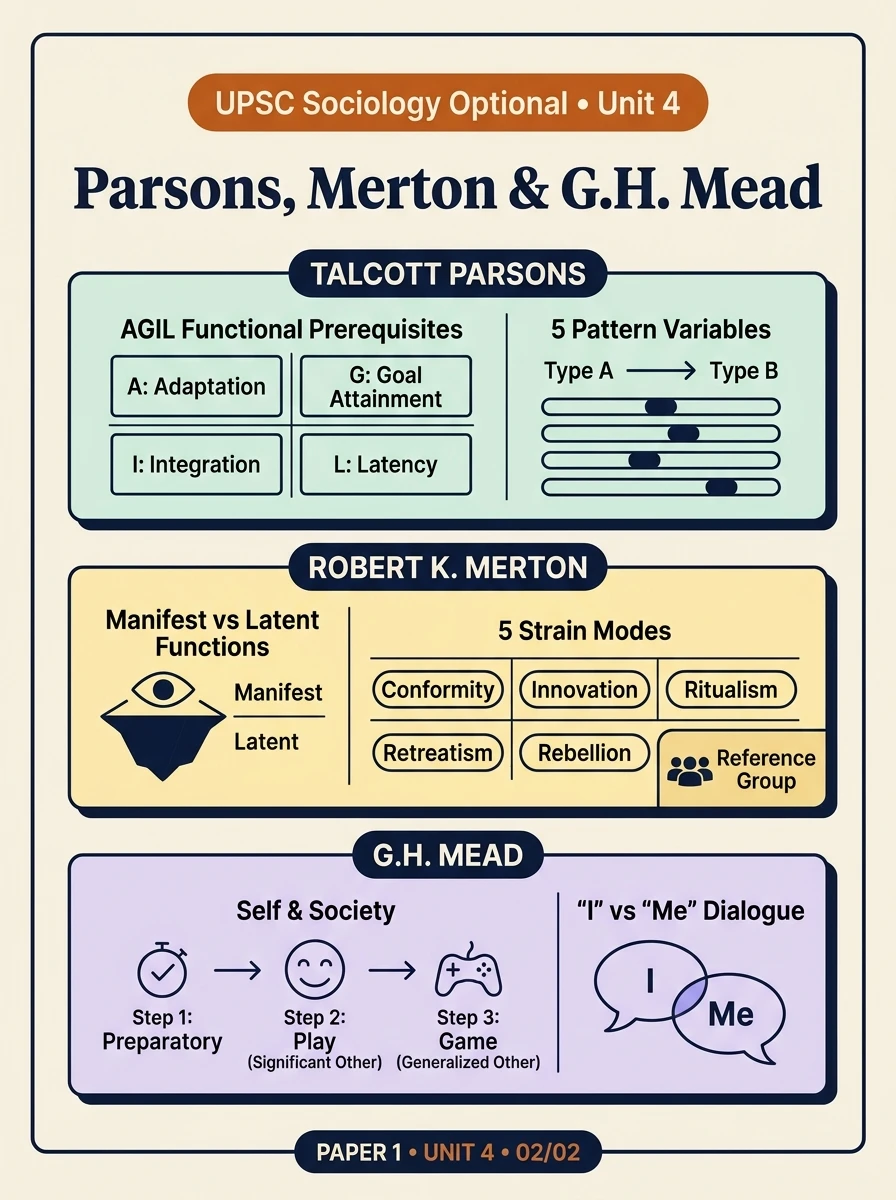
Mead ke model me “play stage” par child different roles imitate karta hai, jaise doctor, teacher, parent. “Game stage” par wo multiple roles ko ek coordinated system me samajhne lagta hai. Digital world me ye transition aur तेज़ dikhai deta hai. Aaj ka adolescent ya UPSC aspirant ek hi time par student, creator, consumer, citizen aur aspirant role निभाता hai. Har platform alag audience deta hai, aur har audience ek different “generalized other” ban jati hai. Matlab ek virtual society jo define karti hai ki “achha student”, “successful aspirant”, “desirable body”, ya “serious intellectual” kaun hai.
Indian context me ye aur relevant hai kyunki social media identity ke saath class, caste, gender, region aur language ka pressure bhi जुड़ जाता hai. NFHS-5 se hame family, education aur gender norms ka broad backdrop milta hai; PLFS digital access aur youth employment anxieties ko contextualize karta hai; ASER school learning gaps dikhata hai; NCRB cyberbullying, online harassment aur mental stress ke risks ko underline karta hai. UPSC aspirant culture bhi ek symbolic universe hai jahan routine, discipline, answer writing, optional notes, mock tests aur “motivation posts” ek moral performance ban jati hain.
Isliye Mead ko padhna sirf theory nahi, balki contemporary Indian self ko samajhne ka tool hai: kaise self interaction me बनता है, kaise digital mediation usse performative banata hai, aur kaise society aspirational identity ko reward aur punish karti hai.
Mead, Cooley, Goffman aur symbolic interactionist lens
G.H. Mead Sociology me symbolic interactionism ke central thinker hain. Unki classic work Mind, Self and Society me self ko two moments me समझाया गया: “I” and “Me.” “I” spontaneous, creative, unpredictable response hai; “Me” internalized social expectations ka organized set hai. Mead ke liye self tab banta hai jab individual apne action ko dusre ki nazar se dekhna seekh leta hai. Is process ka developmental basis hai play stage aur game stage. Play stage me child ek-ek role imitate karta hai; game stage me multiple roles aur rules ko simultaneously coordinate karta hai. Ye shift social cognition ka development hai.
Charles Horton Cooley ne Human Nature and the Social Order me looking-glass self diya. Unke according hum apne imagination ke through dusron ki possible judgment ka reflection dekhte hain: hum sochte hain others hume kaise dekhte hain, phir us evaluation ko feel karte hain, aur uske basis par self-image banate hain. Mead aur Cooley close hain, but difference important hai: Cooley reflection aur self-feeling par focus karte hain, jabki Mead role-taking aur social process ki deeper theory dete hain. Cooley me self more reflective; Mead me self more interactional and processual hai.
Erving Goffman ne The Presentation of Self in Everyday Life me dramaturgical approach diya. Unke अनुसार social life ek stage hai jahan log front stage aur back stage manage karte hain. Front stage par impression management hoti hai; back stage par actor relax karta hai, strategy adjust karta hai. Instagram, LinkedIn aur even UPSC aspirant forums par ye logic aur तेज़ हो जाता hai. Profile, bio, curated feed, success screenshots aur study vlogs front stage performances hain.
Herbert Blumer ne Mead se develop karke symbolic interactionism ko formalize kiya. Unke teen principles: humans things ko meanings ke through act karte hain; meanings interaction me arise karte hain; meanings interpretation ke through modify hote hain. Ye social media self ko explain karne me powerful hai.
Analytical contrast yeh hai: Mead self formation ka core mechanism deta hai; Cooley self-consciousness ka mirror model deta hai; Goffman social performance aur audience management dikhate hain; Blumer meaning-making process ko refine karta hai. Agar Instagram ko samjho, to Cooley batata hai ki likes kyu matter karte hain, Mead batata hai self ko audience ke hisaab se kaise organize kiya jata hai, aur Goffman batata hai ki curated identity practically kaise stage-managed hoti hai. Yahi sociology ka strongest bridge hai from classical theory to digital India.
| Aspect | Mead | Cooley + Goffman |
|---|---|---|
| Core idea of self | "I" and "Me" through social interaction | Cooley: looking-glass self; Goffman: performed self |
| Key mechanism | Role-taking, play stage, game stage | Imagination of others’ judgment; impression management |
| Social media reading | Platform norms become generalized other | Curated profiles and front-stage posts |
| Exam value | Best for processual self formation answers | Best for identity, performance, and everyday life analysis |
Indian evidence: digital self, youth anxiety aur aspirant culture
Indian context me Mead ka framework highly usable hai because self formation ab digital mediation ke through hoti hai. NFHS-5 ne women’s agency, education, internet access patterns aur gender norms ke indicators se household-level inequality ko highlight kiya. Isse samajh aata hai ki self formation neutral nahi hoti; caste-gender-class structures us par direct effect daalte hain. PLFS youth unemployment aur underemployment ka recurring picture deta hai, jo aspirational pressure ko intensify karta hai. Jab employment uncertain hoti hai, tab identity more performative ho jati hai: “I am disciplined”, “I am preparing”, “I am serious.”
ASER reports repeatedly school learning gaps aur foundational literacy/numeracy crisis ko show karte hain. This matters because Mead ka play stage-game stage transition tabhi strong hota hai jab language, symbolic competence aur role-taking capacity develop ho. Learning deficits later digital comparison culture me insecurity ko बढ़ा सकते हैं. NCRB cybercrime data, especially online harassment, cyberstalking aur sexual extortion categories, social media self ko risky environment ke रूप me present karte hain. Women, queer persons aur marginalized youth ke liye digital audience sirf validation nahi, surveillance bhi hai.
Indian ethnographic work bhi important hai. UPSC aspirant culture par Delhi, Prayagraj aur Hyderabad ke coaching hubs me studies dikhati hain ki aspirants apni daily routines ko moral identity me convert karte hain. Study rooms, libraries, mock tests, mentorship groups aur Telegram channels ek alternative “generalized other” banate hain. Success ka अर्थ sirf marks nahi, ek socially recognized self ban jana hota hai. Isliye aspirants “study with me” videos, bio me attempt count, notes aesthetics aur rank-focused self-presentation use karte hain.
Judicially, Supreme Court ke privacy-oriented reasoning—especially K.S. Puttaswamy v. Union of India (2017)—ne dignity, autonomy aur informational privacy ko constitutional value diya. Ye digital self formation ke liye crucial hai, because online identity curation aur data extraction ka direct relation autonomy se hai. Shreya Singhal v. Union of India (2015) expression rights aur online speech limitations ko frame karti hai. Ye cases remind karte hain ki social media self सिर्फ psychological issue nahi, constitutional-sociological issue bhi hai.
Policy reports like Oxfam India aur World Inequality Lab inequality ke symbolic effects ko expose karte hain: unequal access to devices, coaching, urban space aur cultural capital. NITI’s Multidimensional Poverty Index bhi batata hai ki deprivation multiple domains me clustered hai. Self formation tabhi fully “free” ho sakti hai jab material conditions fair hon. Isi liye Indian social media self ko class, caste, region aur gender lens ke bina समझना अधूरा hai.
🔑 Generalized Other
Mead ka concept jo society ke internalized norms aur expectations ko denote karta hai, jiske basis par individual apne behavior ko regulate karta hai.
Critique: Mead ki limits aur balanced synthesis
Mead ka framework powerful hai, but limited bhi hai. First, unka focus micro-level interaction par hai, so structural inequality ka weight sometimes underplayed ho jata hai. Caste, patriarchy, class and digital capitalism self formation ko sirf role-taking se nahi, balki coercion aur unequal resources se bhi shape karte hain. Agar aspirant ke paas quiet room, internet, coaching aur mental safety hi nahi hai, to “I” aur “Me” ka play same level par operate nahi karta.
Second, Mead me agency ka optimistic tone hai. But social media platforms algorithmic governance ke through attention ko manipulate karti hain. Here Shoshana Zuboff ka “surveillance capitalism” useful counterpoint hai. Self only interaction se nahi, data extraction aur algorithmic ranking se bhi बनता hai. Similarly, Bourdieu ka habitus and cultural capital explain करते हैं ki kyun some users naturally platform-savvy lagte hain while others invisible रहते हैं. Foucault’s discipline and surveillance help decode productivity culture and self-monitoring in UPSC spaces.
Third, Goffman ka dramaturgy useful hai, but if overused, it can make all life look fake performance. Real emotional labour, vulnerability, and offline consequences get minimized. Cooley’s mirror self also assumes reflection is available, but marginalized users may face distorted mirrors—mockery, trolling, colorism, casteist abuse, or regional stereotyping.
Hence best synthesis yeh hai: Mead provides the grammar of self, Cooley provides the emotional mirror, Goffman provides the stage, and structural thinkers provide the power map. Instagram identity ko samajhne ke liye in sab ko combine karna hoga. UPSC answer me one-dimensional “social media is only superficial” line avoid karo. Better argument: social media self is simultaneously interactional, performative, unequal, and algorithmically structured.
Answer kaise likhein
- I aur Me ka balance explain karo: spontaneous agency aur internalized social norms ka dialectic self ko form karta hai.
- Play stage se game stage tak role-taking develop hoti hai; Instagram aur aspirant culture me multiple audiences ke hisaab se identity shift hoti hai.
- Cooley ka looking-glass self dikhata hai ki likes, comments aur rankings self-image ko kaise shape karte hain; Goffman impression management samjhata hai.
- Indian context me caste-gender-class, NFHS-5/PLFS/NCRB/ASER aur privacy judgments self formation ko structurally condition karte hain.
Is Blog Se Jude Syllabus Chapters
Every Unit Note + Topic-Wise PYQ Mapped (English + Hinglish)
Paper 1 (10 Units) aur Paper 2 (15 Units) — Complete structured notes, thinkers, mind maps & 597 solved PYQs ek saath.
Khud ko test karo
Is post se 3 sawal
0 / 3 attempted
1. Mead ke theory me 'Me' kya represent karta hai?
2. Play stage aur game stage ka correct relation kya hai?
3. Instagram identity analysis me kaunsa combination most appropriate hai?
FAQ
Aksar poochhe jaane wale sawaal
- Mead aur Cooley me basic difference kya hai?
- Cooley looking-glass self aur imagined judgment par focus karte hain; Mead role-taking, interaction aur self formation ke dynamic process ko explain karte hain.
- Instagram ko Mead se kaise explain karenge?
- Instagram par user audience ke expectations ko internalize karke curated self present karta hai; yahi generalized other aur Goffmanian impression management ka mix hai.
- UPSC answers me is topic ka best use kaise ho?
- Theory + contemporary example + Indian data ka triad use karo: Mead define karo, Cooley/Goffman compare karo, phir aspirant culture, cyber data aur inequality se apply karo.
UPSC PYQs
Is topic ke Previous Year Questions
- 2024 · P1
Explain G.H. Mead's idea of development of 'self ’through the 'generalised other’. (10 marks)
- 2022 · P1
According to Mead the idea of self develops when the individual becomes self- conscious. (10 marks)
- 2019 · P1
According to Mead, "We play a key role in our own socialisation." Explain. (10 marks)
- 2018 · P1
Do you think 'I' and 'Me' are central terms in Mead's work? (10 marks)
Roz ke Sociology notes Telegram pe paao
Daily current affairs, PYQ linkages aur direct mentorship support Telegram par.
Related
Aur padho
- ThinkersOWL BLOGP1
Karl Marx for UPSC Sociology: Historical Materialism, Alienation & Mode of Production (Notes + PYQs)
4 min readKarl Marx for UPSC Sociology: Historical Materialism, Alienation & Mode of Production (Notes + PYQs)
Karl Marx remains the single highest-yielding thinker in UPSC CSE Sociology Optional, appearing almost every year in Paper 1 and shaping critical perspectives in Paper 2. Yet, most aspirants lose marks by writing generic political...
Padho → - ThinkersOWL BLOGP1
Emile Durkheim UPSC Sociology Notes: Social Facts, Division of Labour & Suicide (With Mapped PYQs)
4 min readEmile Durkheim UPSC Sociology Notes: Social Facts, Division of Labour & Suicide (With Mapped PYQs)
In UPSC Sociology Optional, Emile Durkheim stands as the foundational architect who carved out sociology as an autonomous science distinct from psychology and philosophy. For serious aspirants, mastering Emile Durkheim social facts...
Padho → - ThinkersOWL BLOGP1
Max Weber UPSC Sociology: Bureaucracy, Ideal Types, Verstehen & Protestant Ethic (Unit Notes + PYQs)
4 min readMax Weber UPSC Sociology: Bureaucracy, Ideal Types, Verstehen & Protestant Ethic (Unit Notes + PYQs)
Max Weber stands as a foundational pillar of interpretive sociology, offering a powerful methodological counterpoint to Durkheimian positivism and Marxian economic determinism. Whether you are decoding rational-legal authority or...
Padho →