G.S. Ghurye: Father of Indian Sociology, Indology & Six Features of Caste
G.S. Ghurye ne caste ko Indian society ka core structure mana. NFHS-5, PLFS aur NCRB data dikhate hain ki caste aaj bhi mobility, work aur dignity ko shape karti hai.
📑 Quick Jump: Contents (4) & Syllabus Chapters
G.S. Ghurye: Caste ko samajhne ka classic lens
G.S. Ghurye ko often “Father of Indian Sociology” kaha jata hai because he institutionalized Indian sociology through Indology, textual method, and comparative historical analysis. Unki famous book Caste and Race in India (1932) ne caste ko sirf ritual hierarchy nahi, balki ek durable social structure ke roop me conceptualize kiya. UPSC ke perspective se yahan conceptual puzzle important hai: kya caste ek purely religious-brahmanical institution thi, ya ek broader socio-economic system jo kinship, occupation, status, marriage aur political power ko organize karta tha?
Ghurye ka approach essence me Indological tha. Wo Vedic, Dharmashastric aur historical sources se caste ka evolution trace karte hain. Unke according caste ke six structural features—segmental division, hierarchy, restrictions on feeding and social intercourse, civil and religious disabilities, lack of choice of occupation, aur endogamy—Indian society ki deep grammar ko define karte hain. Is framing ne sociological debate ko ek strong typology di, especially when modernity ke baad bhi caste persistence visible thi.
But Indian sociology ka yeh debate one-sided nahi hai. B.R. Ambedkar ne caste ko endogamy-based graded inequality aur Brahmanical domination ka system maana. Yashwant Desai aur other critics ne Ghurye par Brahmanical bias ka aarop lagaya, kyunki unka focus textual tradition par tha, not lived oppression. Meanwhile Verrier Elwin ne tribals ko “backward Hindus” maan-ne wali assimilationist line oppose ki, aur tribal distinctiveness ko defend kiya. Yeh debate aaj bhi relevant hai because India me caste, tribe aur class overlap karti hain.
Contemporary data also confirms relevance: NFHS-5 shows social inequality in health and nutrition, PLFS reveals occupational stratification, NCRB documents atrocities against SC/ST, aur NITI Aayog’s MPI shows deprivation disproportionately concentrated among marginalized communities. Isliye Ghurye ko padhte waqt humein theory, critique aur empirical India—teenon ko saath rakhna chahiye.
Thinkers & Analytical Contrast
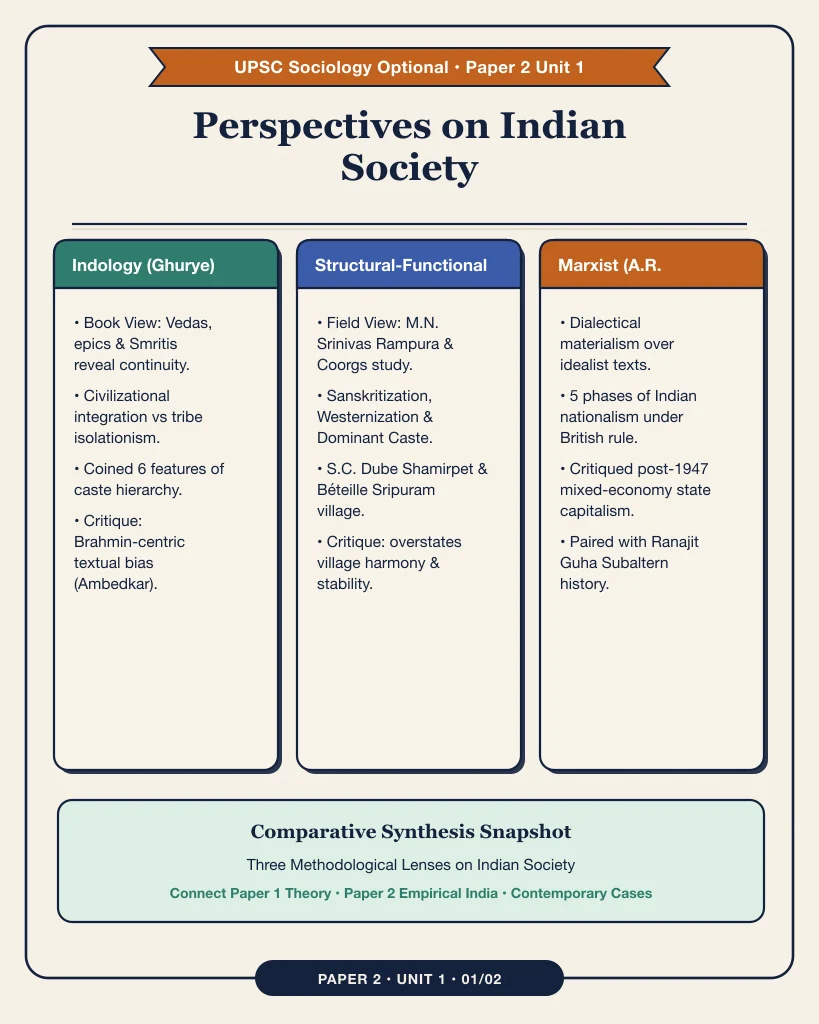
G.S. Ghurye ka core contribution yeh tha ki unhone Indian society ko indigenous categories se read kiya. Caste and Race in India (1932) me unhone caste ko ancient social institution ke roop me define kiya aur uske six features list kiye. Unka larger sociology Indology aur historical reconstruction par based tha. Ghurye ke liye caste ko samajhna means Indian civilization ki continuity, Sanskritization, kinship, aur social stratification ko samajhna. Unka importance isliye bhi hai kyunki unhone Indian sociology ko purely Western imported models se bahar nikala.
B.R. Ambedkar, however, Ghurye ke sabse powerful critic the. In Annihilation of Caste (1936), Ambedkar argued that caste is not merely division of labour, but a system of “division of labourers” reinforced through endogamy and graded inequality. Yahan major difference yeh hai: Ghurye descriptive-historical hain, Ambedkar normative-structural-diagnostic. Ambedkar ke liye Brahmanical texts caste ko legitimate karte hain; isliye textual tradition par reliance itself suspect ho sakta hai.
M.N. Srinivas ne Ghurye se aage jaakar field-based sociology develop ki. Religion and Society among the Coorgs of South India aur later works me unhone Sanskritization, dominant caste, aur mobility ko highlight kiya. Srinivas ka strength yeh tha ki unhone living social processes ko village studies ke through capture kiya. Ghurye structural continuity dikhate hain; Srinivas micro-mobility aur change.
A.R. Desai ne Marxist lens se caste ko class exploitation ke saath joda. Social Background of Indian Nationalism aur broader political economy writings me Desai ne argue kiya ki caste aur class ko alag karke dekhna incomplete hai. Unke liye caste hierarchy agrarian power, land control, aur state institutions se linked hai. Is point par Desai, Ghurye ki relatively culture-centric framing ko challenge karte hain.
Verrier Elwin ka tribal thesis is debate ka important counterpoint hai. Elwin, The Aboriginals aur related writings me, tribes ko separate cultural worlds ke roop me defend karte hain. Ghurye ne tribes ko “backward Hindus” ke रूप me assimilate karne ka tendency dikhaya; Elwin ne is approach ko criticize kiya because it erased tribal autonomy. UPSC answer me yeh contrast bahut scoring hota hai: Ghurye = integrationist textual sociology; Ambedkar = anti-Brahmanical structural critique; Srinivas = empirical mobility; Desai = political economy; Elwin = tribal distinctiveness.
Is analytical contrast ka takeaway yeh hai ki Ghurye foundational hain, par final word nahi. Unki value theory-building me hai, lekin Indian inequality ko fully explain karne ke liye field data, feminist critique, Dalit perspective, aur political economy ko include karna zaroori hai.
| Aspect | Ghurye | Ambedkar/Desai/Elwin |
|---|---|---|
| Core lens | Indological, textual, historical continuity | Structural oppression, political economy, tribal autonomy |
| View of caste | Six features ke through social institution | Endogamy-driven graded inequality and domination |
| Tribes | Backward Hindus / assimilationist tendency | Distinct communities; assimilation questioned |
| Method | Texts, history, comparative sociology | Normative critique, field evidence, Marxist or indigenous perspective |
Indian Data, Reports & Case Evidence
Ghurye ko exam me contemporary relevance ke saath link karna critical hai. NFHS-5 (2019-21) repeatedly shows that social disadvantage is patterned by caste and tribe in health and nutrition outcomes. Stunting, anaemia, sanitation access, and institutional delivery indicators often remain worse among SC/ST households than among upper-caste groups. Yeh directly suggest karta hai ki caste sirf ritual symbol nahi, lived inequality bhi hai.
PLFS reports indicate occupational segmentation. SC/ST workers are disproportionately represented in informal, low-security, and low-wage segments, while higher caste groups have greater access to regular salaried work and non-farm occupations. This supports the idea that caste continues to shape “choice of occupation,” one of Ghurye’s six features, though today the mechanism is mediated by education and labour markets.
NCRB data on crimes against Scheduled Castes and Scheduled Tribes remains a grim reminder that social hierarchy has coercive dimensions. Atrocities such as humiliation, violence, land conflicts, and sexual violence reveal that caste is not only status order but also power and impunity. The legal-political context matters too: the Supreme Court’s jurisprudence on the Protection of Civil Rights Act and the SC/ST (Prevention of Atrocities) Act reflects constitutional recognition of caste oppression.
Empirically, B.R. Ambedkar’s critique is visible in village and urban studies alike. Studies on manual scavenging, sanitation work, and housing segregation show that stigma is inherited through birth, not simply occupation. This is where Ghurye’s focus on endogamy becomes analytically crucial. Endogamy preserves status closure and transmits social inequality intergenerationally.
For tribal questions, Xaxa Committee observations are highly relevant. The committee highlighted how Adivasi communities face displacement, land alienation, and weak access to entitlements. This complicates Ghurye’s assimilationist stance and aligns more with Verrier Elwin’s concern for tribal cultural autonomy. Similarly, Sachar Committee findings on Muslim deprivation can be used cautiously to compare non-caste stratification with caste-based exclusion; the point is that Indian inequality is multi-layered, but caste remains the most institutionally entrenched.
NITI Aayog’s Multidimensional Poverty Index (MPI) also helps show that deprivation is not randomly distributed; SC/ST households are overrepresented among the poor in many states. Oxfam-style inequality reports and WIL studies on labour and unpaid care work further reinforce that social status impacts asset ownership, mobility, and dignity. In short, Ghurye’s framework is still useful, but only when read with present-day data and constitutional justice concerns.
Real-world case studies strengthen answers: manual scavenging in many states, caste violence in Hathras-type incidents, and tribal displacement around mining corridors all show that caste/tribe remain material realities. These examples make your answer more sociologically grounded and policy-relevant.
🔑 Endogamy
Apne caste/community ke andar shaadi karne ki practice; yahi caste hierarchy ko reproduce karti hai aur social closure banati hai.
Critiques, Limits & Nuanced Synthesis
Ghurye ki biggest strength unki foundational mapping hai, but unki biggest limitation bhi wahi hai: textual bias. Because he relied heavily on Sanskritic sources, critics argue that he over-centered Brahmanical norms and underplayed subaltern lived realities. Ambedkar ka point was sharp: caste ko samajhne ke liye dharmashastric texts se zyada important hai endogamy, exclusion, humiliation, and graded inequality. Isliye Ghurye ka framework descriptive to hai, but emancipatory nahi.
A second limitation tribal question me aati hai. Ghurye’s “backward Hindus” view tribes ki distinct identity, ecological relationship, aur self-governance ko flatten kar deta hai. Verrier Elwin aur later tribal scholarship ne dikhaya ki tribes ko simple Hindu variants kehna ethnographic violence ho sakta hai. Xaxa Committee ne bhi state-policy level par Adivasi alienation ko underline kiya.
Third, Ghurye’s model change ko under-theorize karta hai. Modern India me reservations, education, urbanization, political mobilization, and digital platforms caste relations ko alter kar rahe hain. Yet, persistence of endogamy, matrimonial ads, and caste-based violence proves that caste has not disappeared; it has transformed.
Best synthesis yeh hai: Ghurye remains indispensable for understanding caste as a civilizational structure, but his analysis must be corrected by Ambedkar’s anti-Brahmanical critique, Desai’s political economy, Srinivas’s field sociology, and contemporary empirical data. UPSC ke liye mature answer wahi hai jo na Ghurye ko blindly celebrate kare, na unhe reject kare. Use him as a starting point, not the final authority.
Answer kaise likhein
- G.S. Ghurye ne *Caste and Race in India* (1932) me caste ko Indian social structure ka enduring institution mana aur six features identify kiye.
- Unka Indological method Indian sociology ko indigenous base deta hai, lekin textual focus Brahmanical bias ka risk create karta hai.
- Ambedkar ne caste ko endogamy-based graded inequality kaha; Desai ne class-power linkage dikhaya; Elwin ne tribal autonomy defend ki.
- Current India me NFHS-5, PLFS, NCRB aur NITI MPI show karte hain ki caste/tribe aaj bhi health, work, violence aur poverty ko shape karte hain.
Is Blog Se Jude Syllabus Chapters
Every Unit Note + Topic-Wise PYQ Mapped (English + Hinglish)
Paper 1 (10 Units) aur Paper 2 (15 Units) — Complete structured notes, thinkers, mind maps & 597 solved PYQs ek saath.
Khud ko test karo
Is post se 3 sawal
0 / 3 attempted
1. G.S. Ghurye ki famous book kaun si hai?
2. Ambedkar ke according caste ka most important mechanism kya hai?
3. Verrier Elwin ka Ghurye ke tribal view par main objection kya tha?
FAQ
Aksar poochhe jaane wale sawaal
- Ghurye ko Father of Indian Sociology kyon kaha jata hai?
- Kyoki unhone Indian sociology ko institutionalize kiya, Indological method develop kiya, aur caste, tribe aur kinship par foundational work diya.
- Ghurye aur Ambedkar me main difference kya hai?
- Ghurye caste ko historical-social institution ke roop me dekhte hain, jabki Ambedkar ise endogamy aur graded inequality par based oppression system mante hain.
- Ghurye ki tribal thesis par kya criticism hai?
- Unka “backward Hindus” view tribal distinctiveness ko reduce karta hai; Elwin aur Xaxa-type perspectives tribal autonomy aur separate identity ko emphasize karte hain.
UPSC PYQs
Is topic ke Previous Year Questions
- 2025 · P2
“Textual perspective is important in the understanding of Indian Social System.” Discuss. (10 marks)
- 2025 · P2
How would you characterize G. S. Ghurye as a practitioner of 'theoretical pluralism'? Discuss with reference to his Indological works. (20 marks)
- 2024 · P2
What, according to you, are the factors responsible for the continuance of the caste system in modern India? (20 marks)
- 2024 · P2
Differentiate between 'Western' and 'Indological' perspectives on the study of Indian society. Bring out the major aspects of G. S. Ghurye's contribution to the 'Indological' approach. (20 marks)
Roz ke Sociology notes Telegram pe paao
Daily current affairs, PYQ linkages aur direct mentorship support Telegram par.
Related
Aur padho
- Paper 2 IndiaOWL BLOGP2
Perspectives on Indian Society (Paper 2 Unit 1): G.S. Ghurye, M.N. Srinivas & A.R. Desai (PYQ Mapped)
4 min readPerspectives on Indian Society (Paper 2 Unit 1): G.S. Ghurye, M.N. Srinivas & A.R. Desai (PYQ Mapped)
Paper 2 of UPSC Sociology Optional tests your ability to apply sociological theories to India’s complex social reality. Mastering the perspectives on Indian society Ghurye Srinivas AR Desai UPSC expects in Unit 1 is non-negotiable...
Padho → - Paper 2 IndiaOWL BLOGP2
Caste System in India for UPSC Sociology: Purity-Pollution, Dominant Caste, Sanskritisation & Dalit Capitalism
4 min readCaste System in India for UPSC Sociology: Purity-Pollution, Dominant Caste, Sanskritisation & Dalit Capitalism
If you are aiming for 300+ in UPSC Sociology Optional, mastering Paper 2 — Unit 4 (Caste System) is non-negotiable. Every year, UPSC tests your ability to connect classical Indological theories with contemporary realities like...
Padho → - ThinkersOWL BLOGP2
M.N. Srinivas Complete UPSC Sociology Notes: Sanskritisation, Westernisation & Dominant Caste (With PYQs)
4 min readM.N. Srinivas Complete UPSC Sociology Notes: Sanskritisation, Westernisation & Dominant Caste (With PYQs)
Mysore Narasimhachar (M.N.) Srinivas is arguably the most frequently tested Indian thinker in UPSC Mains. For aspirants targeting a top rank, mastering MN Srinivas Sanskritisation dominant caste UPSC sociology frameworks is...
Padho →