Positivism vs Interpretivism vs Phenomenology: Unit 2 Methodology Explained
Positivism, Verstehen aur phenomenology ko Indian society ke context me समझो—NFHS-5, PLFS aur NCRB data se clear hota hai ki ‘facts’ aur ‘meaning’ dono indispensable hain.
📑 Quick Jump: Contents (4) & Syllabus Chapters
Methodology ka core puzzle: society ko “measure” karein ya “understand”?
Sociology Optional ka Unit 2 ek basic but deep question par tikka hai: social reality ko kya natural science ki tarah objective facts ke roop me study kiya ja sakta hai, ya phir human meanings, symbols aur lived experience ko samajhna zyada important hai? Isi debate se positivism, interpretivism aur phenomenology emerge hote hain. UPSC ke perspective se yeh sirf theory nahi, balki answer-writing ka spine hai—kyunki exam me aapse aksar पूछा जाता hai ki suicide, caste, gender, migration, religion, deviance ya bureaucracy ko kis methodological lens se dekhen.
Positivism ke according society me bhi objective patterns hote hain, jaise Durkheim ne suicide rates ko social facts ke roop me pesh kiya. Interpretivism ke liye social action ka matlab actor ke perspective se samajhna zaroori hai; Weber ka Verstehen isi ka classic formulation hai. Phenomenology isse bhi ek kadam aage jaakar everyday life ke taken-for-granted world ko unpack karti hai—Alfred Schutz ke liye social reality intersubjective meanings ka product hai. Harold Garfinkel ki ethnomethodology yeh dikhaati hai ki log routine interaction me order kaise “produce” karte hain. Anthony Giddens ne structuration theory aur double hermeneutic se bataya ki sociology sirf observe nahi karti, balki society ke actors ki self-understandings se bhi interpenetrate hoti hai.
Indian context me yeh debate aur bhi relevant ho jati hai. NFHS-5, PLFS, NCRB, ASER aur NITI MPI jaise datasets hume quantitative regularities dikhate hain—jaise nutrition, employment, crime, learning outcomes aur multidimensional poverty. Lekin caste discrimination, gendered domestic labour, informal work, stigma, religious identity, aur tribal displacement jaise issues ko bina interpretive depth ke samajhna incomplete hoga. Xaxa Committee, Sachar Committee, Oxfam, WIL aur ethnographic studies yeh highlight karti hain ki numbers ke peeche lived inequality ka meaning bhi hota hai. Isi liye Sociology Optional me best strategy hai: positivist rigour + interpretive depth + phenomenological sensitivity.
Thinkers aur core concepts: methodological debate ka skeleton
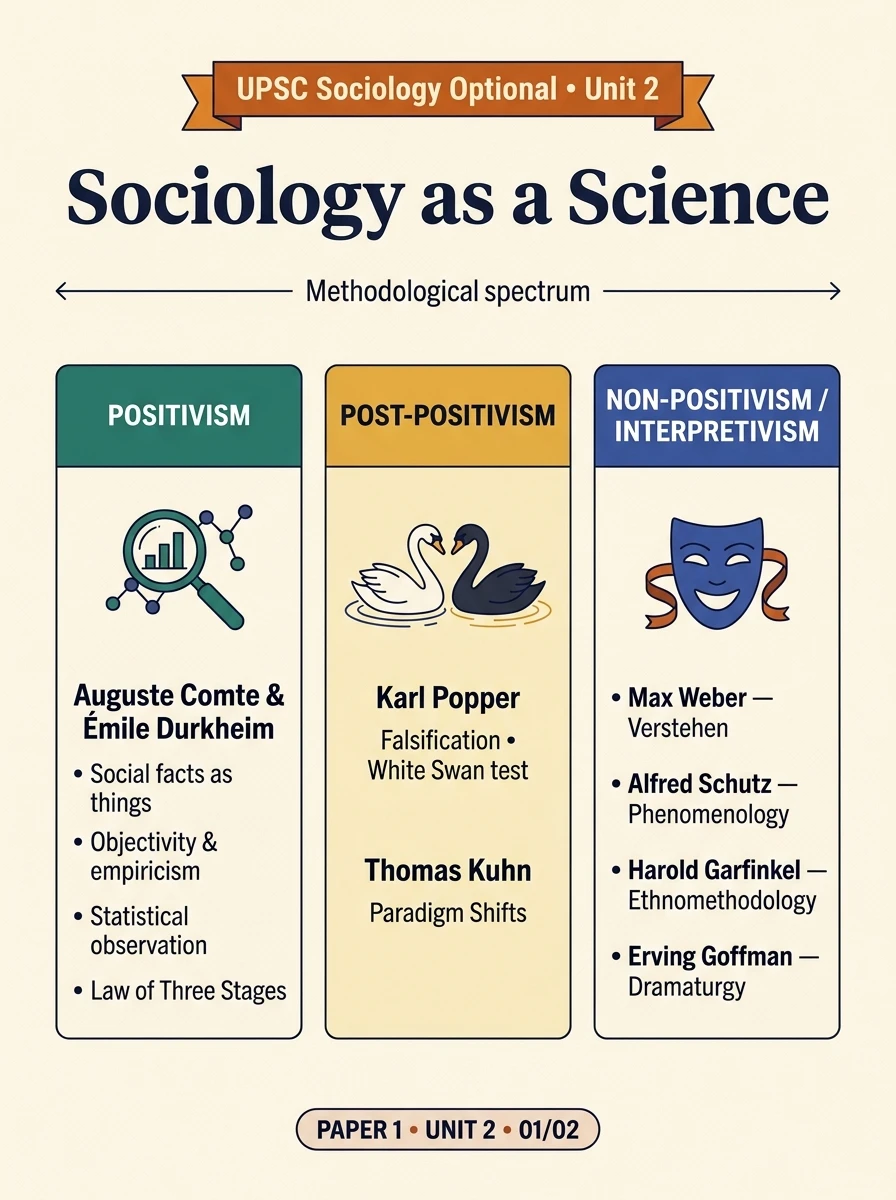
Auguste Comte ne sociology ko “social physics” ke roop me imagine kiya. Uski positivism ka basic claim tha ki society ko objective laws ke through study kiya ja sakta hai, bilkul natural sciences ki tarah. Comte ke liye observation, comparison aur classification central methods the. Unka classic work Course of Positive Philosophy hai. Yahan emphasis individual subjectivity par nahi, balki empirical regularities par tha.
Émile Durkheim ne Comte ki legacy ko institutional form di. The Rules of Sociological Method me unhone argue kiya ki social facts ko “things” ki tarah treat karo. Suicide me unhone show kiya ki apparently personal act bhi social integration aur regulation ke patterns se linked hai. Durkheim ka focus methodology par tha: sociology ko psychology ya philosophy se separate karna. Unki strength yeh hai ki social explanation me rigor aur comparability aati hai; limitation yeh ki lived meaning ka nuance kabhi-kabhi flatten ho jata hai.
Max Weber ne is positivist confidence ko challenge kiya. Economy and Society aur The Protestant Ethic and the Spirit of Capitalism me unhone “social action” ko central banaya. Weber ke liye sociology ka task sirf external regularity dhoondhna nahi, balki actor ke intended meaning ko samajhna hai—yaani Verstehen. Is approach me objectivity ka matlab value-neutrality aur disciplined interpretation hai, not meaninglessness. Weber ne ideal types ka use karke interpretive analysis ko systematic banaya.
Alfred Schutz ne phenomenology ko sociology me deepen kiya. The Phenomenology of the Social World me unhone Husserl-inspired idea diya ki everyday life “stock of knowledge” aur “reciprocity of perspectives” par based hoti hai. Hum dusron ko tab samajhte hain jab hum assume karte hain ki common sense world share kiya ja raha hai. Schutz ne social reality ko intersubjective construction ke roop me dekha—yeh interpretivism se bhi zyada fine-grained lens hai.
Harold Garfinkel ki ethnomethodology ne yeh पूछा ki social order banta kaise hai. Studies in Ethnomethodology me unhone shown kiya ki log everyday conversation, repair, indexicality aur “background expectancies” ke through interaction ko intelligible banate hain. Garfinkel ka famous breaching experiments yeh dikhate hain ki normality tabhi visible hoti hai jab usse disrupt kiya jaye. Iska analytical edge yeh hai ki macro order ko micro practices se connect karta hai.
Anthony Giddens ne The Constitution of Society me structuration theory aur double hermeneutic diya. Double hermeneutic ka matlab hai sociology ki concepts society me वापस circulate hoti hain; actors unhe adopt, resist ya reinterpret karte hain. Isliye social science aur social world ka relationship reflexive hai. Giddens positivism aur interpretivism ke beech bridge banate hain: structure aur agency ko duality of structure ke through integrate karte hain.
Analytically dekha जाए to positivism general patterns aur causal explanation par जोर देता hai; interpretivism meaning, motive aur subjective understanding par; phenomenology everyday lived experience aur intersubjectivity par; ethnomethodology practical accomplishment par; aur Giddens reflexivity aur structure-agency nexus par. UPSC me strong answer tab banta hai jab aap inhe competing dogmas nahi, balki complementary methodological tools ki tarah present karein.
| Aspect | Positivism | Interpretivism / Phenomenology |
|---|---|---|
| Core assumption | Social reality objective aur law-like hoti hai; social facts external constraints hain. | Social reality meanings, intentions aur lived experience se constructed hoti hai. |
| Key thinkers | Comte, Durkheim | Weber, Schutz, Garfinkel, Giddens |
| Method | Observation, comparison, measurement, causal explanation | Verstehen, phenomenological interpretation, ethnomethodological analysis |
| Typical output | Regularities, correlations, social laws, generalizable patterns | Contextual meanings, subjective motives, interactional order, reflexivity |
Indian data aur empirical illustrations: methodology ka field test
Indian sociology me methodology ko samajhne ka best tareeqa hai data aur field examples ko theory se जोड़ना. NFHS-5 show karta hai ki malnutrition, anaemia, women’s health aur sanitation indicators state-to-state kaafi vary karte hain. Positivist lens yahan useful hai, kyunki large-scale surveys se spatial patterns aur policy gaps identify hote hain. Lekin agar aap child nutrition ko sirf percentage me dekhen, to mother’s time poverty, food insecurity, caste-based exclusion, migration aur intra-household gender dynamics miss ho sakte hain—jo interpretive analysis se samajh aate hain.
PLFS labour force participation, unemployment, informalisation aur gender gaps ko map karta hai. But data ke peeche aapko daily wage workers, gig workers, women unpaid labour, aur migrant distress ki lived reality dekhni hoti hai. COVID-19 ke baad reverse migration, informal work loss aur precarity ko samajhne ke liye quantitative trends ke saath qualitative testimonies bhi chahiye. Yehi phenomenological angle hai: worker apne kaam aur insecurity ko kaise experience karta hai?
NCRB crime statistics se women against women violence, cybercrime, communal incidents, aur SC/ST atrocities ka broad pattern milta hai. Lekin reporting bias, under-reporting aur police-station level interaction ki meaning ko samajhna bina interpretivism incomplete hai. Yahan Garfinkel-style ethnomethodological reading useful hoti hai—FIR filing, institutional routine, aur “what counts as crime” ka local production.
ASER reports school learning outcomes me stark inequalities dikhati hain. Positivist measurement ka role clear hai: basic reading aur arithmetic deficits quantify hote hain. Par learning ko school attendance se alag karke dekhna insufficient hai; parental literacy, digital access, language barriers aur classroom interaction ke meanings bhi important hain.
Committee aur policy reports bhi essential hain. Sachar Committee ne Muslim socio-economic disadvantage ko data-backed form me establish kiya; Xaxa Committee ne Adivasi deprivation, displacement aur governance deficits ko foreground kiya. NITI Multidimensional Poverty Index poverty ko income se aage le jaata hai—education, health, living standards ke combined lens se. Isse prove hota hai ki development sirf one-variable story nahi hai.
Case studies me Bhopal gas tragedy survivors, Nirbhaya case ke public outrage and legal mobilization, manual scavenging aur tribal displacement as lived experiences show karte hain ki numbers alone enough nahi. Oxfam India aur Women in Labour (WIL) type labour/gender studies inequality ki lived structure ko visible banati hain. Supreme Court ke Puttaswamy judgment me privacy ko dignity aur autonomy se jodna bhi interpretive-phenomenological reasoning ka example hai, kyunki rights sirf legal texts nahi, embodied personhood ke experiences se जुड़े होते हैं.
Isliye Indian sociology me best research design mixed-methods hota hai: survey, interview, observation, narrative aur documentary analysis ka combination. UPSC me aapko yahi दिखाना hai ki methodology ideology nahi, research strategy hai.
🔑 Verstehen
Weber ka concept jisme social action ko actor ke intended meaning aur subjective understanding ke through interpret kiya jata hai.
Critique: har methodology ki limit aur synthesis ki zarurat
Positivism ki sabse badi strength iski clarity, comparability aur policy relevance hai, lekin uski limitation reductionism hai. Agar hum sirf measurable variables par focus karein, to meaning, emotion, identity aur power relations ka depth miss ho sakta hai. Durkheim ka social fact approach groundbreaking tha, par critics ne point out kiya ki it can underplay agency and reflexivity.
Interpretivism meaningful social action ko samajhne me superior hai, but yeh kabhi-kabhi over-subjective ho sakta hai. Agar har social fact ko sirf interpretation ka matter bana diya jaye, to structural constraints, material inequality aur large-scale causality underemphasized ho sakte hain. Weber khud bhi aware the ki complete objectivity impossible nahi to difficult zaroor hai; isliye ideal types aur value-relevance ka balanced use chahiye.
Phenomenology aur ethnomethodology everyday life ko illuminate karti hain, par inka micro-focus kabhi-kabhi macro power structures—class, caste, state, patriarchy, capitalism—ko side-line kar deta hai. Garfinkel ki micro-ordering insight useful hai, but it must be linked to institutional analysis. Giddens isi gap ko bridge karte hain, yet structuration theory ko abstract bhi mana gaya hai because empirical operationalization complex hoti hai.
A nuanced synthesis yeh hai: sociology ko either/or nahi balki both/and approach lena chahiye. Positivism hume scale aur pattern deta hai; interpretivism meaning aur motive; phenomenology lived experience; ethnomethodology interactional production; aur Giddens reflexivity. Indian sociology me yeh synthesis aur bhi जरूरी hai because caste, religion, gender aur region jaise variables ko ek saath measure bhi karna padta hai aur interpret bhi. UPSC ke best answers me aap yahi दिखाते हैं ki methodological pluralism is not confusion, but sophistication.
Answer kaise likhein
- Positivism (Comte-Durkheim) social facts, measurement aur causal explanation par focus karta hai; isse large-scale patterns samajh aate hain.
- Interpretivism (Weber) Verstehen ke through actor ke subjective meaning ko central banata hai; social action ko context ke bina nahi samjha ja sakta.
- Phenomenology (Schutz) aur ethnomethodology (Garfinkel) everyday life ke intersubjective stock of knowledge aur interactional order ko explain karte hain.
- Giddens ka double hermeneutic dikhata hai ki sociology aur society reflexively linked hain; mixed-method approach UPSC me strongest synthesis hai.
Is Blog Se Jude Syllabus Chapters
Every Unit Note + Topic-Wise PYQ Mapped (English + Hinglish)
Paper 1 (10 Units) aur Paper 2 (15 Units) — Complete structured notes, thinkers, mind maps & 597 solved PYQs ek saath.
Khud ko test karo
Is post se 3 sawal
0 / 3 attempted
1. Durkheim ke according social facts ko kaise treat karna chahiye?
2. Verstehen kis thinker se associated hai?
3. Double hermeneutic kis thinker ka concept hai?
FAQ
Aksar poochhe jaane wale sawaal
- Positivism aur interpretivism ka main difference kya hai?
- Positivism objective social facts aur causal laws dhoondhta hai, jabki interpretivism social action ke subjective meanings aur actor’s perspective ko samajhta hai.
- Schutz Weber se kaise different hai?
- Weber social action ka meaning samajhne par focus karte hain, jabki Schutz everyday life ke taken-for-granted world, intersubjectivity aur stock of knowledge ko phenomenological depth deta hai.
- Garfinkel ka ethnomethodology UPSC me kaise use karein?
- Use everyday interaction, institutional routine aur social order ke micro-production ko explain karne ke liye use karein, especially crime, bureaucracy aur classroom studies me.
UPSC PYQs
Is topic ke Previous Year Questions
- 2025 · P1
What is positivism? Critically analyze the major arguments against it. (10 marks)
- 2023 · P1
How does the dramaturgical perspective enable our understanding of everyday life? (10 marks)
- 2022 · P1
What are the shortfalls of positivist philosophy that gave rise to the non-positivist methods of studying social reality? (10 marks)
- 2021 · P1
How far are sociologists justified in using positivist approach to understand social reality? Explain with suitable illustrations. (10 marks)
Roz ke Sociology notes Telegram pe paao
Daily current affairs, PYQ linkages aur direct mentorship support Telegram par.
Related
Aur padho
- Paper 1 ConceptsOWL BLOGP1
Sociology as a Science: Positivism vs Interpretivism, Value Neutrality & Fact-Value Debate (UPSC PYQs)
3 min readSociology as a Science: Positivism vs Interpretivism, Value Neutrality & Fact-Value Debate (UPSC PYQs)
Paper 1, Unit 2 of the UPSC Sociology Optional syllabus—Sociology as Science—forms the epistemological backbone of sociological inquiry. Whether you are tackling methodological questions directly in Paper 1 or evaluating Indian...
Padho → 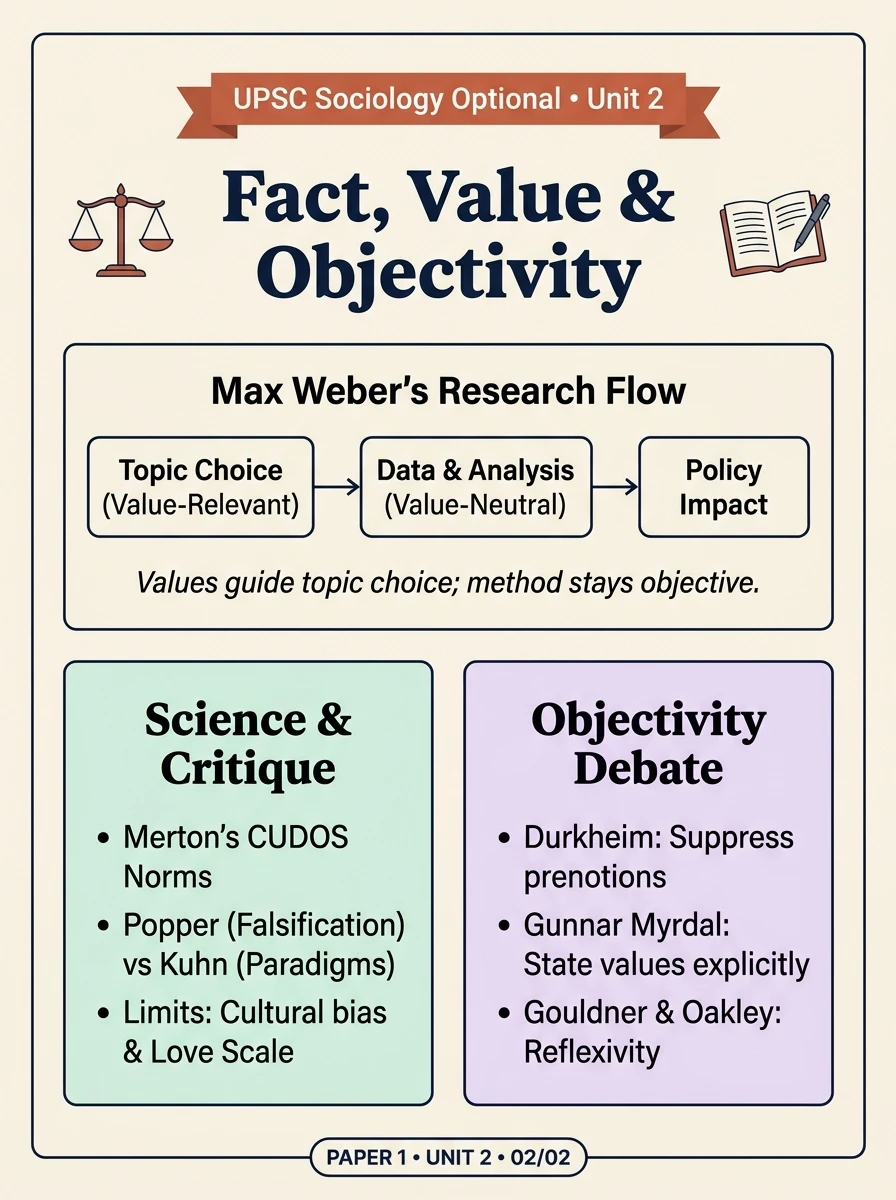 Paper 1 Concepts1 min read
Émile Durkheim: Social Fact, Suicide Types aur Anomie ka UPSC Guide
Durkheim ne kaise Suicide jaise personal act ko sociology se joda? Social Fact ke 2 rules, 4 suicide types aur exam-ready critiques.
Padho →- Paper 1 Concepts1 min read
Sociology vs Common Sense aur Objectivity Debate (Paper 1 Foundation)
Kya Sociology sirf common sense hai? Andre Beteille, Durkheim, Max Weber (Value Neutrality) aur Gunnar Myrdal ke views ke saath complete clarity.
Padho →