Sampling, Hypothesis, Reliability & Validity: Common Mistakes in Paper 1 Unit 3
Sampling, hypothesis, reliability-validity ke common traps UPSC Paper 1 Unit 3 me bahut scoring hain. NFHS-5 jaisi surveys aur hidden populations ke cases se concepts crystal clear hote hain.
📑 Quick Jump: Contents (4) & Syllabus Chapters
Why this Unit Confuses Even Serious Aspirants
Sampling, hypothesis, reliability aur validity dekhne me simple lagte hain, but UPSC Sociology Paper 1 Unit 3 me yahi concepts sabse zyada trap create karte hain. Problem yeh hai ki aspirants definitions ratte hain, par research design ke real sociological implications miss kar dete hain. For example, probability sampling statistically representative hoti hai, but hidden populations jaise transgender persons, migrant sex workers, ya stigmatised Dalit communities ke liye non-probability methods jaise snowball sampling often more practical hote hain. Ek hi concept ka meaning context ke hisaab se change ho jata hai.
Indian sociology me yeh aur important ho jata hai kyunki social inequality, caste stigma, gendered violence, informal labour, aur migration jaise issues often inaccessible populations se related hote hain. NFHS-5 ne large-scale, stratified sampling se health indicators ka robust picture diya, lekin LGBTQ+ ya undocumented migrants jaisi groups ko conventional sampling se capture karna mushkil rehta hai. Isi tarah, classroom ya workplace observations me Hawthorne effect data ko distort kar sakta hai: log unobserved behavior ki jagah ‘observed performance’ show karne lagte hain. Aur ecological fallacy tab hoti hai jab district-level or state-level averages ko individual-level truth maan liya jaye.
UPSC ke liye core puzzle yeh hai: sociology empirical bhi hai aur interpretive bhi. Isliye sample selection, measurement design, and inference ke errors ko mechanically nahi, sociologically samajhna padta hai. Agar aap research method ko society ke power structures, access barriers, aur institutional bias ke saath read karte ho, then answer sharper, more analytical, and more exam-relevant banega. यही is unit ki real scoring strategy hai.
Thinkers, Books and Analytical Contrast
William F. Whyte ki classic book Street Corner Society sociology methods ka iconic example hai. Usne participant observation ke through urban Italian-American gang life ko study kiya, showing that social reality field access ke bina samajhna mushkil hota hai. Whyte ka lesson yeh hai ki sampling kabhi-kabhi purely statistical exercise nahi hoti; field entry, trust, aur rapport bhi method ka part hain. Hidden communities ko samajhne ke liye snowball sampling isi logic se useful hoti hai.
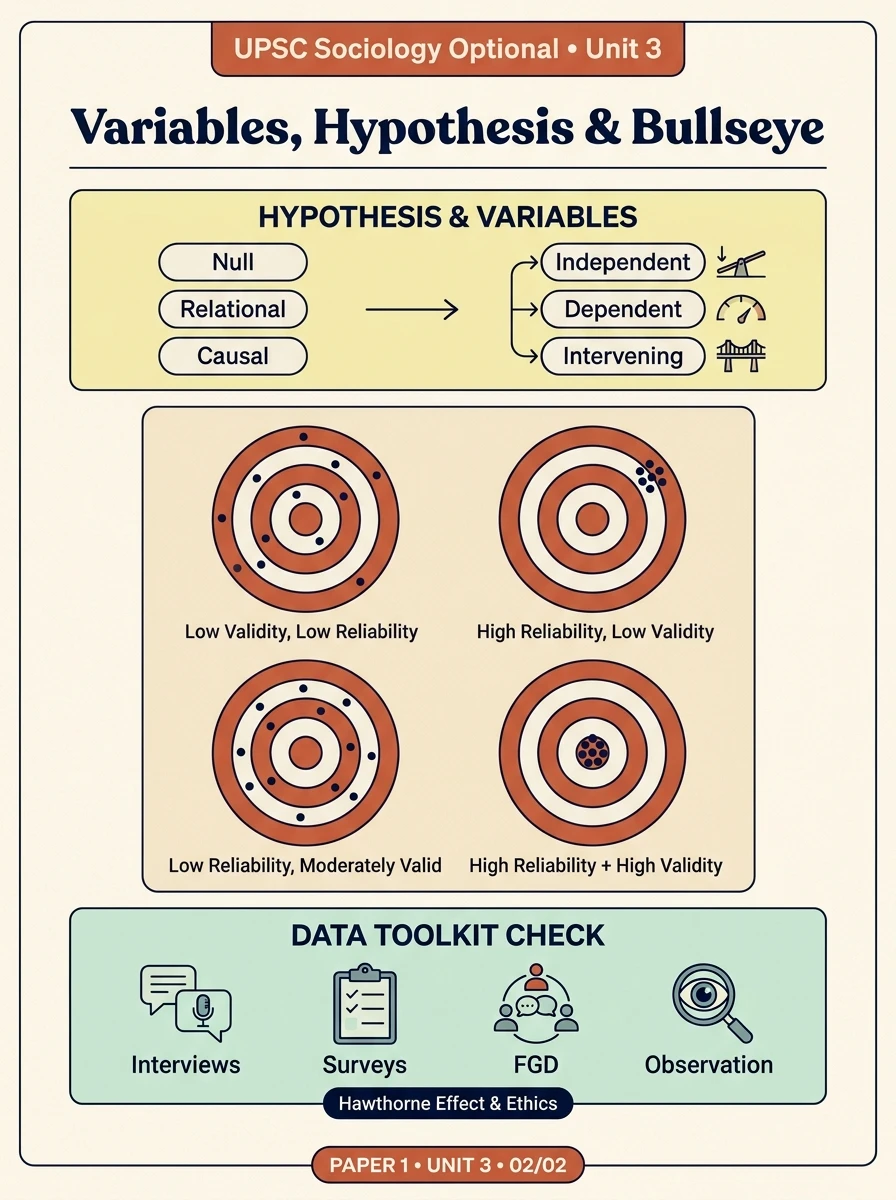
Paul Lazarsfeld ne empirical sociology aur survey research ko systematically develop kiya. Unki work tradition me variable-based research, operationalisation, aur careful measurement par zor tha. Lazarsfeld ka contribution yeh batata hai ki hypothesis testing tabhi meaningful hoti hai jab concepts ko valid indicators me convert kiya jaye. UPSC answer me unka naam reliability aur validity discuss karte waqt aata hai, especially when you distinguish between consistent measurement and accurate measurement.
Herbert Hyman ne survey methodology aur sample design par kaam karke response bias, question wording, aur inference problems ko highlight kiya. Unki approach se yeh samajh aata hai ki ek weakly framed questionnaire se milne wala data reliable lag sakta hai, but valid nahi hota. Matlab repeated measurement same galat cheez ko measure kar sakti hai—this is why reliability is not enough.
C. Wright Mills ka The Sociological Imagination ecological fallacy ko directly name nahi karta, but unki broader argument very useful hai. Mills warn karte hain against abstracted empiricism and against confusing personal troubles with public issues. Is lens se hum state-level averages ko individual destiny samajhne ki galti ko avoid kar sakte hain. For example, high district literacy does not mean every individual woman is educated or empowered.
M. N. Srinivas Indian sociology me fieldwork sensibility ke representative thinker hain. The Remembered Village aur dominant caste analysis me unhone dikhaya ki local social context aur power relations data interpretation ko shape karte hain. Their approach helps us see why caste-sensitive sampling aur insider-outsider dynamics matter in Indian research. Srinivas ke through hum samajh sakte hain ki hidden hierarchies survey answers ko affect kar sakti hain.
Analytical contrast yeh hai: Whyte and Srinivas emphasize field immersion, Lazarsfeld and Hyman emphasize measurement rigor, while Mills reminds us that data ko social structure ke context me read karna chahiye. UPSC ke liye best answer wahi hai jo in sab ko combine kare: representativeness, access, measurement quality, and contextual interpretation.
| Aspect | Probability Sampling | Non-Probability Sampling |
|---|---|---|
| Basis | Known chance of selection; statistical representativeness. | Selection based on access, networks, judgment, or convenience. |
| Use case | NFHS-5, census-like large surveys, generalisable population estimates. | Hidden populations like LGBTQ+, undocumented migrants, stigmatized Dalit groups. |
| Strength | Supports inference, margin of error, and external validity. | Useful where sampling frame is absent and trust is crucial. |
| Risk | Costly and logistically complex. | Higher selection bias and limited generalisation. |
Indian Evidence: Where the Concepts Become Real
India me sampling issues sirf textbook nahi, policy and field reality se linked hain. NFHS-5 ek large-scale survey hai jo stratified sampling design use karta hai, enabling robust estimates on fertility, nutrition, anemia, immunisation, and domestic violence. Iska value yeh hai ki aap state-level comparisons kar sakte ho, but caveat yeh hai ki survey design individual-level causation prove nahi karta. Agar aap district ya state averages ko directly household truth maan loge, ecological fallacy ka risk ho jata hai.
PLFS data labour participation aur unemployment ko nationally track karta hai, but informal, seasonal, aur home-based work ko accurately capture karna difficult hota hai. Migrant women, gig workers, aur unpaid family labour often underreported hote hain. Yahan measurement ka issue only sample size ka nahi, concept definition ka bhi hai.
NCRB reports crime trends provide karte hain, but underreporting and registration bias serious limitation hai, especially sexual violence, caste atrocity, and hate crime contexts me. Isi liye many scholars field studies aur ethnographic work ka use karte hain. Dalit atrocity research me B. R. Ambedkar-inspired social critique, Satish Deshpande’s caste studies, aur Ghanshyam Shah ke writings structural violence ko unpack karte hain. Hidden or stigmatized groups ko snowball sampling se reach kiya jata hai, especially in studies of sex work, transgender communities, and illicit labour networks.
For example, LGBTQ+ health research in urban India often respondent-driven or snowball methods use karti hai, because no official sampling frame exists. Similarly, rural gender and caste studies often need rapport-based entry, not random household selection alone. Xaxa Committee’s report on tribal communities highlighted how social exclusion, land alienation, and weak public service access official averages ke piche chhupe reh sakte hain.
Sachar Committee ne Muslim deprivation ko reveal kiya through multiple indicators, showing why aggregate averages can hide group-level disadvantage. NITI Aayog’s MPI also multidimensional deprivation ko capture karne ki कोशिश karta hai, but even such indices rely on robust indicators and assumptions. ASER, meanwhile, school-based learning outcomes ko ground reality se connect karta hai, but it also reminds us that field conditions and survey design shape results.
Judicially, Indian courts have repeatedly emphasized evidence quality and procedural fairness in cases involving rights and discrimination. For UPSC sociology, the lesson is simple: data is never neutral; who gets counted, how they are counted, and what is left out determines sociological truth.
🔑 Ecological Fallacy
Jab group-level statistics ko directly individual-level truth maan liya jaye; for example, state average income se har person ki income judge karna.
Limitations and Nuanced Synthesis
A common overstatement yeh hai ki probability sampling hamesha superior hoti hai. In reality, agar target population hidden, illegalized, or deeply stigmatized ho, then probability design may be impossible or ethically weak. Snowball sampling perfect nahi hai, but it can be the only feasible route for studying marginalized realities. Isliye method choice should be problem-specific, not formulaic.
Dusri limitation reliability and validity ko binary banana hai. Ek instrument reliable ho sakta hai but invalid bhi. Example: ek flawed caste questionnaire agar consistently caste identity ko misclassify kare, then results reproducible honge but wrong honge. Lazarsfeld-type measurement rigor yahan necessary hai, but interpretive caution bhi equally important hai.
Hawthorne effect par bhi simplistic reading avoid karni chahiye. Log observed hone par apna behavior modify karte hain, but not every change is mere artifact. Kabhi-kabhi observation itself reveals normative expectations and institutional discipline. So effect ko eliminate nahi, contextualise karna chahiye.
Ecological fallacy ka counterpoint yeh hai ki group-level patterns sociologically meaningful hote hain. National or state-level indicators policy analysis ke liye indispensable hain. Problem inference ki range ka hai, not the usefulness of aggregate data. Best synthesis yeh hai: sampling tells us whom we can speak about, hypothesis tells us what relation we are testing, reliability tells us whether measurement is stable, validity tells us whether it is true, and sociological imagination tells us how structure shapes all four.
Answer kaise likhein
- Probability sampling random selection ke through generalisable findings deta hai; non-probability sampling hidden or hard-to-reach groups ke liye practical hoti hai.
- Snowball sampling Dalit, LGBTQ+, migrant, aur stigmatized populations ke studies me useful hai, but selection bias ka risk hota hai.
- Hawthorne effect batata hai ki observation itself behavior change kar sakti hai; isliye fieldwork me reflexivity zaroori hai.
- Ecological fallacy se bachne ke liye aggregate data ko individual-level inference me blind tarike se convert nahi karna chahiye.
Is Blog Se Jude Syllabus Chapters
Every Unit Note + Topic-Wise PYQ Mapped (English + Hinglish)
Paper 1 (10 Units) aur Paper 2 (15 Units) — Complete structured notes, thinkers, mind maps & 597 solved PYQs ek saath.
Khud ko test karo
Is post se 3 sawal
0 / 3 attempted
1. Which sampling method is most suitable for hidden populations without a clear sampling frame?
2. What does the Hawthorne effect refer to?
3. Ecological fallacy occurs when:
FAQ
Aksar poochhe jaane wale sawaal
- Snowball sampling kab use karte hain?
- Jab population hidden ho, sampling frame na ho, aur trust-based network entry zaroori ho—jaise LGBTQ+ communities, sex workers, ya undocumented migrants.
- Reliability aur validity me difference kya hai?
- Reliability consistency hai; validity accuracy hai. Measurement repeatable ho sakti hai, but agar wrong concept measure kar rahi hai to valid nahi hogi.
- Hawthorne effect ka sociology me kya use hai?
- Yeh samjhata hai ki observation se behaviour alter ho sakta hai. Field research, factory studies, aur school research me iska direct impact hota hai.
UPSC PYQs
Is topic ke Previous Year Questions
- 2025 · P1
What do you mean by reliability? Discuss the importance of reliability in social science research. (10 marks)
- 2025 · P1
What is hypothesis? Critically evaluate the significance of hypothesis in social research. (10 marks)
- 2024 · P1
How do you view and assess the increasing trend of digital ethnography and use of visual culture in sociological research? (10 marks)
- 2023 · P1
What are the ethical issues that a researcher faces in making use of participant observation as a method of collecting data? Explain. (10 marks)
Roz ke Sociology notes Telegram pe paao
Daily current affairs, PYQ linkages aur direct mentorship support Telegram par.
Related
Aur padho
 Paper 1 Concepts6 min read
Why bumper A-Level results could be a problem
A-Level results ke baare mein news article se UPSC Sociology Paper 1 ke concepts—objectivity, fact-value distinction, reliability—par discussion. Grade inflation ke example se exam ki validity par sawaal.
Padho →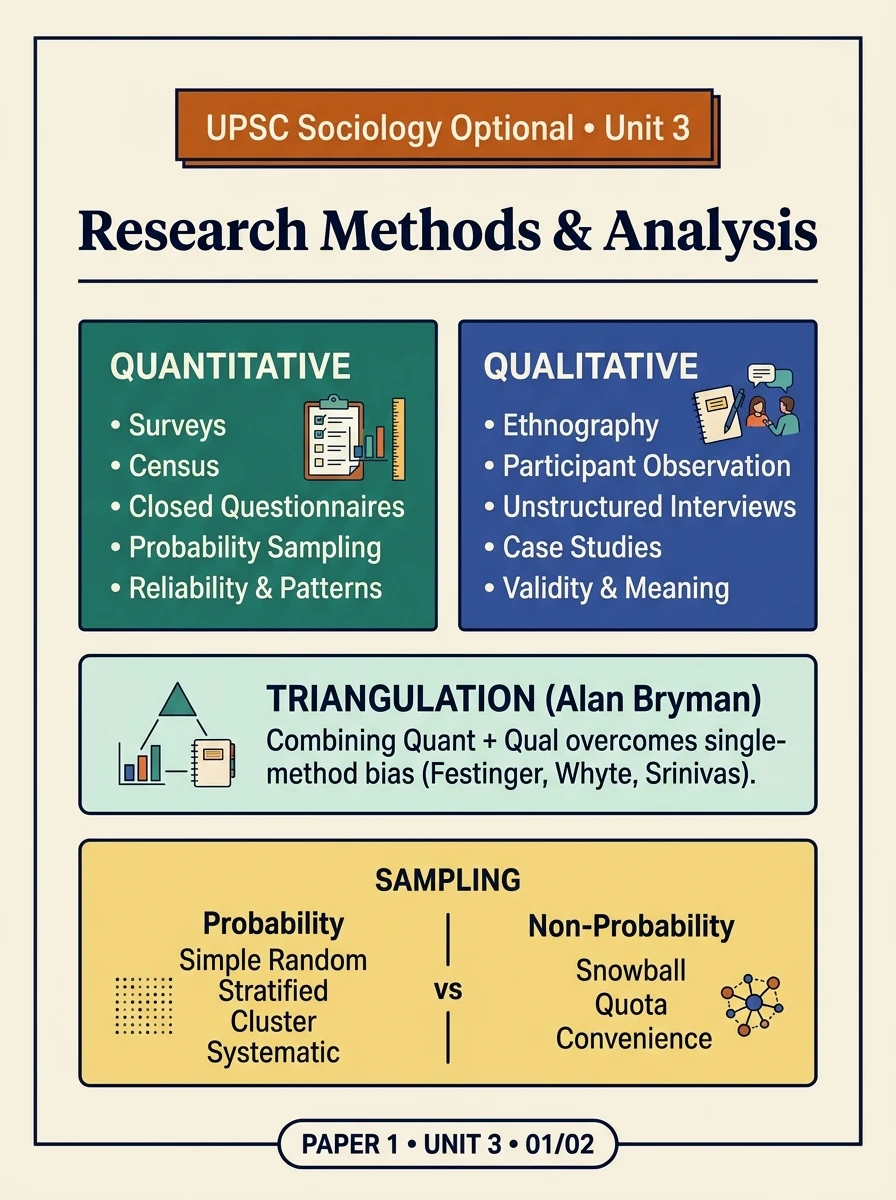 Paper 1 Concepts8 min read
Qualitative vs Quantitative Methods & Triangulation: Unit 3 Fieldwork Blueprint
Fieldwork me sirf numbers ya sirf narratives kaafi nahi hote. NFHS-5 aur NSSO jaisi surveys macro patterns dikhati hain, jabki Srinivas, Beteille aur Whyte participant observation se lived reality खोलते hain.
Padho →