Is the Indian Village Disappearing? Dipankar Gupta vs Surinder Jodhka
Kya Indian village gayab ho raha hai? Dipankar Gupta ke अनुसार non-farm income aur Dalit exit village ko transform kar rahe hain, jabki Surinder Jodhka caste aur rurban mobility ki continuity dikhate hain.
📑 Quick Jump: Contents (9) & Syllabus Chapters
Is the Indian Village Disappearing? A conceptual puzzle
Indian village ko le kar sociology mein ek classic debate hai: kya village ab ek self-contained, caste-ordered, agrarian world nahi raha? Ya phir uska core ab bhi caste, kinship, land aur hierarchy se hi defined hai? Dipankar Gupta is puzzle ko provocative way mein frame karte hain. Unke according, post-green revolution aur post-liberalisation India mein village ka economic centre non-farm income, migration, remittances, petty trade, construction, transport, salaried service aur circular mobility ki taraf shift ho chuka hai. Isliye village ko romantic, static, timeless entity ki tarah padhna misleading ho sakta hai. Unke famous argument Whither the Indian Village? mein village ko ek increasingly “rurban” space ke roop mein dekha gaya hai, jahan urban logics penetrate kar chuke hain.
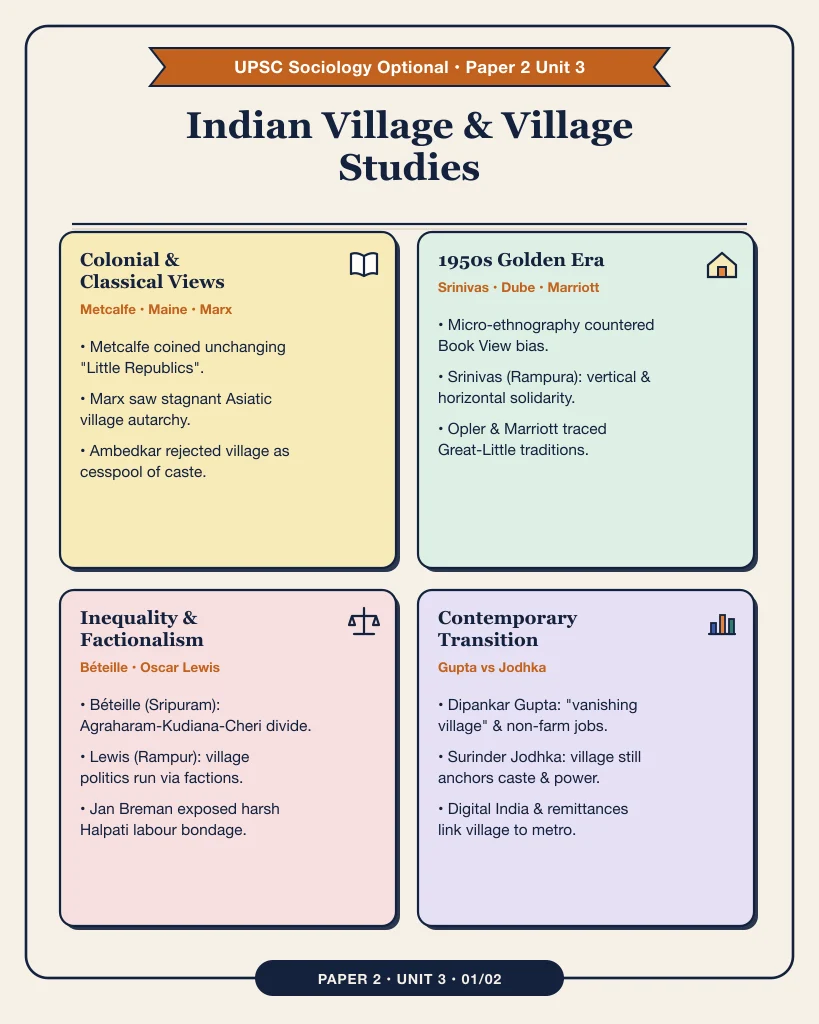
Lekin Surinder Jodhka is thesis ko overstatement maante hain. Unka core point hai ki village “disappear” nahi ho raha; woh transform zaroor ho raha hai, par caste ki social power ab bhi deeply embedded hai. Caste in Contemporary India aur Village Society type analyses mein Jodhka dikhate hain ki land ownership, everyday segregation, endogamy, ritual distance, temple access, residential clustering, aur labour hierarchy ab bhi rural India ko structure karte hain. Rural India mein market aur mobility badhi hai, lekin equality automatic nahi aayi.
Is debate ka importance UPSC Sociology Optional mein bahut high hai, kyunki yeh rural transformation, agrarian relations, caste mobility, differentiation, migration, gender, development aur social change ko ek saath connect karti hai. Aaj ke India mein villages sirf agricultural units nahi, balki multi-activity economies hain. Yet, villages sirf “post-caste modern spaces” bhi nahi bane. NFHS-5, PLFS, ASER, NCRB aur multiple field studies batate hain ki livelihood diversification ke saath social exclusion persist karta hai. Isliye central question yeh nahi hai ki village hai ya nahi; sahi question yeh hai ki village ka social form kis tarah reconstitute ho raha hai, aur kis ke liye yeh transformation emancipatory hai aur kis ke liye exclusionary.
Thinkers and conceptual contrast
1) Dipankar Gupta
Dipankar Gupta ne Indian village ko ek changing social formation ke roop mein dekha. Unki famous intervention Whither the Indian Village? rural India ke “decline of the peasant village” aur rise of diversified livelihoods par focus karti hai. Gupta ke liye key shift yeh hai ki village ab purely agriculture-driven nahi raha. Non-farm economy, migration, wage labour, remittances, small enterprises aur urban consumption patterns ne village ko reconfigure kiya hai. Unka argument basically structural transformation ka hai: jab livelihood base broaden hota hai, to village ka closed, bounded character weaken hota hai. Yeh unko aise theorists se connect karta hai jo social change ko functional differentiation aur modernization ke through samajhte hain.
2) Surinder S. Jodhka
Jodhka ka contribution is debate mein counter-point ke roop mein aata hai. Unki works, especially Caste in Contemporary India aur village ethnographies, dikhati hain ki caste ka everyday presence dissolve nahi hua. Jodhka ke liye rural India mein market penetration aur mobility ke bawajood caste endogamy, occupational inheritance, spatial segregation aur social distance continue karte hain. Dalit settlements, manual labour patterns, local power structures aur symbolic exclusion indicate karte hain ki “village disappearing” ka claim premature hai. Unka analytical frame inequality-sensitive hai: economic diversification ka matlab social democratization nahi hota.
3) André Béteille
Béteille ka Caste, Class and Power this debate ko ek strong comparative sociological depth deta hai. Unhone dikhaya ki caste ko class aur power ke saath analyze karna chahiye, not in isolation. Rural India mein change ko samajhne ke liye stratification matrix important hai. Béteille ka lens Gupta aur Jodhka ko bridge karta hai: village mein economic roles diversify ho sakte hain, but power hierarchy persist bhi kar sakta hai.
4) M.N. Srinivas
Srinivas ka framework, especially dominant caste, Sanskritization aur Westernization, village change ko long-term sociological process ki tarah samjhata hai. Unke according village never static tha; mobility and imitation pehle se exist karte the. Lekin Srinivas ne caste continuity ko bhi central rakha. Jodhka inke legacy se closer lagte hain because they emphasize lived caste relations. Gupta ka argument Srinivas ke village-as-social-system model se break karta hai, kyunki Gupta village ko increasingly porous and non-agrarian dekhte hain.
5) D.N. Dhanagare / T.K. Oommen (optional analytical support)
Dhanagare ne agrarian structure, peasant movements aur rural differentiation par focus karke dikhaya ki rural India simply “vanishing” nahi hota; it fragments and recomposes. T.K. Oommen ne caste, citizenship aur social justice ke through rural hierarchy ko read kiya. Inke insights Gupta ke economic transformation thesis aur Jodhka ke caste persistence thesis dono ko nuanced frame dete hain.
Analytical contrast: Gupta ka stress structural-economic transformation par hai; Jodhka ka stress socio-cultural continuity aur power asymmetry par. Sociology ke liye best answer binary nahi hai, balki “transformation without disappearance” hai.
| Aspect | Dipankar Gupta | Surinder Jodhka |
|---|---|---|
| Core claim | Indian village is losing its classical agrarian and closed character. | Village is transforming, but caste and hierarchy remain deeply active. |
| Main driver of change | Non-farm economy, migration, remittances, and rurban linkages. | Economic diversification operates alongside persistent social exclusion. |
| View on caste | Caste is less central to everyday economic organization than before. | Caste continues to shape labour, marriage, residence, and dignity. |
| Overall conclusion | Village is becoming porous, hybrid, and less distinctive as a social world. | Village is not disappearing; it is restructured, unequal, and socially stratified. |
Indian evidence: what data and cases show
Empirical India Gupta-Jodhka debate ko sharpen karta hai. First, PLFS repeatedly shows that rural workforce ka large share agriculture me fixed nahi hai; construction, trade, transport, domestic work, manufacturing, gig-linked petty services aur seasonal migration important ho chuke hain. Many districts in Uttar Pradesh, Bihar, Rajasthan, Maharashtra and Tamil Nadu show multi-activity rural households where farm income is no longer sole base. Yeh Gupta ke non-farm transition ko support karta hai.
Second, NFHS-5 se rural social change ka dual picture milta hai. On one hand, education, women’s mobility, institutional delivery, sanitation, media exposure aur bank access improve hue. On the other hand, child marriage, anaemia, malnutrition, early labour entry, and gendered dependency ab bhi serious concerns hain. Rural modernization socially uneven hai; yeh Jodhka ke inequality thesis ko support karta hai.
Third, NCRB crime patterns aur violence reports village life ke moral underside ko bhi dikhate hain: caste violence, honour-related abuse, sexual violence, land disputes, and atrocities against SC/ST communities remain visible. SC/ST Atrocities Act usage and reporting across states indicate that caste is not a dead structure.
Fourth, ASER rural schooling data show learning outcomes improving only partially; digital access aur school attendance mein gains hain, but foundational literacy gaps persist. Education-based mobility is real, yet class and caste mediate who benefits.
Fifth, NITI Aayog’s Multidimensional Poverty Index (MPI) rural poverty ke pockets ko highlight karta hai. Rural deprivation decline hua, but tribal and Dalit pockets remain among the most vulnerable. This is crucial for the village debate because a “vanishing village” cannot be assumed where multidimensional deprivation remains concentrated.
Case studies strengthen the argument. Punjab-Haryana ke villages mein agricultural mechanisation, migrant labour and dairy-based diversification dikhati hai ki village economy farm-only nahi रही. Western Uttar Pradesh aur eastern India mein Dalit out-migration, education-based exit, and service-sector entry show Gupta’s point. But Tamil Nadu, Haryana, and parts of Bihar/Rajasthan mein caste panchayat influence, honour control, and residential segregation continue to shape everyday life—Jodhka’s point.
Real ethnographic studies by Jodhka, Rogers, Sukhadeo Thorat, and field work on Dalit hamlets, manual scavenging communities, and agrarian labor show that mobility is often selective: some people exit agriculture, but not necessarily caste. Xaxa Committee reports on tribal marginalisation and Sachar Committee on Muslim deprivation also matter because they remind us that village change is never socially neutral; it is filtered through community-specific disadvantage.
Judicially, the Supreme Court’s Swaran Singh v. State line of cases on SC/ST dignity and atrocity law, along with land and dignity jurisprudence, reflects the persistence of social humiliation in rural contexts. Overall, Indian evidence suggests: village is not disappearing; it is becoming more differentiated, market-linked, and rurban, but caste and inequality remain structurally powerful.
🔑 Rurbanization
Rural spaces mein urban-like livelihoods, consumption, mobility aur institutions ka mix; village ka hybrid transformation, not complete disappearance.
Critique and nuanced synthesis
Dono positions useful hain, but both have limits. Dipankar Gupta ka argument kabhi-kabhi overstates the erosion of village specificity. Ek village sirf income diversification se “urban” nahi ho jaata, because kinship, marriage rules, ritual status, local politics and caste memory continue to matter. Non-farm jobs ka presence automatically equality nahi laata. Many households are diversified, but diversification often happens through low-paid, insecure, and gendered work.
Surinder Jodhka ka emphasis caste continuity ko rightly foreground karta hai, but kabhi-kabhi yeh rural change ke economic dynamism ko underplay kar sakta hai. New labour markets, migration corridors, digital remittances, education, and aspiration-based mobility ne village life ko genuinely alter kiya hai. A purely continuity-based reading risks treating village as frozen hierarchy, whereas actually rural society is now internally fragmented and socially plural.
Best synthesis yeh hai: Indian village is not disappearing; its classical agrarian form is dissolving into a rurban, multi-activity, stratified social space. Economic boundaries are blurring, but social boundaries are not disappearing at the same pace. This is precisely the sociology of uneven development.
For UPSC, the safest analytical line is: “Village is neither dead nor unchanged.” Instead, it is being reconstituted by migration, marketization, agrarian distress, welfare state penetration, education, and digital connectivity. Yet caste, patriarchy, and class power still mediate who can exit, who can move, and who remains trapped in low-status labour. That is why the contemporary Indian village should be studied as a site of transformation without automatic emancipation.
Answer kaise likhein
- Dipankar Gupta argues that non-farm income, migration and remittances have diluted the classical peasant village; village is now porous and connected to urban markets.
- Surinder Jodhka counters that caste continues to shape residence, labour, marriage, dignity and local power, so the village has not disappeared socially.
- Indian data from PLFS, NFHS-5, NCRB, ASER and NITI MPI show livelihood diversification with persistent inequality, especially for Dalits, tribals and women.
- A balanced conclusion is that the village has been restructured, not erased: economic change is faster than social equality.
Is Blog Se Jude Syllabus Chapters
Every Unit Note + Topic-Wise PYQ Mapped (English + Hinglish)
Paper 1 (10 Units) aur Paper 2 (15 Units) — Complete structured notes, thinkers, mind maps & 597 solved PYQs ek saath.
Khud ko test karo
Is post se 3 sawal
0 / 3 attempted
1. Dipankar Gupta ke debate ka central claim kya hai?
2. Surinder Jodhka ka key counter-argument kya hai?
3. Kaunsa term Indian village ke hybrid transformation ko best capture karta hai?
FAQ
Aksar poochhe jaane wale sawaal
- Dipankar Gupta ka main thesis kya hai?
- Unke according Indian village ka classical agrarian form weaken ho raha hai because non-farm economy, migration aur urban linkages village ko transform kar rahe hain.
- Surinder Jodhka Gupta se kaise disagree karte hain?
- Jodhka kehte hain ki village change hua hai, but caste persistence, segregation aur unequal power relations ab bhi central hain.
- UPSC answer mein best conclusion kya hoga?
- Best conclusion hai: Indian village disappear nahi hua; woh rurban, diversified aur internally unequal social space mein reconstitute ho raha hai.
UPSC PYQs
Is topic ke Previous Year Questions
- 2024 · P2
“The decade of 1950s was the golden period of village studies in Indian Sociology.” Explain. (20 marks)
- 2023 · P2
Discuss the challenges faced by the cooperative movement in India and suggest measures to strengthen grass-roots cooperatives. (20 marks)
- 2023 · P2
Do you agree with the view of André Béteille that India’s villages are representative of Indian society’s basic civilizational values? Present a sociological overview. (20 marks)
- 2022 · P2
What role do cooperatives and women’s Self-Help Groups (DAY-NRLM) play in rural poverty alleviation? (10 marks)
Roz ke Sociology notes Telegram pe paao
Daily current affairs, PYQ linkages aur direct mentorship support Telegram par.
Related
Aur padho
- Paper 2 IndiaOWL BLOGP2
Perspectives on Indian Society (Paper 2 Unit 1): G.S. Ghurye, M.N. Srinivas & A.R. Desai (PYQ Mapped)
4 min readPerspectives on Indian Society (Paper 2 Unit 1): G.S. Ghurye, M.N. Srinivas & A.R. Desai (PYQ Mapped)
Paper 2 of UPSC Sociology Optional tests your ability to apply sociological theories to India’s complex social reality. Mastering the perspectives on Indian society Ghurye Srinivas AR Desai UPSC expects in Unit 1 is non-negotiable...
Padho → - Paper 2 IndiaOWL BLOGP2
Caste System in India for UPSC Sociology: Purity-Pollution, Dominant Caste, Sanskritisation & Dalit Capitalism
4 min readCaste System in India for UPSC Sociology: Purity-Pollution, Dominant Caste, Sanskritisation & Dalit Capitalism
If you are aiming for 300+ in UPSC Sociology Optional, mastering Paper 2 — Unit 4 (Caste System) is non-negotiable. Every year, UPSC tests your ability to connect classical Indological theories with contemporary realities like...
Padho → - ThinkersOWL BLOGP2
M.N. Srinivas Complete UPSC Sociology Notes: Sanskritisation, Westernisation & Dominant Caste (With PYQs)
4 min readM.N. Srinivas Complete UPSC Sociology Notes: Sanskritisation, Westernisation & Dominant Caste (With PYQs)
Mysore Narasimhachar (M.N.) Srinivas is arguably the most frequently tested Indian thinker in UPSC Mains. For aspirants targeting a top rank, mastering MN Srinivas Sanskritisation dominant caste UPSC sociology frameworks is...
Padho →