Talcott Parsons: Social System, AGIL Model aur Pattern Variables Made Easy
Parsons ka AGIL model society ko system ki tarah samjhata hai, lekin India me joint family se nuclear family shift, NFHS-5 aur PLFS trends uski limits bhi dikhate hain.
📑 Quick Jump: Contents (4) & Syllabus Chapters
Talcott Parsons: Social System ko samajhne ka puzzle
Talcott Parsons sociology me un thinkers me se hai jinhone society ko random actions ka cluster nahi, balki ek social system ke roop me samjha. Unka core claim tha ki society tabhi survive karti hai jab uske different parts kuch basic functions perform karein. Isi idea ko unhone AGIL model me formalize kiya: Adaptation, Goal attainment, Integration, Latency. Ye framework bahut influential raha kyunki isne family, economy, polity aur religion ko ek interconnected system ki tarah dekhne ka lens diya. But UPSC level pe important question ye hai: kya Indian society jaise unequal, conflict-ridden aur historically stratified context ko Parsons ka equilibrium model adequately explain kar pata hai?
India me social change ko samajhne ke liye Parsons ka relevance tab aur badh jata hai jab hum joint family se nuclear family shift, women’s education, migration, urbanization, caste mobility, aur labor market transformation ko dekhte hain. NFHS-5 family, fertility aur women’s autonomy ke patterns dikhata hai; PLFS employment aur migration pressures ko highlight karta hai; ASER learning outcomes ko family socialization aur educational support se link karne ka scope deta hai. In sab me Parsons ka pattern maintenance aur socialization ka idea useful hai, lekin same time par his model par yeh critique bhi banta hai ki woh conflict, power aur inequality ko systematically underplay karta hai.
Is blog ka exam value yahi hai: aap Parsons ko sirf definition ke roop me nahi, balki Indian empirical reality ke against test karenge. Pattern variables—jaise universalism vs particularism, achievement vs ascription, affectivity vs affective neutrality, diffuseness vs specificity, aur collectivity orientation vs self-orientation—Indian family and kinship changes ko analyze karne ke powerful tools ban sakte hain. Example ke liye, traditional kinship me particularism aur ascription dominant the, jabki modern education aur job market me universalism aur achievement ka pressure badhta hai.
Lekin C. Wright Mills aur Ralf Dahrendorf jaise thinkers ne bataya ki society ko sirf equilibrium se nahi, power, conflict, bureaucracy aur elite domination se bhi samajhna padta hai. Isliye Parsons UPSC me ek ‘grand theory’ thinker hai: extremely important, but equally criticized. Aaj ka challenge ye hai ki aap AGIL ko Indian social facts ke saath connect karke balanced answer likhein—na blind praise, na superficial dismissal.
Parsons aur uske surrounding debate ke thinkers
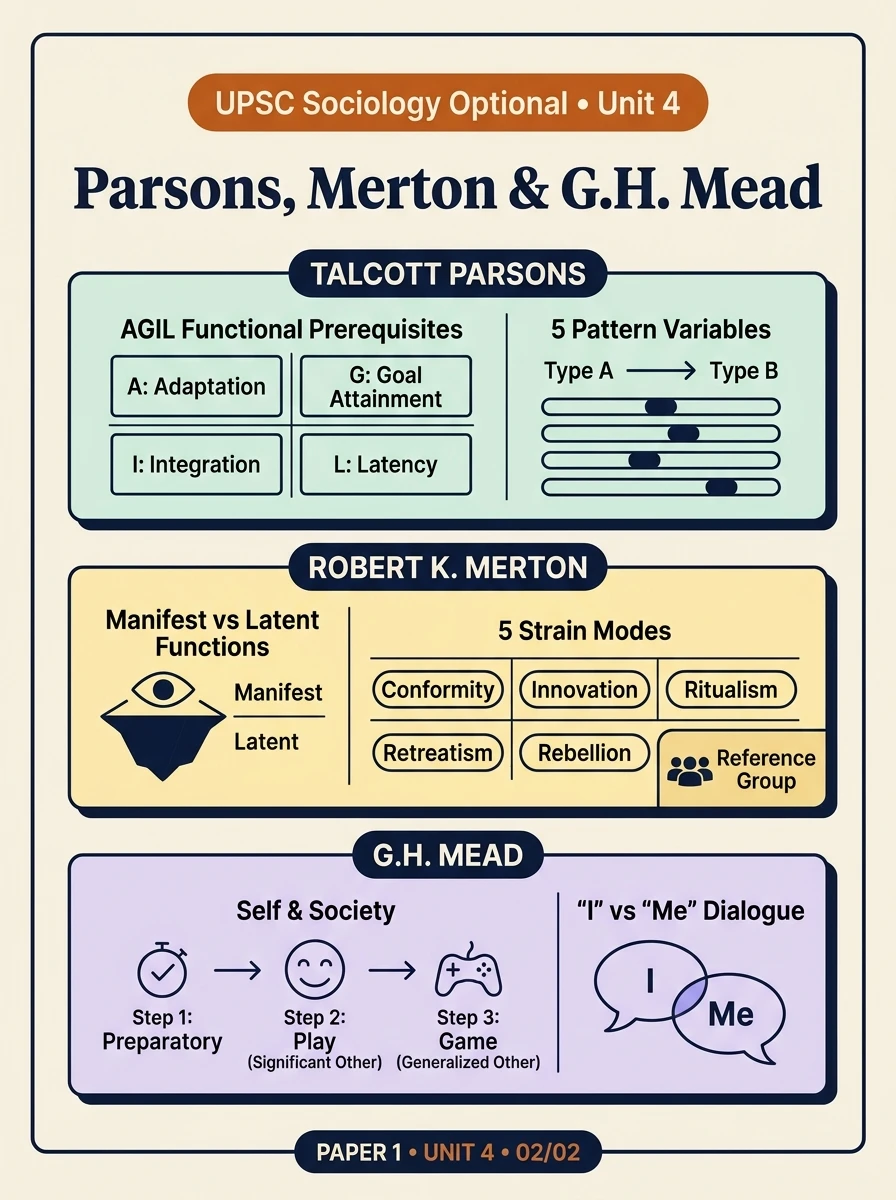
Talcott Parsons ne sociology ko ek grand theoretical architecture diya. Unki books The Social System (1951) aur Toward a General Theory of Action ne social action ko norm-governed aur value-oriented process ke roop me explain kiya. Parsons ke liye society ka survival tab possible hai jab social institutions kuch functional needs fulfill karein. AGIL model unka most famous contribution hai: Adaptation economic subsystem ka function hai; Goal attainment polity aur leadership se linked hai; Integration social order aur coordination ko ensure karta hai; aur Latency ya pattern maintenance values, motivation aur socialization ko sustain karta hai. Is framework ka strength ye hai ki yeh institutions ke interdependence ko highlight karta hai.
Parsons ke pattern variables unke action theory ka aur bhi refined part hain. Unhone bataya ki social action ko classify karne ke liye five dilemmas use kiye ja sakte hain: universalism-particularism, achievement-ascription, affective neutrality-affectivity, specificity-diffuseness, aur self-orientation-collectivity orientation. Ye variables Indian society ko samajhne me kaafi useful hain. Jaise kin-based marriage decisions me particularism, ascription aur diffuseness zyada hota hai; jabki corporate jobs, competitive exams aur formal bureaucracy me universalism, achievement aur specificity ka pressure hota hai.
Robert K. Merton Parsons ke immediate successor/critic ke roop me important hain. Unki Manifest and Latent Functions aur Middle Range Theory ne functionalism ko zyada empirical aur testable banaya. Merton ne dikhaya ki institutions sirf functions hi nahi, dysfunctions bhi create karte hain. UPSC answers me Merton ko Parsons ke balancing partner ke roop me use karna smart strategy hoti hai.
C. Wright Mills ne Parsons par sharp critique ki. Unki classic book The Sociological Imagination (1959) ne ‘grand theory’ aur ‘abstracted empiricism’ dono ko target kiya. Mills ke according, sociology ko common people ke private troubles ko public issues se connect karna chahiye. Parsons unke liye too abstract aur too consensual the; usme power aur historical conflict ka underestimation tha.
Ralf Dahrendorf ne conflict theory ko institutional basis diya. Unki book Class and Class Conflict in Industrial Society (1959) me unhone argument diya ki modern society me authority relations class conflict ka base hain. Parsons ke equilibrium model ke opposite, Dahrendorf society ko authority-backed domination aur change ke through samajhte hain. Ye critique especially Indian context me useful hai jahan caste, class, gender aur state power ke through inequality reproduce hoti hai.
A comparative reading me Parsons useful hai for social order, Merton useful hai for empirical nuance, Mills useful hai for critique of abstraction, aur Dahrendorf useful hai for authority-conflict analysis. UPSC Sociology me best answer woh hota hai jo in thinkers ko oppose nahi, balki dialogue me rakhe. Is tarah aap dikhate ho ki theory aur reality dono ko samajh sakte ho.
| Aspect | Parsonsian Functionalism | Conflict / Critical View |
|---|---|---|
| Core focus | System equilibrium, norms, role integration | Power, domination, conflict, inequality |
| View of society | Society as interdependent system with functional needs | Society as arena of competing interests and authority |
| Change explanation | Gradual differentiation and adaptation | Change driven by contradictions, struggles and contradictions |
| Indian application | Family, religion and institutions maintain order | Caste, class and gender relations reproduce hierarchy |
Indian empirical evidence: Parsons ko ground par kaise parakhें
Parsons ko India me test karna ho to sabse pehle family change dekhna padta hai. NFHS-5 (2019-21) ke indicators show karte hain ki fertility decline, women’s health awareness, contraception use aur childbearing patterns me significant shift hua hai. Ye shift directly family structure aur kinship expectations ko affect karta hai. Urbanization, education aur female employment ke saath nuclear households ka trend badha hai, although India me joint family abhi bhi emotionally aur economically relevant hai. Isse Parsons ke pattern variables ko apply kar sakte hain: traditional kinship me particularism aur diffuseness dominate karte the, lekin modern nuclear setup me decisions zyada specific aur achievement-oriented hote ja rahe hain.
PLFS (Periodic Labour Force Survey) migration, informality aur precarious employment ko highlight karta hai. Jab young adults job ke liye cities move karte hain, to family life me autonomy badhti hai aur traditional control weaken hota hai. Ye adaptation ke dimension ko show karta hai: household economic survival urban labor market ke hisab se reconfigure hota hai. Par isi process me caregiving, elder support aur emotional security ke liye new tensions bhi create hote hain—jise Parsons ne comparatively underplay kiya.
ASER reports ka learning data dikhata hai ki schooling outcomes sirf school par nahi, ghar ke literacy environment aur parental involvement par bhi depend karte hain. Yahan latency/pattern maintenance ka relevance aata hai—values aur motivation family me reproduce hote hain. Agar parental education low ho, to children ka learning support weak ho sakta hai. Isse socialization ke Parsonsian point ko Indian reality se link kiya ja sakta hai.
Caste aur inequality ko samajhne ke liye Xaxa Committee (Scheduled Tribes issues) aur Sachar Committee (Muslim deprivation) helpful hain. Dono reports batati hain ki India me integration sirf moral consensus se nahi hota; state access, education aur labor market participation se hota hai. Similarly, NITI Aayog MPI multidimensional poverty ko show karta hai, jo yeh prove karta hai ki economic adaptation ke bawajood deprivation persist kar sakti hai. Ye functional integration ka simple story nahi hai; yeh layered inequality ka story hai.
Judicially bhi India me family aur social norms transform hue hain. Supreme Court ke decisions on dignity, privacy aur autonomy—jaise K.S. Puttaswamy v. Union of India (2017)—ne personal choice, household surveillance aur individual rights ko stronger footing di. Ye Parsons ke achievement aur universalism ke direction me shift ko indirectly support karta hai. NCRB data on crimes against women aur domestic violence reports remind karte hain ki family sirf harmony ka site nahi, power contestation ka bhi site hai.
Isliye Indian evidence ye suggest karta hai ki Parsons ka model useful hai as a heuristic framework, but complete explanation nahi. India me social system order ke saath inequality bhi reproduce karta hai.
🔑 AGIL
Parsons ka acronym jo social system ke 4 functional imperatives batata hai: Adaptation, Goal attainment, Integration, Latency.
Critique: Parsons ki strength aur limits
Parsons ki sabse badi strength yeh thi ki unhone sociology ko systematic theory aur institutional analysis di. Unka AGIL model aur pattern variables social order ko samajhne ke powerful tools hain. Lekin unki sabse badi limitation yeh bhi hai ki unka model often consensus-biased aur status quo-friendly lagta hai. Woh society ko zyada balanced aur integrated maan lete hain, jabki actual social life me conflict, coercion aur structural inequality central hote hain.
C. Wright Mills ne isi point ko sharply raise kiya. Unke according, Parsons jaisi grand theory logon ki lived reality se dur ho sakti hai. Sociology ko power elite, bureaucracy aur historical change ko center me rakhna chahiye. Dahrendorf ne bhi yahi kaha ki authority relations conflict ka root hain; social order koi natural harmony nahi, balki contested arrangement hai.
Indian context me ye critique aur strong ho jata hai. Caste hierarchy, patriarchy, communal polarization aur labor informality ko sirf functional needs se explain nahi kiya ja sakta. Yahan consent aur coercion dono ka role hai. Joint family ka persistence bhi sirf value maintenance nahi, balki land, inheritance, caregiving aur social security se linked hai. Nuclearization bhi sirf modernization nahi; woh migration, housing cost, gendered labor, aur urban precarity ka outcome bhi hai.
Isliye best synthesis yeh hai: Parsons ko reject karne ke bajay unhe middle-level explanatory framework ki tarah use karo. Jahan aapko institutions ka functional role samajhna ho, wahan Parsons best hai. Jahan inequality, domination aur resistance samajhni ho, wahan conflict theorists—Mills, Dahrendorf, Marxist and feminist perspectives—zyada useful hain. UPSC answer me yahi balanced stance high-value banata hai: functional integration plus conflict analysis. Ye approach theory ko Indian empirical reality se grounded rakhta hai aur answer ko one-dimensional hone se bachata hai.
Answer kaise likhein
- AGIL model se explain kijiye ki economy, polity, kinship aur culture ka interdependence society ko stabilize karta hai.
- Pattern variables ko joint family se nuclear family shift, education, job market aur marriage norms par apply kijiye.
- NFHS-5, PLFS, ASER, Xaxa, Sachar aur NITI MPI se dikhaiye ki adaptation ke saath inequality bhi persist karti hai.
- Mills aur Dahrendorf ki critique add karke batayiye ki Parsons power aur conflict ko underplay karte hain.
Is Blog Se Jude Syllabus Chapters
Every Unit Note + Topic-Wise PYQ Mapped (English + Hinglish)
Paper 1 (10 Units) aur Paper 2 (15 Units) — Complete structured notes, thinkers, mind maps & 597 solved PYQs ek saath.
Khud ko test karo
Is post se 3 sawal
0 / 3 attempted
1. AGIL model me 'I' kis term ko represent karta hai?
2. Parsons ke pattern variables me kaunsa pair modern bureaucratic roles se zyada linked hai?
3. C. Wright Mills ka Parsons par primary critique kya tha?
FAQ
Aksar poochhe jaane wale sawaal
- Parsons ka AGIL model kya hai?
- Ye social system ke 4 functional needs batata hai: Adaptation, Goal attainment, Integration aur Latency.
- Pattern variables India me kaise apply hote hain?
- Ye joint family se nuclear family shift, caste se achievement-based mobility, aur traditional se formal institutions ki taraf change ko samjhate hain.
- Mills aur Dahrendorf Parsons ko kyun criticize karte hain?
- Kyuki Parsons conflict, power aur domination ko kam importance dete hain, jabki Mills aur Dahrendorf inhe society ke core features maante hain.
UPSC PYQs
Is topic ke Previous Year Questions
- 2022 · P1
Critically analyse Parsons views on society as a social system. (10 marks)
- 2021 · P1
Do you think Talcott Parsons gave an adequate theory of social change? Justify your answer. (10 marks)
- 2020 · P1
Analyse the relevance of ‘Pattern Variables ’in the study of Social change. (10 marks)
- 2018 · P1
How can Parsons AGIL framework be used to analyse key problems in a society? Discuss (10 marks)
Roz ke Sociology notes Telegram pe paao
Daily current affairs, PYQ linkages aur direct mentorship support Telegram par.
Related
Aur padho
- ThinkersOWL BLOGP1
Karl Marx for UPSC Sociology: Historical Materialism, Alienation & Mode of Production (Notes + PYQs)
4 min readKarl Marx for UPSC Sociology: Historical Materialism, Alienation & Mode of Production (Notes + PYQs)
Karl Marx remains the single highest-yielding thinker in UPSC CSE Sociology Optional, appearing almost every year in Paper 1 and shaping critical perspectives in Paper 2. Yet, most aspirants lose marks by writing generic political...
Padho → - ThinkersOWL BLOGP1
Emile Durkheim UPSC Sociology Notes: Social Facts, Division of Labour & Suicide (With Mapped PYQs)
4 min readEmile Durkheim UPSC Sociology Notes: Social Facts, Division of Labour & Suicide (With Mapped PYQs)
In UPSC Sociology Optional, Emile Durkheim stands as the foundational architect who carved out sociology as an autonomous science distinct from psychology and philosophy. For serious aspirants, mastering Emile Durkheim social facts...
Padho → - ThinkersOWL BLOGP1
Max Weber UPSC Sociology: Bureaucracy, Ideal Types, Verstehen & Protestant Ethic (Unit Notes + PYQs)
4 min readMax Weber UPSC Sociology: Bureaucracy, Ideal Types, Verstehen & Protestant Ethic (Unit Notes + PYQs)
Max Weber stands as a foundational pillar of interpretive sociology, offering a powerful methodological counterpoint to Durkheimian positivism and Marxian economic determinism. Whether you are decoding rational-legal authority or...
Padho →