10-Marker vs 20-Marker Sociology Answers: Word Count, Flowcharts & Time Strategy
10-marker aur 20-marker Sociology answers ka real game word count nahi, argument design hai. NFHS-5, PLFS aur NCRB data ke saath 7-minute vs 14-minute strategy samjho.
📑 Quick Jump: Contents (4) & Syllabus Chapters
10-marker vs 20-marker: same syllabus, different architecture
UPSC Sociology Optional mein sabse common confusion hota hai: same topic par 10-marker aur 20-marker ka answer kya same style se likhna chahiye? Short answer: bilkul nahi. Yeh sirf word count ka matter nahi hai; yeh argument density, conceptual framing, aur presentation architecture ka question hai. 10-marker mein examiner ko fast clarity chahiye: define karo, 2 thinkers do, aur ek India-based example se relevance show karo. 20-marker mein examiner ko depth chahiye: context banao, 3 perspectives lao, critique karo, aur synthesis ke saath close karo. Isi liye time strategy bhi alag hoti hai—roughly 7 minutes for a 10-marker and 14 minutes for a 20-marker.
Sociology Optional ki beauty yahi hai ki isme rote learning se zyada analytical writing reward hoti hai. Ek hi issue—jaise caste, gender, religion, globalization, development, education, or social change—par aap different levels of explanation de sakte ho. For example, caste ko 10-marker mein Dumont aur Srinivas ke through define kar sakte ho, lekin 20-marker mein aap jajmani, Sanskritization, dominant caste, intersectionality, aur state policy ka layered analysis de sakte ho. Isi tarah gender par 10-marker mein liberal feminism aur radical feminism ka contrast enough ho sakta hai, jabki 20-marker mein intersectionality, patriarchy, labour market segmentation, and empirical India data add karni padegi.
Indian relevance bahut strong hai, because UPSC answers sirf theory ke लिए नहीं, बल्कि India’s social reality ko interpret karne ke liye hote hain. NFHS-5 ne women’s nutrition, anaemia, fertility patterns, aur child health disparities ko highlight kiya; PLFS ne informal employment aur gendered labour participation ko foreground kiya; NCRB data violence and crime patterns dikhata hai; ASER education outcomes ka ground reality batata hai; aur Xaxa, Sachar, NITI MPI, Oxfam, aur WIL-type reports inequality ko empirical context dete hain. Achha Sociology answer wahi hota hai jo concept + thinker + Indian evidence + balanced critique ko ek coherent flow mein convert kare. Is blog ka core puzzle yahi hai: limited time mein maximum sociological value kaise create karein?
Thinkers jo answer ko high-value banate hain
Sociology Optional mein thinker selection random nahi hona chahiye; woh question ki demand ke according hona chahiye. Sabse pehle, Emile Durkheim useful hain jab aap social facts, integration, or collective conscience explain kar rahe ho. Unki book The Rules of Sociological Method aur Suicide answer ko scientific rigor deti hain. Agar question social order, norms, or deviance par hai, Durkheim se aap structural explanation build kar sakte ho. Lekin limitation yeh hai ki Durkheim over-structural ho sakte hain; individual agency kam dikhti hai.
Doosre, Max Weber ka value lies in verstehen, social action, authority, bureaucracy, aur class-status-party framework. Economy and Society aur The Protestant Ethic and the Spirit of Capitalism se aap modern institutions, rationalization, aur value-oriented action ko explain kar sakte ho. Weber UPSC answers mein especially useful hain jab aap state, bureaucracy, legitimacy, aur religion-based social change discuss karte ho. Unka strength nuanced interpretation hai; weakness yeh hai ki macro inequality ke material base ko kabhi-kabhi insufficiently capture karte hain.
Teesre, Karl Marx class conflict, historical materialism, alienation, and mode of production ke liye indispensable hain. Manifesto of the Communist Party aur Capital class exploitation ko theoretically solid banate hain. Agar question labour, inequality, globalization, or agrarian change par hai, Marx ka lens powerful hota hai. But pure economic reductionism se बचना zaroori hai, because Indian society mein caste, kinship, religion, and gender bhi equally constitutive hain.
Chauthe, M.N. Srinivas India-specific sociology ke liye must-use thinker hain. Social Change in Modern India aur Caste in Modern India se Sanskritization, Westernization, dominant caste, aur secularization ko anchor kiya ja sakta hai. Unka major contribution yeh hai ki unhone Indian society ko indigenous categories se read karne ki koshish ki. Phir bhi, critics kehte hain ki unka framework sometimes dominant caste gaze ko naturalize karta hai.
Paanchve, Andre Beteille aapko caste-class-power triad deta hai, especially Caste, Class and Power through. Jab question inequality, elite formation, or rural stratification par ho, Beteille ka analytical balance bahut काम aata hai. Unki strength comparative and empirical orientation hai. Iske saath Yogendra Singh ka mention useful hai for modernization, social change, and structural differentiation in India. Modernization of Indian Tradition se aap tradition-modernity tension ko handle kar sakte ho.
Analytical contrast simple rakho: Durkheim explains order, Marx explains conflict, Weber explains meaning and legitimacy, Srinivas explains Indian social change, Beteille explains stratification, aur Yogendra Singh explains modernization. 10-marker mein 2 thinkers enough hote hain; 20-marker mein 3 perspectives ka smart blend banta hai. Best answers wahi hote hain jo one-dimensional nahi hote—unmein structure, agency, history, aur Indian evidence sab ek saath aate hain.
| Aspect | 10-Marker | 20-Marker |
|---|---|---|
| Ideal length | Around 150 words | Around 250 words |
| Core structure | Define + 2 thinkers + India example | Context + 3 perspectives + critique + synthesis + mini diagram |
| Depth expectation | High clarity, low elaboration | Conceptual layering, balanced evaluation |
| Presentation style | Short intro, 2 body points, 1-line conclusion | Mini intro, subheadings/flowchart, nuanced conclusion |
Indian data aur evidence: answer ko ground reality se jodo
Sociology Optional mein theory tabhi score karti hai jab woh Indian reality se connect ho. Isliye empirical anchors zaroori hain. NFHS-5 ne women’s anaemia, child undernutrition, early marriage, aur fertility transitions par strong evidence diya. Ye data gender, health, aur social development questions mein instantly usable hai. For example, women’s anaemia rates aur child stunting aapko patriarchy, nutrition inequality, aur household resource allocation ke sociological reading tak le jati hain.
PLFS labour market ki informal nature aur women’s LFPR ke volatility ko samajhne mein useful hai. India mein majority workforce informal sector mein hai, jo Marxist labour exploitation, dual labour market, aur gendered segmentation arguments ko empirical backing deta hai. Agar question work, labour, or urbanization par hai, PLFS cite karna answer ko contemporary bana deta hai.
NCRB data crime, violence, custodial issues, and social order questions mein essential hai. Domestic violence, crimes against women, aur vulnerable groups ke patterns aapko patriarchy aur social control frameworks se analyze karne ka base dete hain. Similarly, ASER reports rural learning outcomes aur foundational literacy gap dikhati hain. Education and social mobility ke essays mein ASER se argument strong hota hai ki schooling access aur learning achievement alag cheezein hain.
Committee aur report side par Sachar Committee Muslims ke socio-economic deprivation ko document karti hai. Isse minority disadvantage, identity, and citizenship debates ko support milta hai. Xaxa Committee tribal marginalization, displacement, land alienation, aur governance failures ko highlight karti hai; tribal development aur forest rights answers mein yeh gold standard source hai. NITI Aayog MPI multidimensional poverty ko income se beyond jata hai—nutrition, education, housing, and living standards ke link ko show karta hai. Yeh development sociology mein crucial hai.
High inequality arguments ke लिए Oxfam reports wealth concentration aur elite capture ko illustrate karti hain. WIL (Women in Leadership) type datasets aur leadership representation evidence gendered glass ceiling ko support karte hain. In sab ke saath aap Supreme Court rulings ko bhi use kar sakte ho: NALSA v. Union of India (2014) transgender rights ke liye, aur Navtej Singh Johar (2018) decriminalization of homosexuality ke liye. These judgments show how law becomes a site of social change.
Ethnographic studies bhi important hain. M.N. Srinivas ka Rampura fieldwork, André Béteille ka Sripuram study, aur Sajjan Kumar-type contemporary rural/urban ethnographies se aap Indian social structure ka lived reality दिखा सकते हो. Best strategy yeh hai: theory ko committee/report/data ke saath triangulate karo. UPSC ko sirf textbook sociology nahi, empirically grounded sociology chahiye.
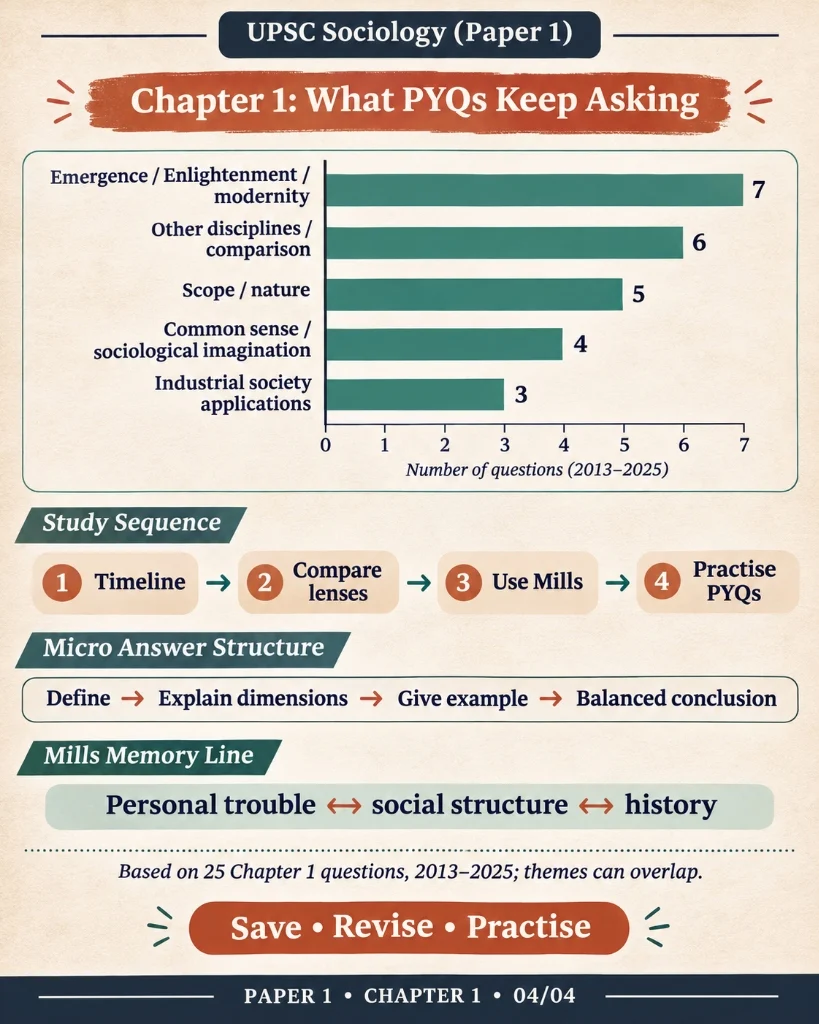
🔑 Sociological imagination
Personal issues ko public structures aur historical context se connect karke dekhne ki ability.
Critique: kab 10-marker aur 20-marker fail ho jata hai?
Sabse common limitation yeh hoti hai ki aspirants 10-marker aur 20-marker dono ko same generic essay bana dete hain. Yeh scoring nahi hota, because examiner ko format-specific economy chahiye. 10-marker mein over-explanation se answer diffuse ho jata hai; 20-marker mein under-development se answer superficial lagta hai. Ek aur mistake hai thinker dumping—Durkheim, Weber, Marx ko naam ke liye ghusa dena without analytical relevance. Sociology Optional mein thinker tabhi meaningful hota hai jab uska concept answer ke central problem ko solve kare.
Theoretical critique bhi zaroori hai. Durkheim structure ko overvalue karte hain; Marx class ko overdetermine kar sakte hain; Weber meaning aur legitimacy deta hai but inequality ka full material explanation नहीं देता. Srinivas Indian sociology ke लिए foundational हैं, par unke concepts par elite or middle-caste bias ka critique hua hai. Beteille ne stratification ko refine kiya, but caste-power dynamics ka full political economy कभी-कभी short रह जाता है. Feminist thinkers—jaise Usha Menon, Nandini Gooptu, aur broader intersectional scholarship—yaad dilate hain ki gender ko class aur caste se separate nahi treat kiya ja sakta.
Nuanced synthesis ka matlab hai: ek theory ko absolute truth na banao. Better answer yeh hota hai jo structural explanation + agency + data + policy angle ko jode. Example: caste ko sirf ritual hierarchy nahi, balki political economy, education access, and social mobility ke lens se dekho. Gender ko sirf patriarchy nahi, balki labour segmentation, unpaid care work, aur legal reform ke साथ समझो. 20-marker mein mini diagram, comparative contrast, aur 1-line evaluation se answer mature lagta hai. Final lesson simple hai: sociology mein best answer woh nahi jo sab kuch likhe, balki woh jo sahi cheez ko right depth mein likhe.
Answer kaise likhein
- 10-marker formula: Define the concept, add 2 relevant thinkers, and finish with 1 India example.
- 20-marker formula: Give context, use 3 perspectives, add critique, and conclude with synthesis.
- Har answer mein 1 mini flowchart/diagram use karo agar concept allow karta ho—this improves readability.
- Time discipline: 10-marker ≈ 7 minutes, 20-marker ≈ 14 minutes; last 1 minute conclusion ke liye reserve karo.
Is Blog Se Jude Syllabus Chapters
Every Unit Note + Topic-Wise PYQ Mapped (English + Hinglish)
Paper 1 (10 Units) aur Paper 2 (15 Units) — Complete structured notes, thinkers, mind maps & 597 solved PYQs ek saath.
Khud ko test karo
Is post se 3 sawal
0 / 3 attempted
1. 10-marker Sociology answer ka best structure kya hai?
2. Which report is most useful for multidimensional poverty?
3. Which thinker is most associated with Sanskritization?
FAQ
Aksar poochhe jaane wale sawaal
- 10-marker mein sabse important cheez kya hai?
- Clarity: precise definition, 2 thinkers, aur 1 relevant Indian example.
- 20-marker mein flowchart zaroori hai kya?
- Zaroori nahi, but mini diagram answer ko visual structure deta hai aur examiner ko quickly path dikhata hai.
- Kya har answer mein Marx, Weber, aur Durkheim likhna chahiye?
- Nahi. Sirf wahi thinker use karo jo question ke core issue ko directly explain kare.
UPSC PYQs
Is topic ke Previous Year Questions
- 2025 · P1
In what way is the scope of sociology unique? Explain. (10 marks)
- 2025 · P1
What is the relationship (similarities and differences) between sociology and history in terms of their area of study and methodology? Discuss. (10 marks)
- 2024 · P1
Sociology is the product of European enlightenment and renaissance. Critically examine this statement. (10 marks)
- 2024 · P1
Discuss the nature of Sociology. Highlight its relationship with Social Anthropology. (10 marks)
Roz ke Sociology notes Telegram pe paao
Daily current affairs, PYQ linkages aur direct mentorship support Telegram par.
Related
Aur padho
 Strategy & Toppers8 min read
Haralambos vs Ritzer vs IGNOU: Minimum Booklist for 300+ in Sociology Optional
Haralambos, Ritzer aur IGNOU ko smartly combine karke 300+ target karo. NFHS-5, PLFS, NCRB aur Sachar-Xaxa data ke saath selective reading se Paper 1-2 dono cover hote hain.
Padho →- Strategy & Toppers10 min read
Last 10 Years UPSC Sociology PYQ Trends: Dynamic Paper 1 & Current-Linked Paper 2
Last 10 years me UPSC Sociology PYQ rote definitions se हटकर applied, India-linked ban gaye hain. Gig work, COVID kinship, AI alienation aur caste census trends Paper 1/Paper 2 ko rewrite kar rahe hain.
Padho → 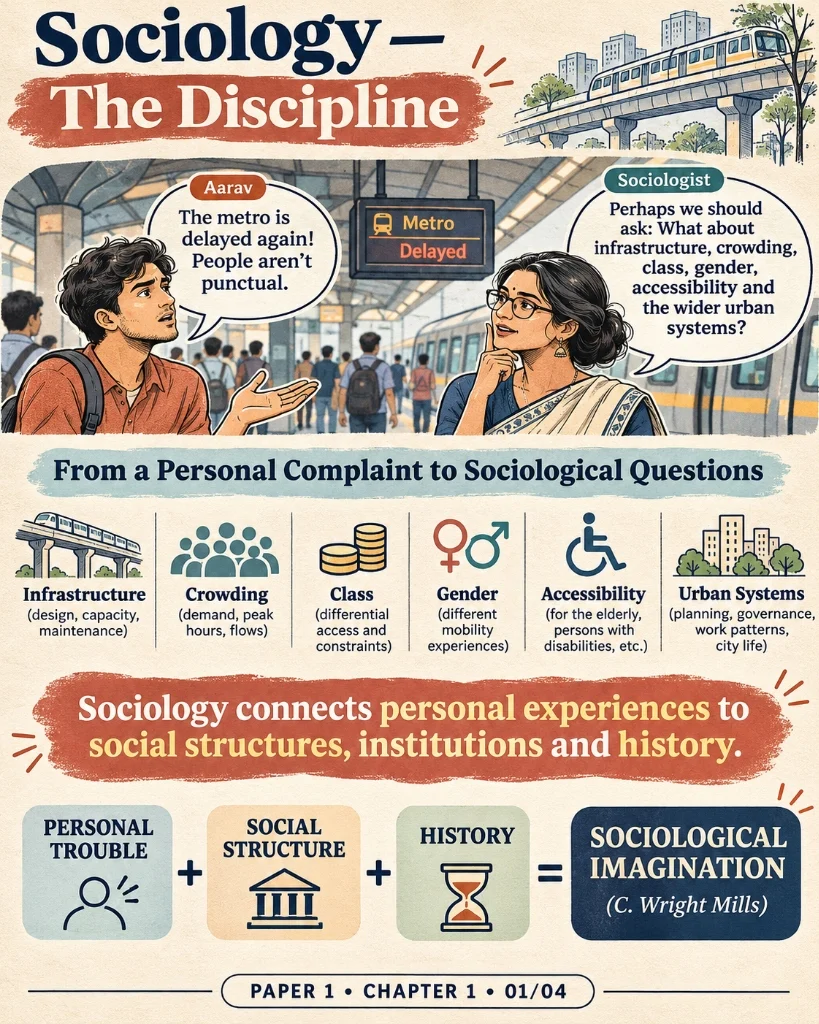 Answer Writing2 min read
UPSC Sociology Mains mein 300+ Marks Kaise Laayein: Complete Answer Framework
10-marker aur 20-marker Sociology answers ka exact structure: sociological jargon, P1-P2 interlinking, thinkers, current affairs aur visual diagrams.
Padho →