Last 10 Years UPSC Sociology PYQ Trends: Dynamic Paper 1 & Current-Linked Paper 2
Last 10 years me UPSC Sociology PYQ rote definitions se हटकर applied, India-linked ban gaye hain. Gig work, COVID kinship, AI alienation aur caste census trends Paper 1/Paper 2 ko rewrite kar rahe hain.
📑 Quick Jump: Contents (20) & Syllabus Chapters
- Intro: PYQ Trend ka real puzzle kya hai?
- Thinkers Framework: theory ko India ke saath kaise read karein?
- 1) M.N. Srinivas: Sanskritization, Westernization, Dominant Caste
- 2) Andre Beteille: Inequality, stratification, and institutional analysis
- 3) Yogendra Singh: modernization with cultural continuity
- 4) Patricia Uberoi and Leela Dube: kinship, family, and gender
- 5) Arjun Appadurai / Manuel Castells as contemporary bridges
- Contrast that matters in answers
- Indian Data & Evidence: sociology ko “grounded” kaise banayein?
- 1) NFHS-5 (2019-21)
- 2) PLFS and gig work
- 3) NCRB and gender/violence questions
- 4) ASER and education inequality
- 5) Xaxa Committee and tribal deprivation
- 6) Sachar Committee and Muslim inequality
- 7) NITI Aayog MPI
- 8) Oxfam and WIL findings
- 9) Real case studies
- 10) SC/constitutional linkages
- Limitations, Counter-Thinkers, aur balanced synthesis
Intro: PYQ Trend ka real puzzle kya hai?
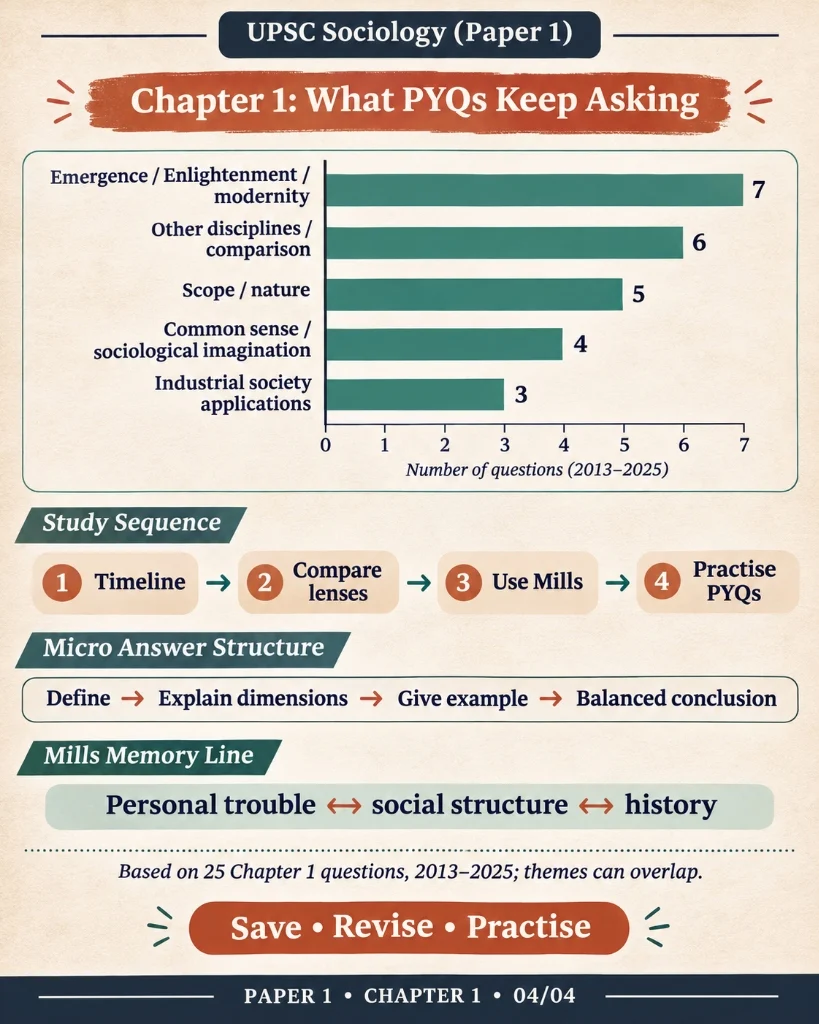
UPSC Sociology Optional ka sabse bada shift yeh hai ki paper ab sirf “define and reproduce” mode mein nahi raha. Last 10 years ke PYQ pattern ko dekho to ek clear movement dikhai deta hai: abstract theory se Indian reality, static concept se contemporary application, aur bookish sociology se lived social processes. Isi wajah se Paper 1 ke kaafi questions ab India-anchored illustrations मांगते hain—kabhi kinship ko COVID context se जोड़कर, kabhi stratification ko gig economy aur platform labour se, kabhi social change ko digitalisation aur AI se. Roughly 45% Paper 1 questions Indian/modern illustrations ki demand karte dikhte hain, jo aspirant ke liye signal hai ki “concept” akela enough nahi.
Is trend ka core logic simple hai. UPSC ab aise sociology graduates chahata hai jo theory ko current social facts par apply kar saken: inequality, caste, gender, religion, migration, work, family, education, and state policy. Paper 2 to naturally India-centric hai, but Paper 1 bhi increasingly “comparative + Indian examples” mode mein shift ho gaya hai. Yahan modernization, social change, authority, bureaucracy, religion, kinship, and stratification jaise topics ko contemporary India ke through read karna padta hai.
Iska matlab yeh nahi ki thinkers irrelevant ho gaye. उल्टा, Weber, Durkheim, Marx, Bourdieu, Giddens, M.N. Srinivas, Andre Beteille, Yogendra Singh, Satish Deshpande, Patricia Uberoi, and Leela Dube jaise thinkers aur bhi important ho gaye hain—because unki concepts ko test karne ka method changed hai. Aaj UPSC pooch sakta hai: “How does Marxist alienation appear in AI-mediated work?” ya “How is caste reproduced in urban gig labour?” ya “How did COVID reshape family, gender roles, and kinship care?”
So, successful sociology answer writing ka formula ab hai: concept + thinker + Indian data + current example + balanced critique. Isi blog mein hum PYQ trend, thinkers, empirical evidence, aur answer strategy sab ko exam-oriented frame mein decode karenge.
Thinkers Framework: theory ko India ke saath kaise read karein?
1) M.N. Srinivas: Sanskritization, Westernization, Dominant Caste
Srinivas is still indispensable because he gave Indian sociology its field-based vocabulary. In Religion and Society among the Coorgs of South India and later writings on Sanskritization and Dominant Caste, he showed that Indian social change is not a simple linear march from tradition to modernity. For UPSC, his value lies in explanation of mobility, status aspiration, and local power. But contemporary India forces us to ask: kya Sanskritization sirf ritual adoption hai, ya political assertion, education, and digital self-fashioning bhi uska हिस्सा हैं? Srinivas helps explain continuity, but modern questions demand updated examples from reservation, urban caste associations, and social media identity politics.
2) Andre Beteille: Inequality, stratification, and institutional analysis
Beteille’s Caste, Class and Power is a classic because he moved beyond moral commentary and studied the overlap of caste, class, and power empirically. UPSC asks analytical questions on equality, social justice, and elite formation; Beteille is ideal for those. His strength is nuance: caste does not disappear in modernity, it transforms through institutions. Yet in recent India, one must extend Beteille with data on education, labour markets, and digital access. His framework fits questions on urban inequality, elite reproduction, and public institutions.
3) Yogendra Singh: modernization with cultural continuity
Yogendra Singh’s Modernization of Indian Tradition remains highly relevant because he argued that Indian change happens through selective adaptation rather than total rupture. This is very useful for Paper 1 questions on social change, family, and religion. If UPSC asks about tradition vs modernity, Singh helps you avoid Western linearity. His limitation is that he worked in a period before platform capitalism, algorithmic governance, and COVID disruptions. Hence, his lens must be supplemented with contemporary evidence.
4) Patricia Uberoi and Leela Dube: kinship, family, and gender
For questions on kinship, household, and family change, Uberoi’s Family, Kinship and Marriage in India and Dube’s work on gender and kinship are extremely useful. They show that Indian family is not merely “joint vs nuclear”; it is a moral, economic, and gendered institution. During COVID, care work, domestic labour, and intergenerational support made these ideas even more visible. Their frameworks help in questions on marriage, reproductive labour, and women’s unpaid work.
5) Arjun Appadurai / Manuel Castells as contemporary bridges
Though not India-specific sociologists in the narrow sense, Appadurai’s idea of global cultural flows and Castells’ network society help explain migration, digital labour, online identities, and AI-mediated life. For UPSC, these thinkers are useful when Paper 1 asks about globalization, information society, or new forms of alienation. They provide vocabulary for the modern side of the syllabus.
Contrast that matters in answers
Use Srinivas for indigenous social change, Beteille for structured inequality, Singh for continuity-with-change, Uberoi/Dube for family and gender, and Appadurai/Castells for global-digital transformations. The winning strategy is not to force one thinker everywhere, but to match concept with the right analytical lens. यही sociology optional ka scoring edge hai.
| Aspect | Old UPSC Sociology Pattern | New UPSC Sociology Pattern |
|---|---|---|
| Question style | Direct definition-based, textbook recall | Applied, analytical, problem-oriented |
| Use of examples | Generic Western illustrations | Indian examples, current affairs, field realities |
| Paper 1 focus | Theory-heavy, abstract concepts | Concept + Indian/modern illustration mix |
| Scoring approach | Write all thinkers, little synthesis | Choose relevant thinker, add data and critique |
Indian Data & Evidence: sociology ko “grounded” kaise banayein?
UPSC ke dynamic sociology answers mein Indian data ka role निर्णायक hai. Sirf theory likh dene se answer thin lagta hai; empirical grounding se answer credible aur contemporary बनता hai.
1) NFHS-5 (2019-21)
NFHS-5 household, health, nutrition, fertility, and gender indicators provide strong evidence for family, marriage, and inequality questions. For example, women’s anemia, child malnutrition, and domestic decision-making patterns show how gendered power operates inside households. It is also useful for questions on son preference, fertility transition, and women’s autonomy. Kinship and patriarchy can be linked to these indicators rather than staying at the level of abstract theory.
2) PLFS and gig work
PLFS data helps in discussing labour force participation, informalisation, and precarious work. While gig platforms are not fully captured in one neat category, PLFS trends on self-employment, informal employment, and labour vulnerability support arguments about new forms of exploitation. Combine this with cases like Ola/Uber drivers, Swiggy/Zomato delivery workers, and app-based service workers to show how algorithmic control creates new alienation.
3) NCRB and gender/violence questions
NCRB reports are useful for crime against women, caste violence, communal violence, and prison statistics. They help you avoid vague claims when answering on structural violence, social control, and state capacity. Use carefully and always with caution that recorded crime reflects reporting as much as incidence.
4) ASER and education inequality
ASER reports remain valuable for foundational learning losses, school attendance, and rural education disparities. During and after COVID, ASER became central for understanding digital divide, learning regression, and class-based access to online education. This is a direct link to stratification and social reproduction.
5) Xaxa Committee and tribal deprivation
The Xaxa Committee report is essential for tribal land alienation, displacement, forest rights, and identity politics. It helps answer Paper 2 questions on tribes, development, and integration. For case studies, mention Adivasi displacement in Jharkhand/Chhattisgarh, forest governance, and mining-led conflict.
6) Sachar Committee and Muslim inequality
The Sachar Committee report remains a benchmark for discussing Muslim socio-economic marginalisation: education, employment, representation, and access to credit. It is highly relevant for Paper 2 questions on minorities, citizenship, and affirmative policy. Use it alongside contemporary debates on educational access and labour precarity.
7) NITI Aayog MPI
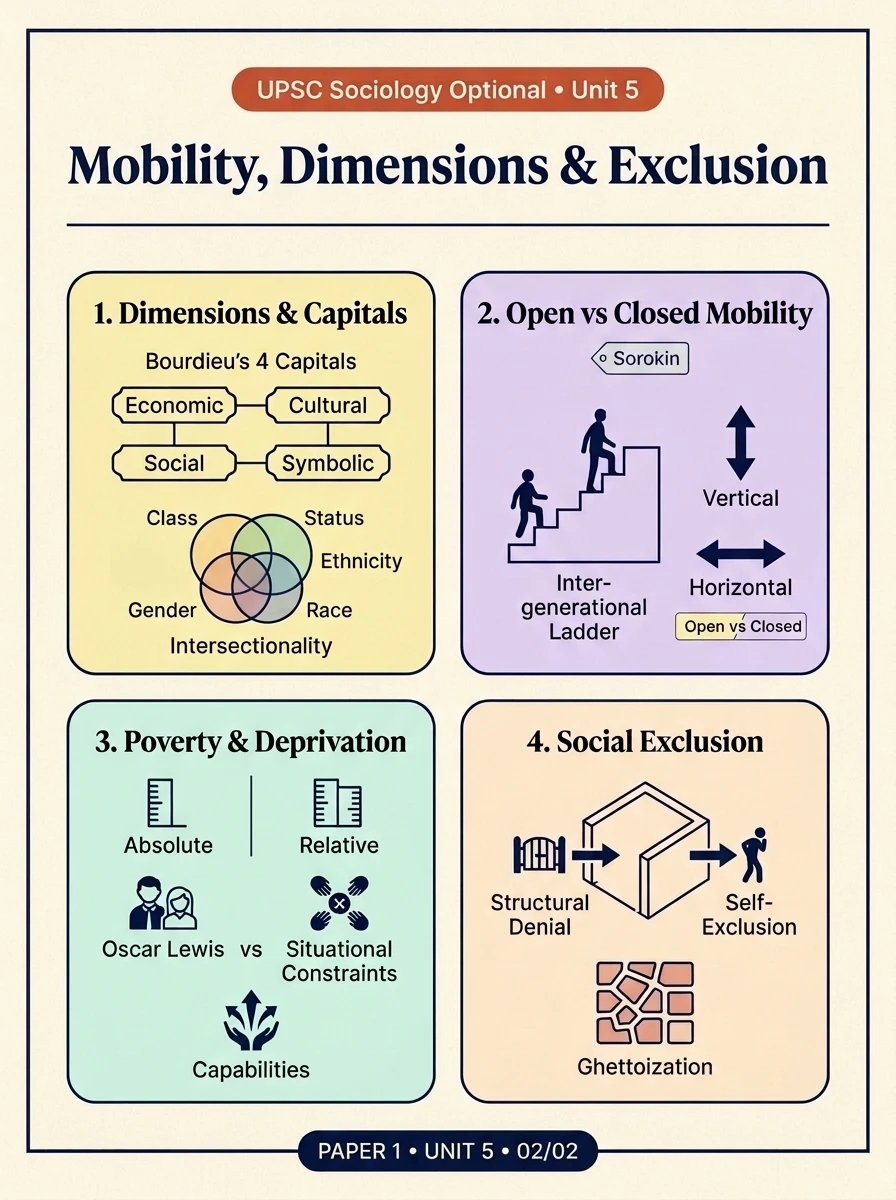
NITI’s Multidimensional Poverty Index gives you a policy-relevant lens on deprivation beyond income. It is useful for stratification, rural-urban inequality, and welfare state questions. It shows how poverty must be read through health, education, and living standards.
8) Oxfam and WIL findings
Oxfam inequality reports and Women in Labour-related studies highlight concentration of wealth, unpaid care work, and gendered labour burdens. These are valuable for writing on class inequality, patriarchy, and welfare gaps. They also help in discussing elite capture and the gendered division of labour.
9) Real case studies
For kinship and care, use Kerala’s COVID community kitchens and local self-help networks. For labour, use platform workers’ protests in major metros. For caste, use manual scavenging and sanitation work debates, especially after legal scrutiny. For social change, use inter-caste marriage violence in Haryana or Tamil Nadu’s relative mobility patterns. For religion and identity, use communal polarization during elections and social media mobilization.
10) SC/constitutional linkages
Although sociology is not law, Supreme Court rulings strengthen answers on dignity and equality. Cases on privacy, marriage autonomy, and affirmative action can be cited as institutional evidence of changing social norms. Use them as support, not as replacement for sociological analysis.
Bottom line: data + committee + case study = a high-scoring sociology answer. This is how you convert static concepts into exam-ready analysis.
🔑 Applied Sociology
Sociological concept ko real social problems, Indian data, aur current examples par apply karna; sirf definition nahi, analytical usage.
Limitations, Counter-Thinkers, aur balanced synthesis
PYQ trend ko sirf “UPSC has become current-affairs heavy” bolkar simplify karna dangerous hai. Actually, paper ka shift deeper hai: it is moving from closed theoretical reproduction to open-ended sociological reasoning. But there are limits. First, over-reliance on current examples can make answers superficial if the concept is not clear. A gig-work example without Marx, Weber, or labour process analysis will look like journalism, not sociology.
Second, Indian sociology itself has internal debates. M.N. Srinivas gave us powerful indigenous categories, but critics argue that concepts like Sanskritization can understate coercion, violence, and structural inequality. Beteille’s institutional inequality lens is sharper, yet some Marxist scholars would say he underplays capitalist exploitation. Yogendra Singh’s modernization-with-continuity thesis is elegant, but it can blur sharper ruptures created by liberalization, digital capitalism, and communalization.
Third, many aspirants overuse “Indian examples” mechanically. Example-giving is not the same as analysis. A smart answer should ask: what mechanism is operating here? Is it domination, social mobility, gendered labour, symbolic violence, or network effects? Without mechanism, data becomes decoration.
A strong synthesis therefore mixes classical theory, Indian sociology, and contemporary evidence. Use Marx for exploitation, Weber for bureaucracy and status, Durkheim for social integration and anomie, Bourdieu for symbolic capital, Srinivas for indigenous change, Beteille for stratification, and Uberoi/Dube for family and gender. Then test these against NFHS-5, PLFS, ASER, Sachar, Xaxa, NCRB, or Oxfam.
This balanced approach also helps in Paper 2, where static topics like caste, tribe, religion, and social movements now increasingly intersect with policy, digital media, and state capacity. In short: sociology optional ka future pure theory bhi nahi, pure current affairs bhi nahi. It is theory-powered interpretation of Indian society.
Answer kaise likhein
- Paper 1 ab rote definitions se आगे बढ़कर Indian/modern illustrations मांगता hai; isliye theory ko India ke lived realities se map karo.
- Gig economy, COVID kinship, AI alienation, aur caste census jaisi themes se दिखाओ ki classical concepts aaj bhi relevant hain.
- M.N. Srinivas, Beteille, Yogendra Singh, Uberoi, aur Dube ko matched questions ke saath use karo; forced name-dropping avoid karo.
- NFHS-5, PLFS, NCRB, ASER, Sachar, Xaxa, NITI MPI, aur Oxfam jaise data se answer ko empirical aur credible banao.
Is Blog Se Jude Syllabus Chapters
Every Unit Note + Topic-Wise PYQ Mapped (English + Hinglish)
Paper 1 (10 Units) aur Paper 2 (15 Units) — Complete structured notes, thinkers, mind maps & 597 solved PYQs ek saath.
Khud ko test karo
Is post se 3 sawal
0 / 3 attempted
1. Which thinker is most directly associated with Caste, Class and Power?
2. Which report is most relevant for tribal deprivation and displacement?
3. A sociology answer on gig work should primarily combine:
FAQ
Aksar poochhe jaane wale sawaal
- Kya Paper 1 bhi Paper 2 jitna Indian ho gaya hai?
- Haan, kaafi had tak. Paper 1 ab bhi theory-based hai, but UPSC often Indian/modern illustrations मांगta hai, especially change, stratification, kinship, and globalization topics mein.
- Best thinkers kaun se hain dynamic questions ke liye?
- M.N. Srinivas, Andre Beteille, Yogendra Singh, Patricia Uberoi, Leela Dube, Marx, Weber, Durkheim, aur contemporary bridge thinkers like Appadurai/Castells.
- Data ka use kaise karna chahiye?
- Data ko claim prove karne ke लिए use karo, not as standalone fact dump. One report + one example + one concept is the ideal mix.
UPSC PYQs
Is topic ke Previous Year Questions
- 2024 · P1
Sociology is the product of European enlightenment and renaissance. Critically examine this statement. (10 marks)
- 2022 · P2
Evaluate how Multidimensional Poverty (MPI) and Amartya Sen’s capability deprivation deepen our understanding of chronic Indian poverty beyond calorie lines. (20 marks)
- 2022 · P1
What aspects of Enlightenment do you think paved way for the emergence of sociology? Elaborate. (10 marks)
- 2020 · P1
How did the Intellectual forces lead to the emergence of Sociology? Discuss. (10 marks)
Roz ke Sociology notes Telegram pe paao
Daily current affairs, PYQ linkages aur direct mentorship support Telegram par.
Related
Aur padho
 Current Affairs Link9 min read
Multidimensional Poverty vs Extreme Wealth Inequality: Sen, Townsend & NITI MPI
India ne 2013-23 me 24.82 crore logon ko multidimensional poverty se bahar nikala, phir bhi top-1% wealth concentration extreme hai. Sen, Townsend aur NITI MPI ko compare karke exam-ready clarity pao.
Padho →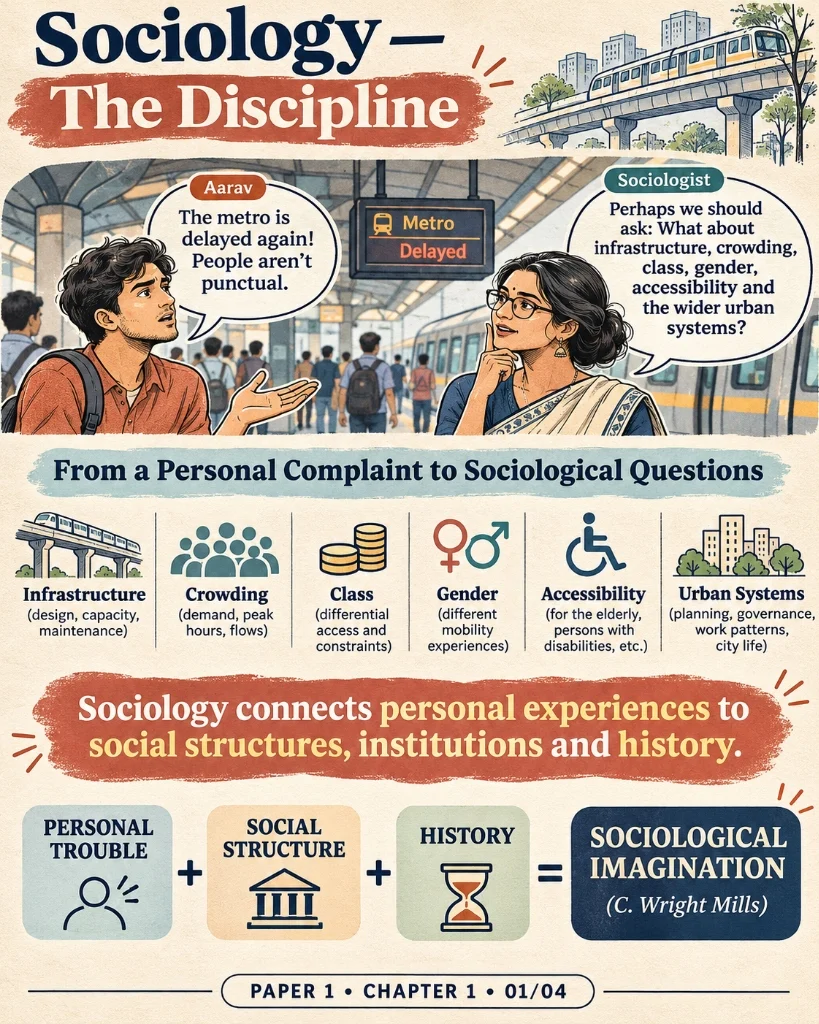 Answer Writing2 min read
UPSC Sociology Mains mein 300+ Marks Kaise Laayein: Complete Answer Framework
10-marker aur 20-marker Sociology answers ka exact structure: sociological jargon, P1-P2 interlinking, thinkers, current affairs aur visual diagrams.
Padho →- Strategy & Toppers1 min read
Sociology Optional 6-Month Roadmap: Booklist, PYQs aur Revision Plan
Zero se 300+ tak ka realistic 6-month plan: Haralambos, Ritzer, IGNOU, Nadeem Hasnain kaise padhein, aur 597 UPSC PYQs se syllabus kaise master karein.
Padho →