Sociology of Religion: Durkheim, Weber, Marx & Peter Berger’s Sacred Canopy
Religion sirf belief system nahi, social order ka engine bhi hai. NFHS-5 aur PLFS se India mein ritual, identity aur inequality ka live link dikhta hai—Durkheim, Weber, Marx, Berger se समझें.
📑 Quick Jump: Contents (4) & Syllabus Chapters
Sociology of Religion: Conceptual Puzzle aur Indian Relevance
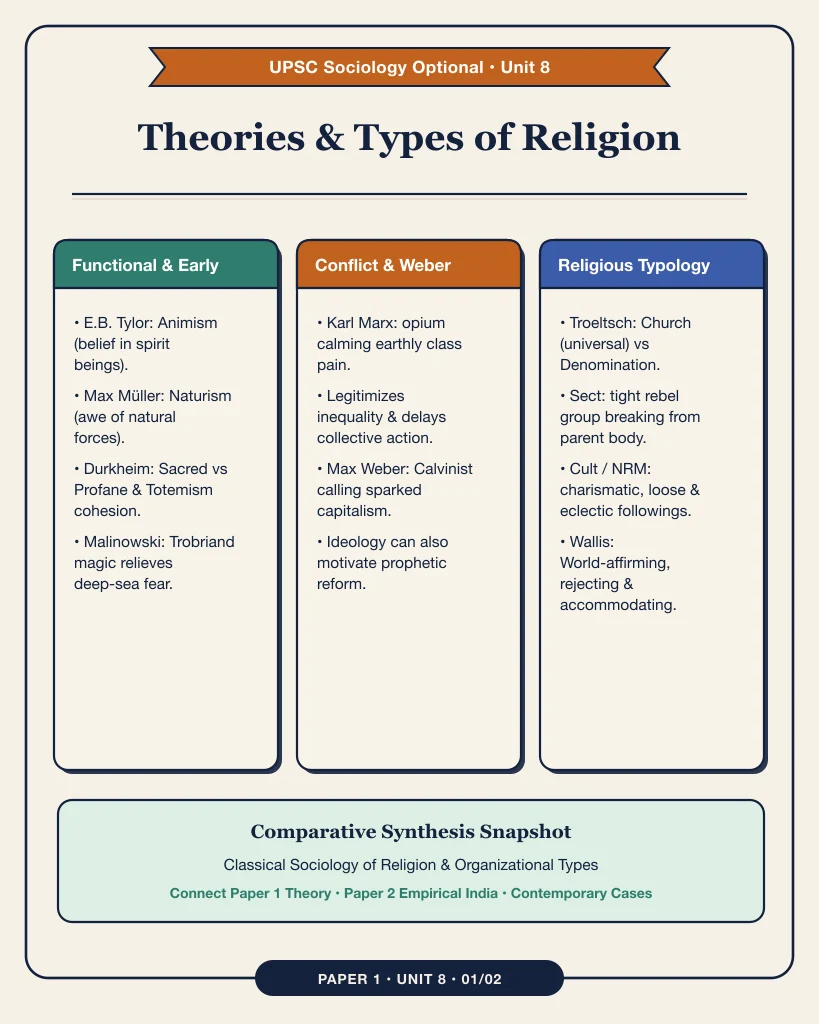
Religion ko sociology mein sirf faith ya theology ke roop mein nahi, balki ek social institution ke roop mein samjha jata hai. Yahan core puzzle yeh hai: religion ek taraf social solidarity create karta hai, moral order deta hai aur meaning generate karta hai; doosri taraf hierarchy, exclusion, gender control aur political mobilization ka instrument bhi ban sakta hai. Isi duality ko Durkheim, Weber, Marx, Malinowski aur Troeltsch ne different lenses se explain kiya.
India is puzzle ka best laboratory hai. Ek hi society mein temple economy, Sufi traditions, church networks, caste ritual, pilgrimage circuits, communal polarization, aur “spiritual but not religious” urban youth sab coexist karte hain. NFHS-5 shows ki health, nutrition aur fertility outcomes religion-caste location ke saath strongly patterned hote hain. PLFS aur NSS-style labour patterns bhi informal work, unpaid care aur ritual calendars se indirectly linked hote hain. NCRB communal crime trends, Sachar Committee ka Muslim deprivation data, aur recent Supreme Court cases on religious freedom sab indicate karte hain ki religion private sphere tak limited nahi hai.
Durkheim ke liye religion society ka symbolic mirror hai; Weber ke liye it can transform economic conduct through worldviews; Marx ke liye it may soothe suffering while legitimizing domination; Malinowski ke liye it anxiety reduction mechanism hai; aur Berger ke liye religion ek “sacred canopy” banakar reality ko meaningful aur legitimate banata hai. India mein in sab theories ko ek saath padhe bina caste-based ritual hierarchy, conversion debates, sectarian movements, reform traditions, aur digital religiosity ko samjha hi nahi ja sakta. UPSC ke liye yeh topic especially useful hai kyunki yahan theory, comparative sociology, aur Indian evidence ka synthesis likhne se high-quality, analytical answer banta hai.
Thinkers: Core Theoretical Debate
Émile Durkheim ne The Elementary Forms of Religious Life (1912) mein religion ko sacred aur profane ke distinction ke through define kiya. Uske liye religion ka real function belief truth nahi, balki social cohesion hai. Totemism ko study karke Durkheim ne argue kiya ki clan ka totem actually society ka symbolic representation hota hai. Jab community sacred object ko worship karti hai, woh indirectly apni collective conscience ko worship kar rahi hoti hai. Yahan religion ka essence ritual solidarity, collective effervescence aur moral integration hai. Durkheim ka strength yeh hai ki woh religion ko social facts ke roop mein explain karta hai; limitation yeh ki power aur conflict ko relatively underplay karta hai.
Max Weber ne The Protestant Ethic and the Spirit of Capitalism mein dikhaya ki ideas bhi economic behavior shape karte hain. Protestantism, especially Calvinist asceticism, ne “inner-worldly asceticism” ko promote kiya: worldly success ko divine calling ke sign ke roop mein dekha gaya, but pleasures aur conspicuous consumption ko discourage kiya gaya. Isliye disciplined labour, savings aur rational bookkeeping kapitalism ke cultural preconditions ban gaye. Weber ka analysis deterministic nahi hai; woh causal affinity dikhata hai, not one-way cause. India ke context mein Weber useful hai jab hum ascetic orders, missionary discipline, ya reformist religious ethics ko economic conduct se link karte hain.
Karl Marx ke liye religion “the opium of the masses” hai. Critique of Hegel’s Philosophy of Right mein religion ko real suffering ka illusory comfort kaha gaya. Marx ka point sirf mocking nahi tha; religion material misery ko reflect bhi karta hai aur legitimize bhi. Feudal, colonial aur capitalist systems mein religion ruling ideology ka part ban sakta hai, especially jab priestly authority or sacred norms exploitation ko naturalize kar dein. Par Marx ko reductionist kehna bhi easy hai; kai cases mein religion resistance language bhi deta hai.
Bronislaw Malinowski ne anxiety thesis di. Uske functionalist view mein religion uncertainty aur crisis—death, danger, fishing, illness—ke moments par psychological security deta hai. Trobriand Islanders ka classic example dikhata hai ki risky situations mein ritual intensifies. Malinowski religion ko practical coping device ke roop mein dekhta hai, na ki sirf false consciousness ya pure social glue ke roop mein.
Peter Berger ne The Sacred Canopy mein religion ko nomos-building mechanism bataya. Society ek meaningful universe banati hai jahan religion legitimacy provide karta hai. Berger ke according religion chaos ko order mein convert karta hai aur “plausibility structures” ke through faith ko socially sustain karta hai. Modernity mein pluralism canopy ko fragile banata hai, but religion persist karti hai. Berger ka lens India ke liye powerful hai kyunki multiple religions aur sects ek hi public sphere mein competing sacred canopies banate hain.
In thinkers ka contrast important hai: Durkheim solidarity pe focus karta hai, Weber meaning + economic action pe, Marx domination pe, Malinowski coping pe, aur Berger legitimacy + reality construction pe. Together, they give a complete sociology of religion.
| Aspect | Durkheim-Marx-Weber-Berger | Key Contrasts |
|---|---|---|
| Core focus | Social solidarity and collective conscience | Meaning, domination, rationalization, and legitimacy |
| Religion ka function | Sacred ritual se group integration | Weber: ethic formation; Marx: ideology; Berger: reality maintenance |
| Key text | Durkheim: The Elementary Forms of Religious Life (1912) | Weber: The Protestant Ethic; Marx: Critique of Hegel’s Philosophy of Right; Berger: The Sacred Canopy |
| Main limitation | Power and conflict ko understate karta hai | Over-broad applications; historical context specific insights |
Indian Evidence: Religion as Lived Social Structure
India mein sociology of religion ko empirical grounding dena zaroori hai. NFHS-5 repeatedly shows that fertility, nutrition, child marriage, women’s autonomy aur healthcare access me caste-religion gradients exist karte hain. Many Muslim and SC/ST households still face higher vulnerability in indicators linked to deprivation, though intra-community variation bhi kaafi hai. Yahan religion identity alone explanation nahi hai; it intersects with class, region aur gender.
Sachar Committee Report (2006) ek landmark data source hai. Isne Muslims ki underrepresentation in public employment, lower educational attainment, aur relatively poor access to credit and formal jobs document kiya. Is report se yeh samajh aata hai ki religion in India sirf belief nahi, socio-economic stratification ka axis bhi hai. NITI Aayog’s MPI poverty mapping ko state-level deprivation ke saath read karne par clear hota hai ki districts with high deprivation often overlap with marginalized religious and caste groups, especially in backward regions.
PLFS labour data se gendered and informal work patterns dikhti hain. Many women’s labour force participation remains low across communities, but religious-cultural norms, purdah, mobility restrictions aur care burdens bhi participation ko shape karte hain. Isse Weberian point milta hai: values and conduct are mutually shaping.
NCRB data communal violence, hate crime cases aur riot-related policing patterns ko trace karne ke liye use hota hai. Though numbers alone full reality capture nahi karte, they show that religion can become political conflict’s trigger. Supreme Court ke interventions—like S.R. Bommai v. Union of India on secularism and Shayara Bano on arbitrary triple talaq—dikhate hain ki state religion ko regulate bhi karti hai aur rights protect bhi.
Ethnographically, M.N. Srinivas ke studies on Sanskritization aur dominant caste ritual mobility batate hain ki religion caste hierarchy ko reproduce bhi karta hai aur negotiate bhi. Susan Bayly ne Hindu social order aur religious reform ke historical ties ko highlight kiya. T.N. Madan ne Indian secularism ke “meaning of secularism” debate mein argue kiya ki religion modern India mein disappear nahi hota; rather, it remains a powerful moral idiom. Gail Omvedt aur B.R. Ambedkar ki anti-caste perspective se pata chalta hai ki religion liberation ka medium bhi ho sakta hai, especially conversion politics mein.
Real cases: Sabarimala debate ne gender, faith aur constitutional morality ko clash mein dikhaya; Babri Masjid-Ram Janmabhoomi dispute religion, memory aur politics ke intersection ka case hai; Dargah, church, gurudwara langar jaise institutions social service aur solidarity ke hubs hain. Isliye Indian sociology of religion mein one-line verdict possible nahi: religion can reproduce inequality, but it also creates welfare, identity and collective ethics.
🔑 Sacred Canopy
Peter Berger ka concept: religion ek socially constructed meaningful order hai jo life ko legitimacy aur stability deta hai.
Critique: Limits aur Nuanced Synthesis
In theories ki sabse badi limitation yeh hai ki koi bhi single theory religion ki full complexity capture nahi karti. Durkheim religion ko too harmonious aur integrative dikhata hai; caste violence, sectarian exclusion aur gender hierarchy jaise conflict dimensions uske model mein weakly addressed hain. Marx ka “opium” metaphor powerful hai, but agar religion ko sirf ruling-class ideology maan liya jaye, toh devotional resistance, anti-caste spirituality, aur liberation theology miss ho jaati hai. Weber ideas aur ethics ki importance dikhata hai, but kuch readings mein Protestantism aur capitalism ka link overgeneralize ho sakta hai. India mein capitalist development ko religion se directly explain karna risky hai because state policy, colonialism, caste and global markets equally important hain.
Malinowski ka anxiety thesis useful hai, but religion ko mainly psychological coping device banana insufficient hai; ritual sirf fear reduction nahi, social reproduction aur power enactment bhi hai. Berger ka sacred canopy thesis modern pluralism ko well explain karta hai, but secularization aur post-secular revival ka mixed reality aur bhi complex hai. Contemporary India mein social media, algorithmic religiosity aur political messaging ne sacred canopy ko fragmented aur highly competitive bana diya hai.
Nuanced synthesis yeh hai: religion ko simultaneously meaning system, social institution, power structure, aur emotional infrastructure ke roop mein analyze karo. UPSC answer mein ek-sided claim avoid karein—na religion ko wholly emancipatory bolo, na wholly oppressive. Better formulation yeh hai ki religion can stabilize society, motivate ethical conduct, soothe uncertainty, and also legitimate inequality. Best sociology wahi hai jo context, history aur institutions ko ek saath dekhe.
Answer kaise likhein
- Durkheim ke अनुसार religion social solidarity aur collective conscience ka symbolic system hai; totemism mein clan society ko worship karta hai.
- Weber ne Protestant ethic aur inner-worldly asceticism se bataya ki religious ideas economic conduct aur rational capitalism ko shape kar sakti hain.
- Marx ke liye religion suffering ka response bhi hai aur domination ka ideology also; 'opium' phrase false comfort aur legitimation dono indicate karta hai.
- India mein religion caste, gender, communal politics aur welfare institutions se linked hai; NFHS-5, Sachar, NCRB aur case laws is link ko empirically support karte hain.
Is Blog Se Jude Syllabus Chapters
Every Unit Note + Topic-Wise PYQ Mapped (English + Hinglish)
Paper 1 (10 Units) aur Paper 2 (15 Units) — Complete structured notes, thinkers, mind maps & 597 solved PYQs ek saath.
Khud ko test karo
Is post se 3 sawal
0 / 3 attempted
1. Durkheim ke अनुसार totemism kya represent karta hai?
2. Weber ke Protestant Ethic thesis mein key idea kya hai?
3. Peter Berger ka 'Sacred Canopy' concept kis cheez par focus karta hai?
FAQ
Aksar poochhe jaane wale sawaal
- Durkheim ke liye religion ka main function kya hai?
- Religion group solidarity, collective conscience aur sacred order ko sustain karta hai; totemism uska classic example hai.
- Weber aur Marx mein basic difference kya hai?
- Weber religion ko meaning and action-shaping force maanta hai, jabki Marx religion ko ideology and domination se jodta hai.
- Berger ka Sacred Canopy India mein kaise relevant hai?
- India ke plural religious landscape mein multiple sacred canopies coexist karti hain, jo identity, legitimacy aur moral order construct karti hain.
UPSC PYQs
Is topic ke Previous Year Questions
- 2025 · P1
How do theories of Marx, Weber and Durkheim differ in understanding religion? Explain. (10 marks)
- 2024 · P1
How do religious communities contribute to the cultural diversity of India? (10 marks)
- 2024 · P1
How do you understand the phenomena of the mushrooming of sects and cults in contemporary society? Discuss the factors responsible for the trend. (10 marks)
- 2024 · P1
Discuss the concept of animism and differentiate it from naturism. (10 marks)
Roz ke Sociology notes Telegram pe paao
Daily current affairs, PYQ linkages aur direct mentorship support Telegram par.
Related
Aur padho
 Paper 1 Concepts10 min read
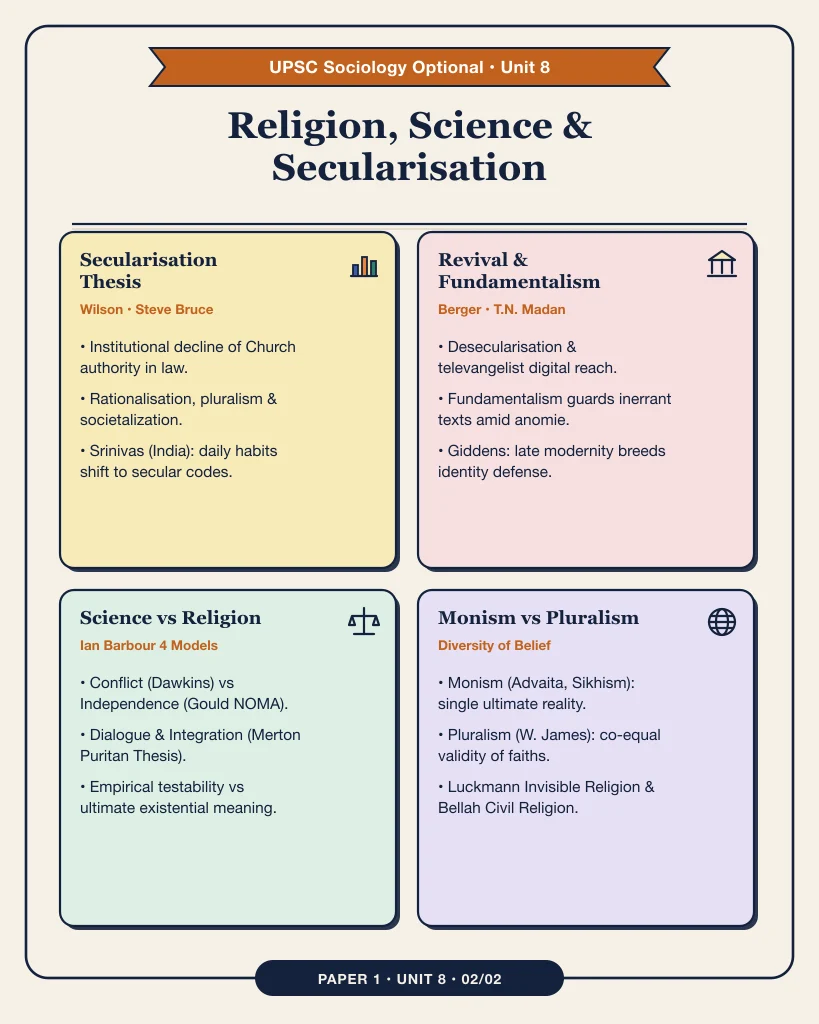
Secularization, Resurgence of Fundamentalism & Civil Religion in Modern Society
Secularization ka simple decline story India ko fully explain nahi karti. NFHS-5, PLFS aur NCRB data दिखाते हैं ki religion public life se गया nahi—rehabilitated hua. Bellah, Wilson, Casanova aur Indian critiques se is debate ko समझिए.
Padho →