Secularization, Resurgence of Fundamentalism & Civil Religion in Modern Society
Secularization ka simple decline story India ko fully explain nahi karti. NFHS-5, PLFS aur NCRB data दिखाते हैं ki religion public life se गया nahi—rehabilitated hua. Bellah, Wilson, Casanova aur Indian critiques se is debate ko समझिए.
📑 Quick Jump: Contents (4) & Syllabus Chapters
Conceptual Puzzle: Modernity ka Ant, ya Religion ka Return?
Sociology of religion me ek classic puzzle hai: kya modernity ke saath religion decline ho jata hai, ya sirf uska form बदल जाता hai? Classical secularization thesis ke mutabik industrialization, urbanization, rationalization aur scientific worldview ke saath religion ka social power kam hona chahiye. Lekin contemporary world me hum dekhte hain ki religion disappear nahi hua; balki kabhi private life me, kabhi public sphere me, aur kabhi politics me naye रूप mein return karta hai. Isliye "secularization" ko sirf religion ki death ki tarah padhna inadequate hai.
UPSC Sociology ke liye yeh topic bahut important hai kyunki yeh modernity, social change, identity politics, nationalism, state, citizenship aur communalism ko ek saath connect karta hai. India is debate ka live laboratory hai. Constitution ne India ko secular state banaya, lekin Indian society deeply religious hai. Babri Masjid demolition, cow politics, anti-conversion debates, hijab controversy, temple mobilization, aur digital-age religious polarization dikhate hain ki public sphere me religion abhi bhi powerful force hai.
Yahan do extreme traps avoid karne chahiye. Pehla, Western secularization ko universal law maan lena. Doosra, religion ko sirf irrational ya regressive assume kar lena. Reality zyada layered hai: state secular ho sakta hai, society religious reh sakti hai; religion decline bhi kar sakta hai aur re-enter bhi kar sakta hai. Jose Casanova ne isi liye kaha tha ki modernity ka matlab religion ka vanish hona nahi, balki "de-privatization" bhi ho sakta hai. Robert Bellah ne American context me "civil religion" ka idea diya, jahan national rituals, symbols aur sacred narratives religion-like public cohesion create karte hain.
Indian context me T.N. Madan aur Ashis Nandy ne Western secularism ko uncritically import karne par critique kiya. Unke liye India ki religio-cultural plurality ko samjhe bina secularism ko Eurocentric model ki tarah impose karna social reality se disconnect create karta hai. Isliye is topic ka core question hai: modern society me religion ka role khatam hua hai, ya uska social location transform hua hai? Yeh essay-type issue Paper 1 me social change, religion, modernity aur rationalization se जुड़ता hai; Paper 2 me communalism, nationalism, state policy aur Indian secularism se directly linked hai.
Thinkers: Decline Thesis se Public Religion tak
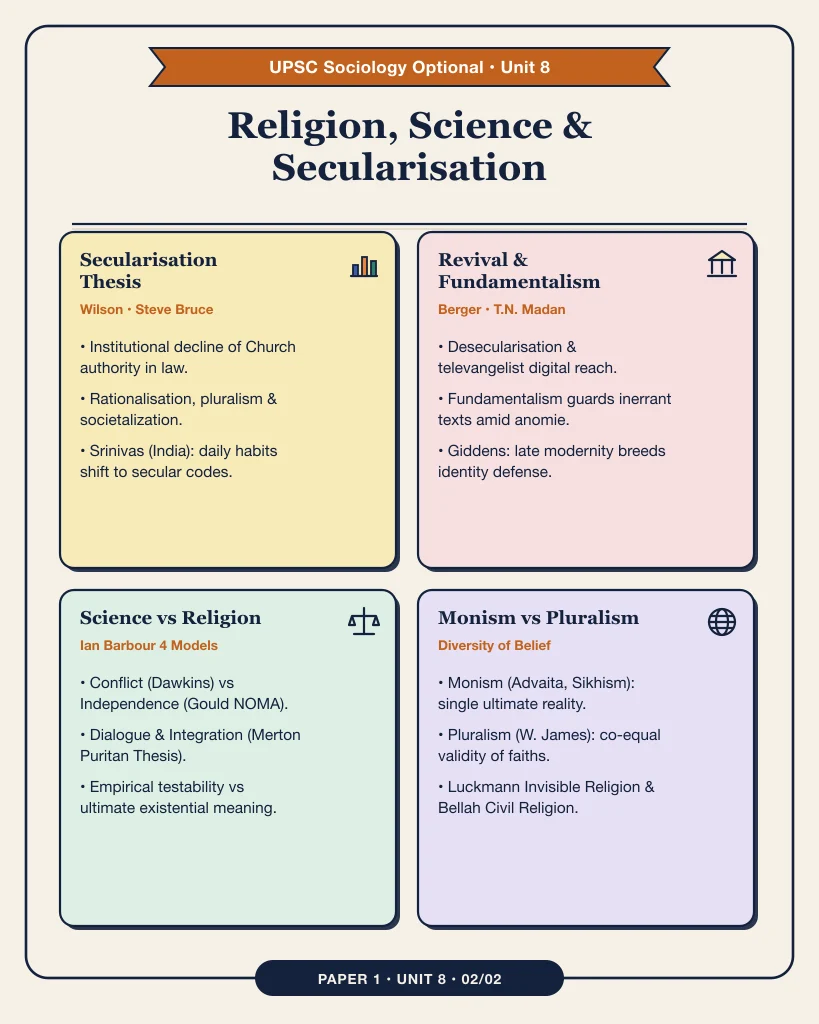
Bryan Wilson classical secularization thesis ke major proponents me se ek the. Unki works, especially Religion in Secular Society aur The Noble Savage, me argument tha ki modern industrial society me religion ka social significance decline hota hai. Wilson ke hisaab se specialization, bureaucracy aur scientific rationality religion ko social organization ke central principle se हटाकर private preference bana dete hain. Unka strength yeh tha ki unhone modern institutions ke differentiation ko clearly capture kiya. Lekin limitation yeh thi ki unhone religion ke adaptive resilience ko underplay kiya.
Peter Berger initially secularization thesis ke strong supporter the, but later unhone self-correction ki. Unki early book The Sacred Canopy me religion ko meaning-maintenance system maana gaya tha, par later he admitted that the world "as secular as predicted" nahi bani. Yeh shift important hai because it shows sociology itself is not frozen.
Jose Casanova ne Public Religions in the Modern World me decisive intervention diya. Unhone secularization ke three meanings differentiate kiye: social structural differentiation, decline of religious belief/practice, aur privatization of religion. Casanova ke अनुसार modernity structural differentiation la sakti hai, but religion ka public sphere me re-entry bhi possible hai. Poland, Latin America, aur US examples se unhone दिखाया ki religion democratic politics, human rights aur social movements me active role play kar sakta hai. Iska analytical contribution yeh hai ki "secular" aur "modern" synonymous nahi hain.
Robert N. Bellah ne Beyond Belief aur essay on "Civil Religion in America" me civil religion ka concept diya. Civil religion ka matlab state religion nahi, balki aisi shared sacred symbolism jo nation ko moral legitimacy देती hai—jaise flag, constitution, national martyrs, memorial rituals. Bellah ke liye American presidency, Thanksgiving-like rituals, aur civic oaths ek quasi-religious national order create karte hain. This concept is crucial because it shows modern nation-states ka apna sacral order hota hai even when formal theology absent ho.
T.N. Madan ne Modern Myths, Locked Minds aur Indian secularism-related writings me kaha ki secularism India me ek elite ideology ban sakti hai jo mass religious life ko properly understand nahi karti. Unka point tha ki India ki civilization me dharma, ethical life aur everyday practice deeply embedded hain, so a rigid Western separation model socially feasible nahi.
Ashis Nandy ne The Intimate Enemy aur later essays me Western secularism ko psychological-cultural critique kiya. Unke लिए secularism kabhi-kabhi religion ka neutral alternative nahi, balki another worldview ban jata hai jo power aur violence ke saath collude kar sakta hai. Nandy ka emphasis tha that true pluralism should respect lived traditions, not merely replace them with abstract state neutrality.
In thinkers ka contrast clear hai: Wilson decline dekhte hain; Casanova transformation aur public return dekhte hain; Bellah civil cohesion ka symbolic form batate hain; Madan aur Nandy India-specific critique ke through Western model ki limits dikhate hain. UPSC answer me best strategy yeh hai ki one-sided conclusion na दें—modern society me religion neither simply disappears nor remains unchanged; it gets reconfigured in public, private and national forms.
| Aspect | Secularization Thesis | Public Religion / Counter-View |
|---|---|---|
| Core claim | Modernity ke saath religion ka social power aur authority decline hoti hai. | Religion disappear nahi hota; public sphere me naye roles ke saath re-emerge karta hai. |
| Key thinker | Bryan Wilson; early Peter Berger. | Jose Casanova; Robert Bellah. |
| State-society relation | Differentiation: state, economy aur science religion se separate hote hain. | State secular ho sakta hai, par religion public morality, identity aur nationalism me active रह sakta hai. |
| Indian implication | Western-style decline thesis India ke lived religiosity ko fully explain nahi karti. | India me secularism ka meaning multicultural accommodation, not total privatization, ke रूप me समझा जा सकता hai. |
Indian Evidence: Religion ka Decline nahi, Reconfiguration
India me secularization ko simple decline ke रूप me पढ़ना empirical reality se मेल नहीं खाता. First, NFHS-5 (2019-21) ka broad social picture dikhata hai ki family formation, fertility, contraception aur women’s autonomy par religion, caste aur region ka strong influence bana hua hai. Yeh indicate karta hai ki religion direct political slogan se आगे जाकर everyday social norms ko shape karta rehta hai. Same survey me health behavior aur gender norms par community-specific differences दिखते हैं, jo show karte hain ki modern institutions ke saath traditional identities coexist karti hain.
Second, PLFS aur labour-market studies se pata chalta hai ki education aur urban employment badhne ke बावजूद social attitudes mechanically rationalize nahi hote. Many urban workers continue to rely on community networks, religious associations, and festival-based informal economies. Religion yahan belief system ke saath-साथ social capital ka source hai.
Third, NCRB data communal violence aur hate crime reports ke through religion ke public salience ko indicate karta hai. Frequent flashpoints around processions, festival routes, social media rumours, aur local disputes show karte hain ki religion merely private realm me confined nahi hai. Public order aur citizenship se directly linked hai.
Fourth, ASER findings consistently dikhate hain ki learning outcomes and schooling deficits rural India me persist karte hain. Iska sociological implication yeh hai ki scientific-rational attitudes ka spread uneven hai. Education increase se necessarily secular worldview auto-generate nahi hota; socialization, family, community aur media ka role significant rehta hai.
Fifth, Sachar Committee Report (2006) ne Muslim minority ke educational, occupational aur infrastructural deprivation ko document kiya. Yeh report religion-based identity ko merely symbolic nahi, structural disadvantage ke lens se samajhne me help karti hai. When exclusion persists, religion often becomes a marker of collective identity and mobilization.
Sixth, NITI Aayog’s Multidimensional Poverty Index (MPI) poverty and deprivation ko multidimensional terms me measure karta hai. Poverty, exclusion aur weak public services religious and caste identities ke through experienced hote hain; isliye grievance politics often moral-religious framing le leti hai.
Seventh, Xaxa Committee and tribal studies show karte hain ki adivasi societies me religion, ritual, land aur identity tightly interwoven hote hain. Conversion debates, forest rights and cultural autonomy issues indicate that secular policy cannot ignore local cosmologies.
Empirical case studies bhi important hain: Babri Masjid demolition (1992) and aftermath ne show kiya ki religion nationhood ke contestation me central hai. Ayodhya verdict (2019) institutional legal resolution tha, but social meaning-making continue rahi. Triple talaq judgment and subsequent legislation ne personal law, gender justice aur religious authority ke बीच constitutional negotiation dikhayi. Hijab controversy in Karnataka ne education, gender, autonomy aur identity politics ko spotlight kiya. These cases prove that in India religion has not vanished; it has been reassembled through law, politics, media and civil society.
Thus, Indian data suggests a more accurate formulation: secularization here is selective, uneven and contested, not a linear decline of religion. Public religion, civil religion, and communal mobilization coexist with constitutional secularism.
🔑 Civil Religion
Nation ke symbols, rituals aur founding ideals ka aisa sacred public form jo formal religion nahi hota, but collective loyalty aur moral legitimacy produce karta hai.
Critical Assessment: Decline Thesis Ki Limits
Secularization theory ki sabse badi limitation uska Eurocentric bias hai. Wilson aur early secularization theorists ne Western Europe ke historical trajectory ko universal template ki tarah treat kiya, jabki India, US, Latin America aur Middle East me religion ka social life different pattern follow karta hai. Modernity ka matlab har jagah same nahi hota. Kahin religion decline hota hai, kahin privatize hota hai, aur kahin public mobilization ka engine ban jata hai.
Doosri limitation yeh hai ki "religion" ko ek monolithic category samajh liya jata hai. In reality, religion me belief, ritual, identity, institution, ethics aur politics alag dimensions hain. Ek dimension weak ho sakta hai while another strengthen ho sakta hai. For example, attendance decline ho sakta hai, but identity politics increase ho sakti hai.
Teesri limitation yeh hai ki secularization thesis state neutrality aur social secularization ko confuse kar deti hai. State ka secular hona zaruri nahi ki society bhi secular ho. India me constitutional secularism, legal pluralism aur popular religiosity simultaneously exist karte hain.
Yahan Casanova ka corrective useful hai because he shows that modern differentiation does not require religion’s disappearance. Bellah yeh samjhate hain ki modern nation bhi sacred meanings generate karte hain. Indian theorists Madan aur Nandy reminder dete hain ki secularism ko civilizational context se cut karke impose nahi karna chahiye. However, unki critique par bhi ek caution hai: cultural sensitivity ka matlab communal politics ko normalize karna nahi hota.
Best synthesis yeh hai: modern society me religion ka role decline se zyada transformation ka hai. Religion often privatized in some domains, public in others, and politicized in still others. UPSC answer me nuanced line yeh honi chahiye: secularization is neither total disappearance of religion nor simple revival; it is a contested reconfiguration of religion under modern conditions.
Answer kaise likhein
- Secularization theory ke mutabik modernity, rationalization aur differentiation se religion ka social authority decline hota hai; Bryan Wilson is thesis ke key proponent the.
- Jose Casanova ne argue kiya ki religion modern society me public sphere se पूरी तरह disappear nahi hota; woh human rights, democracy aur identity politics me active reh sakta hai.
- Robert Bellah ka civil religion concept दिखाता hai ki nation-states bhi sacred symbols aur rituals ke through moral cohesion produce karte hain.
- India me T.N. Madan aur Ashis Nandy ne Western secularism ko context-blind aur Eurocentric bataya; empirical data aur case studies prove karte hain ki religion public life me persistent aur transformed hai.
Is Blog Se Jude Syllabus Chapters
Every Unit Note + Topic-Wise PYQ Mapped (English + Hinglish)
Paper 1 (10 Units) aur Paper 2 (15 Units) — Complete structured notes, thinkers, mind maps & 597 solved PYQs ek saath.
Khud ko test karo
Is post se 3 sawal
0 / 3 attempted
1. Jose Casanova ke according secularization ka kaunsa aspect most accurate hai?
2. Robert Bellah ka civil religion concept kis se related hai?
3. T.N. Madan aur Ashis Nandy ka central critique kya hai?
FAQ
Aksar poochhe jaane wale sawaal
- Kya secularization ka matlab religion ka complete disappearance hai?
- Nahi. Secularization ka stronger sociological meaning differentiation aur declining authority hai, not total disappearance. Casanova ke अनुसार religion public sphere me re-enter bhi kar sakta hai.
- Civil religion aur actual religion me kya difference hai?
- Actual religion deity, scripture aur formal institutions par based hota hai. Civil religion nation ke symbols, constitutional ideals aur public rituals ko sacred meaning deta hai.
- India me secularism par Madan aur Nandy ka critique kyun important hai?
- Kyuki unhone दिखाया ki Western secularism ko uncritically import karna India ki lived religiosity, plurality aur cultural history ko ignore kar deta hai.
UPSC PYQs
Is topic ke Previous Year Questions
- 2025 · P1
What is the nature of relationship between science and religion in modern society? Analyze with suitable examples. (10 marks)
- 2023 · P2
How do you account for the simultaneous spread of everyday secularization and heightened public religion in contemporary India? (20 marks)
- 2023 · P1
How do you account for the increasing significance of religion in public and personal spheres in the context of secularization thesis in India? Explain. (10 marks)
- 2022 · P2
Examine Rajeev Bhargava’s model of Indian secularism ('principled distance') alongside T.N. Madan and Ashis Nandy’s critiques. (20 marks)
Roz ke Sociology notes Telegram pe paao
Daily current affairs, PYQ linkages aur direct mentorship support Telegram par.
Related
Aur padho
- Paper 2 India9 min read
Communalism & Ethnic Conflict: Paul Brass, Ashutosh Varshney aur Bipan Chandra
Communalism aur ethnic conflict sirf “spontaneous hatred” nahi hote. Brass ke riot systems, Varshney ke civic networks, aur NFHS-5/PLFS/NCRB data se samjho ki India me violence kaise organize hota hai.
Padho → 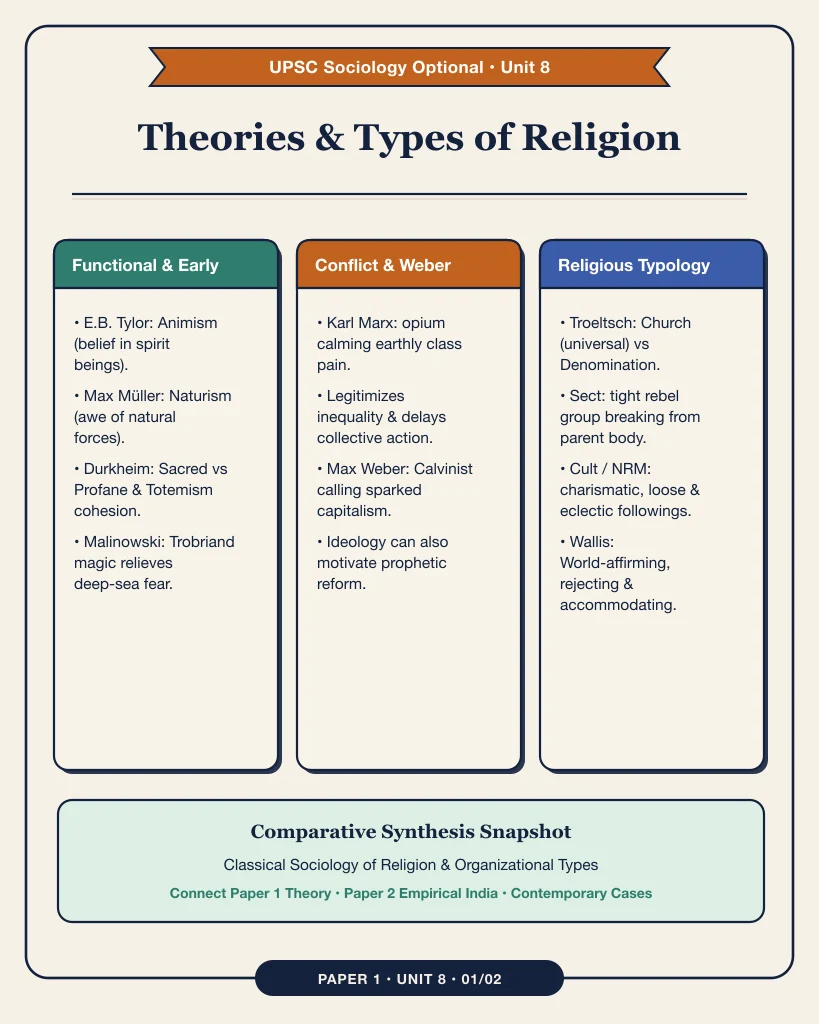 Paper 1 Concepts9 min read
Sociology of Religion: Durkheim, Weber, Marx & Peter Berger’s Sacred Canopy
Religion sirf belief system nahi, social order ka engine bhi hai. NFHS-5 aur PLFS se India mein ritual, identity aur inequality ka live link dikhta hai—Durkheim, Weber, Marx, Berger se समझें.
Padho →