Family vs Household & Kinship: A.M. Shah, Irawati Karve aur Sylvia Walby
Family aur household ek jaise nahi hote. NFHS-5 household size 4.4 dikhati hai, par India me functional jointness, chulha, commensality aur kinship zones ka logic ab bhi alive hai.
📑 Quick Jump: Contents (4) & Syllabus Chapters
Family vs Household & Kinship: conceptual puzzle
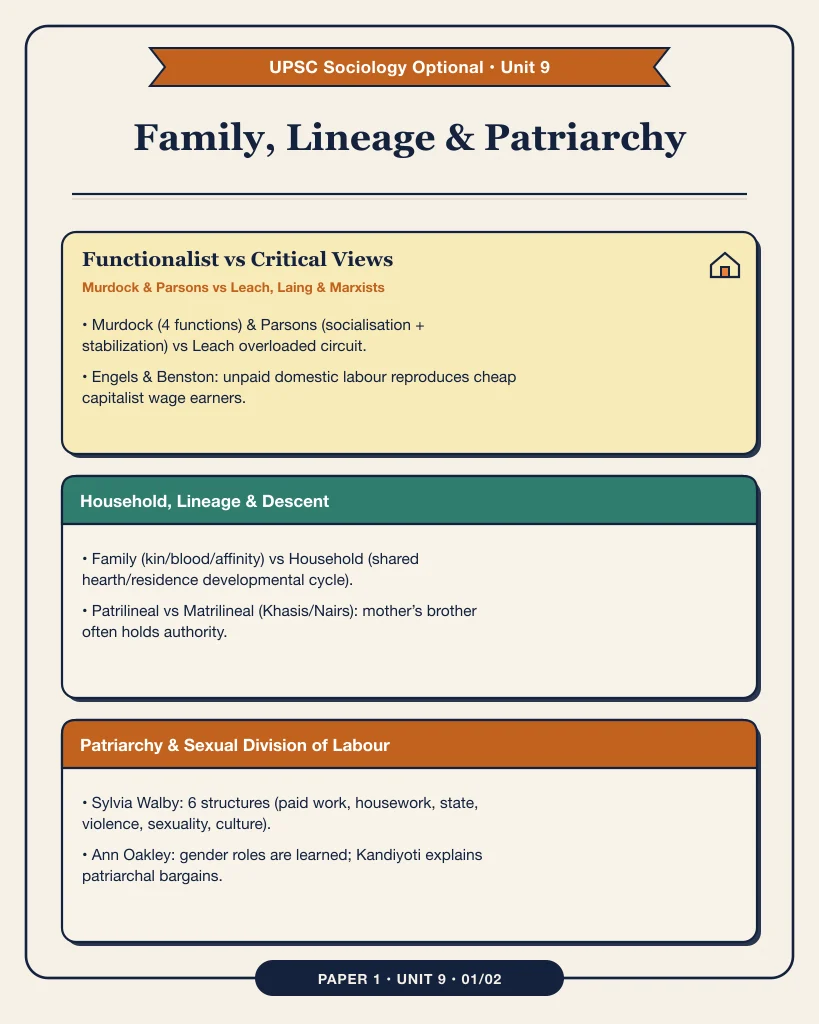
UPSC Sociology me “family” aur “household” ko same maan lena ek classic mistake hai. Family ek kinship-based social institution hai, jabki household ek residential and domestic unit hai jo logon ke ek saath rehne aur resource-sharing ko capture karta hai. India me dono overlap karte hain, but identical nahi hote. Yeh distinction tab aur important ho jata hai jab hum NFHS-5 ka data dekhte hain: average household size around 4.4 hai, jo smaller households ki direction indicate karta hai. Lekin kya iska matlab joint family khatam ho gayi? Bilkul nahi. A.M. Shah ne bataya ki Indian family ko “joint” ya “nuclear” jaisi binary se samajhna inadequate hai; reality me functional jointness, shared obligations, aur chulha/commensality ka logic kai gharon me alag form me zinda hai.
Is topic ka Indian relevance bahut high hai kyunki urbanization, migration, women’s employment, rising education, declining fertility, aur welfare-state interventions ne living arrangements ko transform kiya hai. Phir bhi caste, lineage, marriage rules, inheritance, care work, aur ritual obligations family-kinship ko strongly shape karte hain. Irawati Karve ne India ke kinship patterns ko North-South-East-Central zones me map karke dikhaya ki kinship sirf household structure nahi, balki marriage rules, descent, residence, aur taboo systems ka complex pattern hai. Dusri taraf Sylvia Walby jaise theorists se hum samajh sakte hain ki family ko patriarchal structure aur unpaid domestic labor ke lens se dekhna zaroori hai.
Isliye sociology me central question yeh hai: kya India me family “fragmented” ho rahi hai, ya sirf uska form बदल रहा hai? Kya household size ka kam hona kinship solidarity ke decline ka proof hai, ya kinship ka functional reorganization? Isi conceptual puzzle ko handle karna high-scoring Sociology answer ki jaan hai.
Thinkers, concepts aur analytical contrast
A.M. Shah is topic ke sabse important Indian sociologists me se ek hain. Unki classic books jaise The Family in India aur Family, Kinship and Marriage in India family ko rigid ideal type ki tarah nahi, balki a changing social process ki tarah dekhti hain. Shah ne “joint family” myth ko problematize kiya aur argue kiya ki India me aksar household split ho sakte hain, par kinship obligations, ritual participation, property linkages, aur emotional support maintained rehte hain. Unka key insight “functional jointness” hai: log alag housing me reh sakte hain, but same family network ke through cooperation karte hain. Yahan chulha/commensality important hai—ek saath khana banana-khana social solidarity ka powerful marker hai. Shah ke liye family ko samajhne ka matlab sirf co-residence nahi, balki everyday practices of sharing and separation ko dekhna hai.
Irawati Karve ne Kinship Organization in India me India ke kinship map ko North-South-East-Central divisions me classify kiya. Unki major contribution yeh hai ki kinship systems ko region, language, descent, marriage rules, aur residence patterns ke saath systematically analyze kiya. North India me agnatic and patrilineal emphasis strong, South me cross-cousin marriage jaise patterns, East me relatively flexible forms, aur Central India me mixed patterns milte hain. Karve ka framework exam me bahut useful hai, but isse static typology ki tarah nahi padhna chahiye. Modernization, migration, education, aur caste mobility ne in zones ko blur bhi kiya hai.
I.P. Desai ne family ko functional lens se dekha. Unka work yeh dikhata hai ki joint family ka decline ka matlab support system ka collapse nahi hota. Kinship network, remittances, elder care, ritual reciprocity, aur crisis support family ki functions ko household boundaries se bahar extend kar dete hain. Isse “household” aur “family” ka distinction aur clear hota hai.
Pauline Kolenda ne Indian family studies me empirical rigor add ki. Unhone North India me household structure, joint family claims, aur residence patterns par fieldwork-based analysis ki. Kolenda ne show kiya ki idealized joint family rhetoric aur lived realities me gap hota hai. Unka contribution useful hai kyunki yeh household-level data ko kinship ideology se connect karta hai.
Sylvia Walby ka perspective Western feminist theory se aata hai, but India ke context me bahut relevant hai. In Theorizing Patriarchy aur related works me Walby ne patriarchy ko private family ke andar hidden domination se bahar nikal kar public institutions, labor markets, state, aur culture se connect kiya. Is lens se family sirf affectionate unit nahi, balki unpaid care work, gendered control, aur women’s subordination ka site bhi hai. Shah aur Karve family/kinship structure ko samajhte hain; Walby power aur gender inequality ko foreground karti hain. Yeh contrast answer ko theoretically rich banata hai.
Overall, Shah hume form-function gap samjhate hain, Karve spatial-cultural variation, Desai and Kolenda empirical household realities, aur Walby gendered power structure. Together, yeh “family vs household & kinship” ko multidimensional issue banate hain.
| Aspect | Family | Household |
|---|---|---|
| Core basis | Kinship, marriage, descent, ritual ties | Co-residence and domestic unit |
| Key indicator | Relationships and obligations | Shared residence, meals, resources |
| Change in India | Functional continuity despite spatial separation | Average size shrinking; living arrangements diversifying |
| Analytical focus | A.M. Shah, Karve, Desai | Census/NFHS and domestic arrangement studies |
Indian data aur empirical evidence
India me family-household debate ko sirf theory se nahi, data se bhi dekha jana chahiye. NFHS-5 ke according average household size around 4.4 hai, jo smaller households aur demographic transition ki direction batata hai. Iska matlab yeh nahi ki kinship khatam ho gaya; balki living arrangements me fragmentation, migration-linked separation, aur nuclear residence ka rise hua hai. Urban India me rent constraints, job mobility, aur education-driven individualization household size ko reduce karte hain.
PLFS patterns se bhi household livelihoods par pressure dikhta hai: labour market precarity, informal employment, aur women’s unpaid care burden family strategies ko reshape karte hain. Jab household income volatile hoti hai, tab kinship support networks—cash transfers, childcare, eldercare, and migration support—aur important ho jate hain.
NCRB data domestic violence aur dowry-related crimes ke through family ko idealized harmony ke bajay conflict arena ke roop me dikhata hai. Isse Sylvia Walby ka patriarchal analysis Indian context me relevant hota hai. Family sirf solidarity ka site nahi, control aur violence ka bhi site hai.
ASER findings schooling aur children’s domestic responsibilities ke intersection ko highlight karte hain. Rural households me sibling care, elder support, aur seasonal labor participation family organization ko influence karte hain. Household size chhota hone par bhi inter-household kinship duties continue reh sakti hain.
Ethnographic studies me A.M. Shah, Pauline Kolenda, aur I.P. Desai ne dikhaya ki many Indian families me adult sons alag residence me shift ho sakte hain, phir bhi property, ritual visits, festivals, and emergency support ke through jointness remain karti hai. Yeh “split residence, shared kinship” ka pattern hai.
Xaxa Committee report ne tribal communities me kinship, land, aur community support systems ke distinct forms ko emphasize kiya—yahan family aur household ka relation non-brahmanical aur non-urban contexts me different hota hai.
Sachar Committee ne Muslim households me education, employment aur urban segregation ke pressures ko highlight kiya, jo family strategies aur residential clustering ko affect karte hain.
NITI MPI poverty deprivation ke context me household ko welfare delivery unit ke roop me position karta hai. But sociologically, household ko family se equal nahi maana ja sakta, because deprivation and care are mediated by kinship, gender, and caste.
Finally, Oxfam aur women’s labor reports, plus Indian women’s labor studies, yeh dikhate hain ki unpaid care work largely households ke andar women par shift hota hai. Thus, family-household debate me gender, class, migration, and state policy sabko integrate karna zaroori hai.
🔑 Functional jointness
Jab family members alag households me rehkar bhi economic, ritual, emotional aur care-related support ko continue rakhte hain.
Critique aur nuanced synthesis
Is debate ki sabse badi limitation yeh hai ki “joint” aur “nuclear” ko binary opposition bana diya jata hai. A.M. Shah ne is binary ko challenge kiya, lekin aspirants kabhi-kabhi unhe sirf joint family ke defender ki tarah present kar dete hain. Actually Shah ka contribution yeh hai ki family ko dynamic network ke roop me samjha jaye.
Dusri limitation Karve ka zonal model hai. North-South-East-Central typology extremely useful hai, but it can over-generalize regional cultures. Internal diversity—caste, class, tribe, religion, and migration—ko ignore karne se kinship zones static lagne lagte hain. Aaj metropolitan India, inter-caste marriages, inter-state migration, and digital communication ne kinship ko territorial boundaries se kaafi had tak detach kar diya hai.
Sylvia Walby ka patriarchal lens powerful hai, but agar usse mechanically apply kiya jaye to Indian kinship ke gift, ritual, and reciprocity dimensions underplayed ho sakte hain. India me family sirf oppression ka site nahi; yeh welfare, identity, and emotional security ka bhi site hai. Isliye gender inequality ko deny kiye bina kinship solidarity ko bhi recognize karna chahiye.
A balanced synthesis yeh hogi: family and household overlap karte hain, but analytically distinct hain; kinship structures household boundaries ko exceed karti hain; aur Indian family change ka story decline ka nahi, transformation ka hai. Small households, functional jointness, gendered labor, and regional kinship variation—sab ek saath exist karte hain. High-scoring answer wahi hoga jo data, theory, aur lived realities ko integrate kare, na ki sirf “joint family is dying” jaisa simplistic conclusion de.
Answer kaise likhein
- A.M. Shah ke according Indian family ko joint/nuclear binary se nahi, functional jointness aur commensality se samjho.
- Irawati Karve ki kinship zones North-South-East-Central regional variation explain karti hain, but aaj internal diversity bhi note karo.
- NFHS-5 ka average household size 4.4 small households ka signal hai, par kinship obligations aur support networks continue hain.
- Sylvia Walby se gendered power aur unpaid care work analyze karo; family sirf solidarity nahi, patriarchy ka site bhi hai.
Is Blog Se Jude Syllabus Chapters
Every Unit Note + Topic-Wise PYQ Mapped (English + Hinglish)
Paper 1 (10 Units) aur Paper 2 (15 Units) — Complete structured notes, thinkers, mind maps & 597 solved PYQs ek saath.
Khud ko test karo
Is post se 3 sawal
0 / 3 attempted
1. A.M. Shah kis concept ke liye sabse zyada known hain?
2. Irawati Karve ka famous work kaunsa hai?
3. NFHS-5 ka average household size lagbhag kitna report hota hai?
FAQ
Aksar poochhe jaane wale sawaal
- Family aur household me basic difference kya hai?
- Family kinship-based unit hai; household co-residence aur domestic arrangement ko denote karta hai. Dono overlap karte hain but same nahi hote.
- A.M. Shah ka main contribution kya hai?
- Unhone joint family myth ko challenge karke functional jointness, commensality aur lived kinship practices ko central banaya.
- Karve ki kinship zones aaj bhi relevant hain?
- Haan, as a heuristic framework. Lekin unhe static map ki tarah nahi, changing and internally diverse regions ki tarah read karna chahiye.
UPSC PYQs
Is topic ke Previous Year Questions
- 2025 · P1
What is kinship? Briefly explain G. P. Murdock's contribution to the study of the kinship system. (10 marks)
- 2024 · P2
Do you think that family bondings are being affected by the changing kinship patterns in India? Comment. (10 marks)
- 2024 · P1
What are the ‘basic and irreducible ’functions of the family as proposed by Talcott Parsons? Explain. (10 marks)
- 2023 · P1
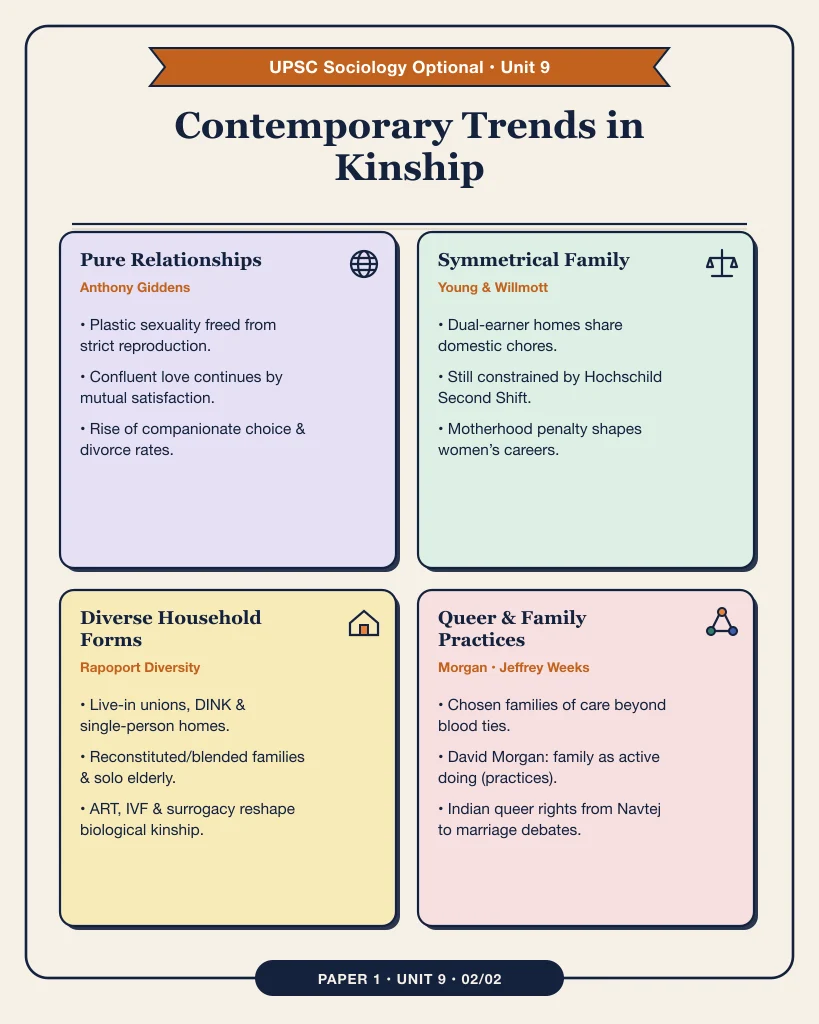
Analyze critically David Morgan’s views on family practices. 2023 10. How do you assess the changing patterns in kinship relations in societies today? (10 marks)
Roz ke Sociology notes Telegram pe paao
Daily current affairs, PYQ linkages aur direct mentorship support Telegram par.
Related
Aur padho
 Current Affairs Link8 min read
Live-in Relationships, Supriyo Verdict & Post-Modern Kinship Shifts in India
Live-in relationships aur Supriyo verdict ne India me kinship, marriage aur autonomy ka debate teekha kiya hai. NFHS-5, PLFS aur SC rulings dikhati hain ki family ab sirf tradition nahi, negotiation bhi hai.
Padho →