Taylorism, Fordism & Harry Braverman’s Deskilling in the AI & Platform Era
Taylorism se AI-era tak control ka evolution: Indian IT layoffs, call-centre algorithms aur gig work mein new deskilling. NFHS-5, PLFS aur NCRB dikhate hain job insecurity aur rising precarity.
📑 Quick Jump: Contents (4) & Syllabus Chapters
Taylorism, Fordism aur AI-era mein deskilling ka puzzle
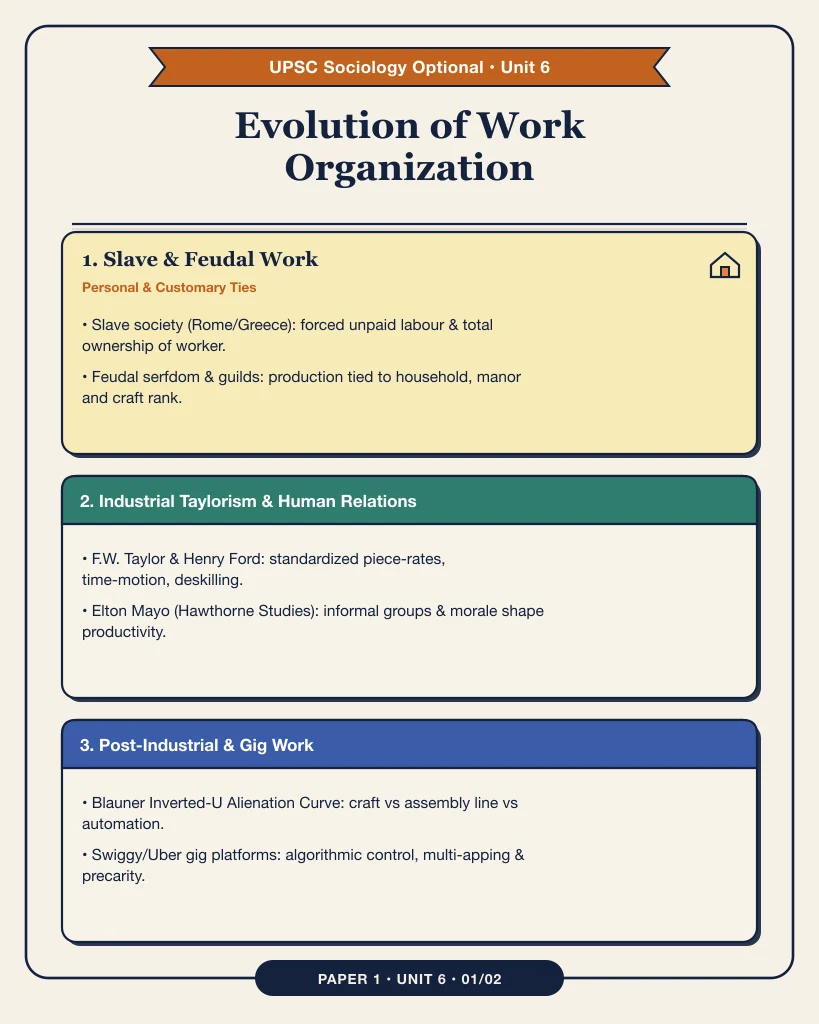
Industrial sociology ka core sawal yeh hai: kya technology worker ko free karti hai ya usse aur tightly control karti hai? F.W. Taylor ki Scientific Management ne production ko time-motion studies, task fragmentation aur managerial control ke through rationalize kiya. Fordism ne assembly line aur mass production se standardization ko aur deep kar diya. Aaj AI, cloud platforms aur algorithmic management ne yahi logic digital form mein repackage kar diya hai. UPSC Sociology Optional ke liye yeh topic isliye crucial hai kyunki yeh work, control, labour process, alienation aur inequality ko ek hi frame mein connect karta hai.
India mein yeh debate sirf factory floor tak limited nahi hai. IT sector layoffs, BPO/call centre scripting, gig workers ke app-based surveillance, aur warehouse/logistics mein KPI-driven monitoring dikhate hain ki deskilling ab software-led ho gaya hai. Ek side skilled labour ka myth hai—coder, analyst, customer support executive, delivery partner—aur doosri side standardized workflows, auto-generated scripts aur productivity dashboards. Isse labour process pe managerial control strong hota hai aur worker ka autonomy weak.
Sociological perspective se dekhें to yeh koi simple technological progress story nahi hai. Braverman ne dikhaya tha ki monopoly capitalism mein management ka aim labour knowledge ko separate karke worker ko replaceable banana hota hai. Ritzer ne McDonaldization se efficiency, calculability, predictability aur control ko modern institutions ka logic bataya. Zuboff ne surveillance capitalism mein data extraction aur behavioural prediction ko naya profit model kaha. Indian context mein yeh transition especially relevant hai because formal jobs kam, informal work zyada, aur digital platforms rapidly expanding hain. Agar India’s employment structure, rising precarity aur inequality ko samajhna hai, to Taylorism se AI-era tak ki continuity samajhna zaroori hai.
Key Thinkers: From Scientific Management to Surveillance Capitalism
F.W. Taylor is the starting point. In The Principles of Scientific Management (1911), he argued that every task can be broken into smallest measurable units, timed, standardized and supervised by managers. Sociology mein Taylorism ka importance yeh hai ki it replaces worker discretion with managerial expertise. Iska result partial work, repetitive motions and loss of craft autonomy hota hai. Taylor ka model early industrial factories ke liye bana tha, but its logic survives today in digital task decomposition.
Harry Braverman is the most important critique. In Labor and Monopoly Capital (1974), he argued that monopoly capitalism systematically degrades work through deskilling. Management separates conception from execution, so knowledge shifts from worker to planner, engineer or software system. Braverman ke liye automation ka paradox yeh hai ki machines worker ko free nahi karti; instead, they often intensify control and standardization. Indian IT layoffs, process automation and AI-based ticket resolution Bravermanian deskilling ko reframe karte hain.
George Ritzer’s The McDonaldization of Society (1993) expands Weberian rationalization. He says modern life is shaped by four principles: efficiency, calculability, predictability and control. McDonaldization sirf fast food tak nahi; universities, hospitals, call centres and e-commerce platforms sab is logic se run hote hain. Indian BPOs mein scripts, average handling time and quality scores are classic examples. Ritzer yeh dikhata hai ki rational systems often produce irrational consequences—stress, burnout and dehumanization.
Shoshana Zuboff in The Age of Surveillance Capitalism (2019) adds a new dimension. She argues that corporations don’t just sell services; they extract behavioural data, predict actions and shape choices. Algorithmic management mein worker behaviour continuously tracked hota hai—location, response time, idle time, customer rating. This is not mere surveillance; it is economic extraction through prediction. Platform labour like Swiggy, Zomato, Uber and Amazon delivery embodies this mode.
Michel Foucault ko bhi background mein rakhna useful hai. Discipline and Punish mein he shows how modern power works through surveillance and self-discipline. AI-era workspaces mein dashboards, biometric attendance and performance heatmaps workers ko internalize karne par majboor karte hain. Braverman stresses labour process degradation, Ritzer highlights rationalized systems, and Zuboff focuses on data-driven control. Together, they show that the AI era is not post-work freedom but a new regime of managed labour, where deskilling and surveillance often travel together.
| Aspect | Classical Industrial Control | AI & Platform-Era Control |
|---|---|---|
| Main logic | Time-motion optimization and task standardization | Data-driven automation, prediction and algorithmic assignment |
| Worker role | Manual executor of fragmented tasks | Monitored user/worker following app prompts and scripts |
| Control mechanism | Foreman supervision and factory discipline | Dashboards, ratings, nudges, AI QA and real-time tracking |
| Outcome | Deskilling, alienation and wage discipline | Precarity, surveillance, burnout and flexible insecurity |
Indian Evidence: IT layoffs, platform work aur precarity
Indian context mein deskilling aur control ko samajhne ke liye labour market data aur sector-specific evidence dono useful hain. PLFS (Periodic Labour Force Survey) repeatedly show karta hai ki India ka workforce largely informal hai, aur stable wage employment limited hai. Even among educated youth, underemployment aur mismatch common hai. Yeh structural condition AI-era deskilling ko aur sharper banati hai because many workers are pushed into flexible but insecure service jobs.
NCRB data aur cyber/identity related complaints ka rise indirectly show karta hai ki digital systems ke through monitoring aur data abuse concern badh raha hai. Platform workers ke liye exact national count abhi fragmented hai, but multiple policy reports indicate rapid expansion in gig and platform economy. NITI Aayog’s report on gig and platform economy (2022) estimates large future growth in this sector, while also flagging weak social security and algorithmic asymmetry.
Call centre and BPO ethnographies India mein highly relevant hain. Scholars have documented how agents are trained to adopt accent neutralization, scripted empathy and metric-based performance. This is classic Braverman-style labour control where “soft skills” appear human but are actually standardized. Similarly, IT services mein layoffs and automation have exposed the fragility of supposedly knowledge-intensive jobs. When firms use AI for code assistance, ticket routing or customer support triage, many mid-level tasks get compressed, making workers more replaceable.
Case studies are important. Infosys, TCS and Wipro have periodically reorganized teams around productivity metrics and automation-led restructuring, reflecting a shift from project-based craft to standardized delivery. In logistics and food delivery, Swiggy and Zomato riders face incentive-based control, surge-time pressure and app surveillance. Amazon warehouse and delivery operations globally have become symbols of algorithmic management; Indian logistics ecosystems increasingly mirror this model.
For social inequality, Oxfam-style inequality reports repeatedly show concentration of wealth and insecurity among workers. While these are not government statistics, they are useful for framing the power imbalance between capital and labour. Xaxa Committee and Sachar Committee are also relevant indirectly because marginalized communities are overrepresented in precarious and low-control work. NITI MPI can help connect digital insecurity with multidimensional deprivation. A strong sociology answer should therefore show that AI and platforms do not abolish Taylorism; they digitize it, extending control into new sectors of Indian labour.
🔑 Deskilling
The process by which complex worker knowledge is broken into simpler, routinized tasks so management or machines can control production more easily.
Critique: Har technocratic change deskilling nahi hota
Braverman ka thesis powerful hai, but it is not universally sufficient. Critics argue that all technology does not necessarily degrade work; sometimes it creates reskilling, new autonomy and higher cognitive demands. Skilled software engineers, data scientists and AI trainers may gain new forms of expertise, even if many others face standardization. So a blanket claim that AI always deskills would be too deterministic.
Another limitation is that Braverman underplays worker resistance and negotiation. Labour process is not one-way domination only. Workers use informal networks, unionization, strategic slowdown and digital literacy to resist control. In platform work, riders sometimes game the algorithm, switch apps, or coordinate through WhatsApp groups. This shows agency within constraint.
Ritzer’s McDonaldization also has limits. Not all rationalization is negative; in public services, standardization can improve access, transparency and reliability. The issue is not efficiency itself but when efficiency becomes the sole metric and replaces humane judgment.
Zuboff, too, is useful but sometimes overextends the concept of surveillance capitalism across all digital life. In India, one must distinguish between state surveillance, corporate data extraction and everyday convenience. Aadhaar-enabled systems, biometric attendance and app monitoring may overlap, but their institutional logics differ.
A nuanced synthesis for UPSC is that AI-era work combines Taylorist fragmentation, Bravermanian deskilling, Ritzer’s rationalization and Zuboff’s surveillance, but these processes are uneven. Some jobs are upgraded, many are degraded, and most are polarized. The best answer therefore avoids technological determinism and instead treats AI as a social relation shaped by class, capital, state policy and labour bargaining power.
Answer kaise likhein
- Define Taylorism as scientific management: task fragmentation, time-motion study and managerial control over labour process.
- Use Braverman to explain deskilling: separation of conception from execution; automation often strengthens capital’s control over labour.
- Apply Ritzer and Zuboff to Indian digital work: McDonaldized call centres and surveillance-driven platform labour show new forms of standardization and data extraction.
- Link with India-specific evidence: PLFS informality, NITI Aayog gig economy report, IT layoffs, BPO ethnographies and app-based delivery precarity.
Is Blog Se Jude Syllabus Chapters
Every Unit Note + Topic-Wise PYQ Mapped (English + Hinglish)
Paper 1 (10 Units) aur Paper 2 (15 Units) — Complete structured notes, thinkers, mind maps & 597 solved PYQs ek saath.
Khud ko test karo
Is post se 3 sawal
0 / 3 attempted
1. Who wrote *Labor and Monopoly Capital*?
2. Which concept is most closely associated with efficiency, calculability, predictability and control?
3. Algorithmic monitoring of workers in apps and platforms is best linked to which thinker?
FAQ
Aksar poochhe jaane wale sawaal
- Taylorism aur Fordism mein basic difference kya hai?
- Taylorism task-level scientific management hai, jabki Fordism assembly line, mass production aur standardized goods par based industrial system hai.
- Braverman ka central argument kya tha?
- Braverman ne kaha ki monopoly capitalism work ko deskill karta hai aur worker se knowledge छीनकर management aur machines ko transfer karta hai.
- Platform work ko sociologically kaise dekhna chahiye?
- Platform work ko flexible employment ke saath algorithmic surveillance, rating-based discipline aur insecure labour relation ke रूप mein dekhna chahiye.
UPSC PYQs
Is topic ke Previous Year Questions
- 2025 · P1
What are the major problems faced by the labour migrants while working in informal sectors of Indian States? Discuss. (10 marks)
- 2024 · P1
Describe the differing principles of work organization in feudal and capitalist societies. (10 marks)
- 2024 · P1
Critically assess the impact of technological advancement and automation on the nature of work and employment. (10 marks)
- 2024 · P1
Define the concept of 'gig' economy and discuss its impact on labour market and workers' social security net. (10 marks)
Roz ke Sociology notes Telegram pe paao
Daily current affairs, PYQ linkages aur direct mentorship support Telegram par.
Related
Aur padho
 Thinkers2 min read
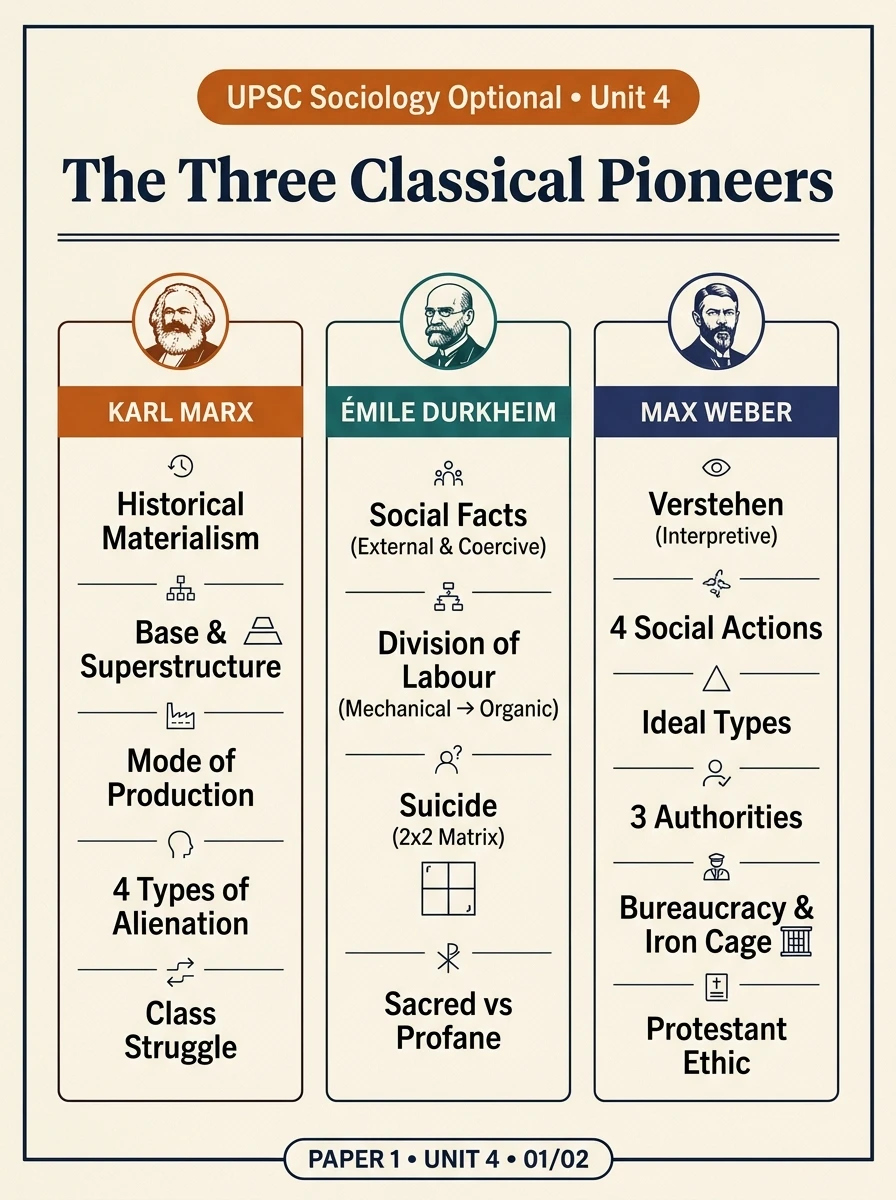
Karl Marx ki Alienation Theory aur Aaj ki Gig Economy (Paper 1 + 2)
Zomato-Swiggy gig workers aur IT burnout par Karl Marx ke 4 types of alienation aur commodity fetishism ko kaise apply karein — UPSC Mains guide.
Padho →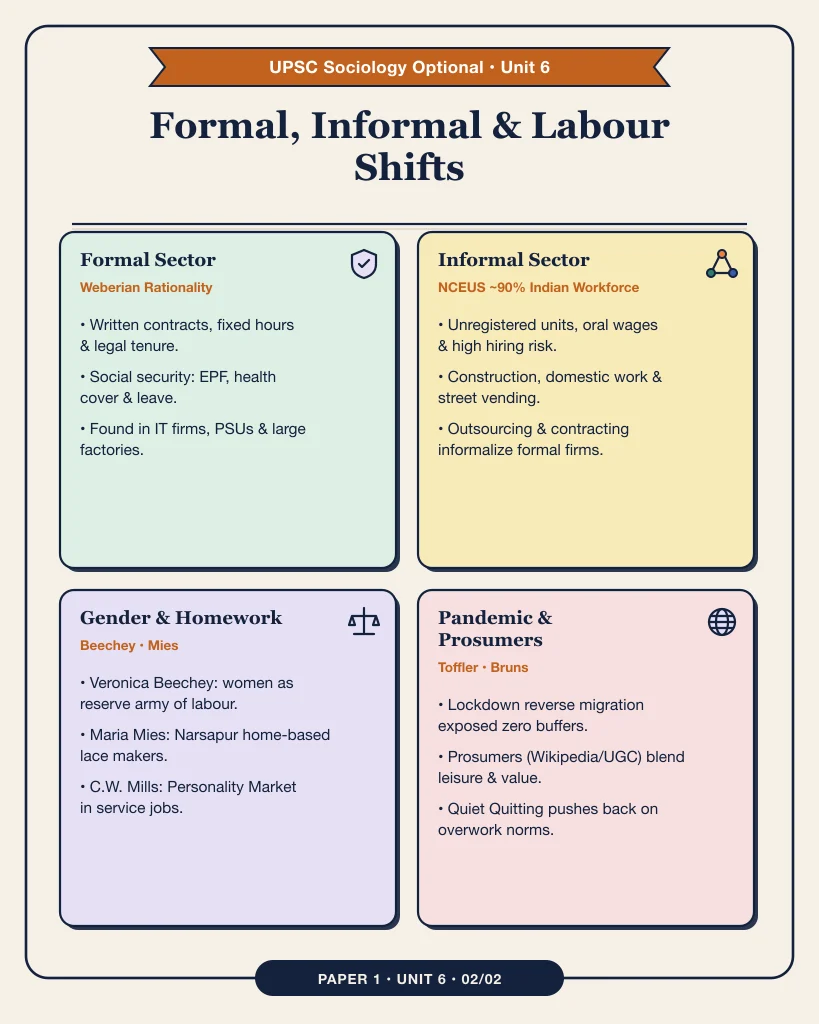 Paper 1 Concepts9 min read
Formal vs Informal Work: Keith Hart, Jan Breman & India’s 90% Informal Labour
India ka labour market paradox: 90%+ workers informal hain, par gig/platform work “new age” lagta hai. Keith Hart, Jan Breman aur Guy Standing ke lens se understand karo ki informality ka future kya hai.
Padho →