How to Use Western & Indian Thinkers Together in UPSC Sociology Paper 2
Western theory ko India par mechanically apply mat karo. Marx-A.R. Desai, Weber-Beteille, Durkheim-Srinivas bridge karke agrarian class, caste-status-power aur religion ke Indian case studies ko data-backed way me answer karo.
📑 Quick Jump: Contents (4) & Syllabus Chapters
Why UPSC loves the bridge between Western and Indian thinkers
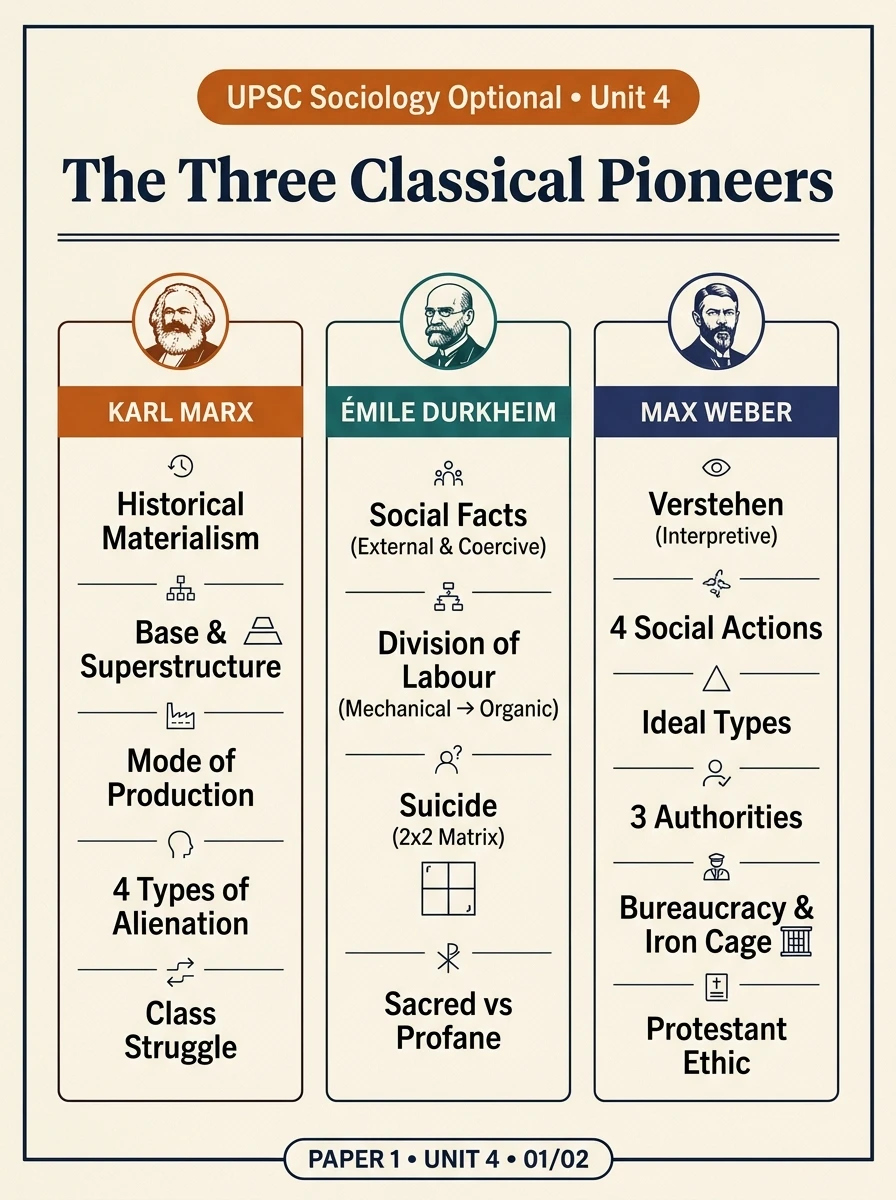
UPSC Sociology me sabse bada conceptual puzzle yeh hai ki Western theories ko India par blindly apply kaise na kiya jaye, aur phir bhi unhe useful kaise banaya jaye. Paper 2 ka real demand hai: theory ko India-specific empirical reality se connect karna. Isi liye best answers woh hote hain jahan aap Marx ko A.R. Desai ke through agrarian relations me, Weber ko Andre Beteille ke through caste-status-power me, Durkheim ko M.N. Srinivas ke through religion aur social cohesion me, aur Merton ko Srinivas ke Sanskritization-as-reference group framework me bridge karte ho.
Yeh bridge technique sirf stylistic nahi, analytical strategy hai. Western thinkers broad abstraction dete hain—class conflict, social action, authority, solidarity, reference groups. Indian thinkers unhe native field realities ke saath re-interpret karte hain—land relations, jajmani remnants, caste hierarchy, village studies, ritual mobility, peasant movements, aur everyday social change. UPSC is approach ko reward karta hai kyunki isse aap dikhate ho ki sociology is not a bookish import, but a comparative, context-sensitive discipline.
Indian society ki complexity yeh hai ki class aur caste aksar overlap karte hain, religion both integrative and divisive role play karta hai, aur modernity linear nahi balki layered hai. NFHS-5 me fertility decline aur women’s health gaps dikhte hain; PLFS me employment informality; NCRB me social violence; ASER me learning deficits—yeh sab data batate hain ki social structure abhi bhi unequal hai. Isliye theory + Indian evidence ka combination paper 2 me high-scoring tool hai.
Agar aap answer me simple contrast nahi, balki synthesis likhte ho—"Marx explains exploitation, Desai Indian agrarian class formation, Weber explains stratification, Beteille Indian caste as status hierarchy, Durkheim explains function of religion, Srinivas shows lived religion and mobility"—to aapki presentation mature lagti hai. UPSC ko exactly yahi depth chahiye: comparative, Indianized, and empirically grounded sociology.
Thinkers ko kaise combine karein: bridge, not replacement
Sabse pehle, Marx aur A.R. Desai ko agrarian class analysis me pair karo. Marx ne class ko means of production ke relation se define kiya; exploitation, surplus value, aur class struggle unki core ideas hain, as seen in The Communist Manifesto and Capital. A.R. Desai ne Social Background of Indian Nationalism aur agrarian writings me dikhaya ki India me class formation colonialism, land relations, tenancy, and peasant resistance se shape hoti hai. Marx se aap structural conflict samajhte ho; Desai us conflict ko Indian countryside, zamindari remnants, commercialization, and peasant politics me localize karte hain.
Second pair: Weber and Andre Beteille. Weber ki Economy and Society aur Class, Status, Party me stratification ko sirf class tak limit nahi kiya gaya; status honour aur power ko separate dimensions maana gaya. Beteille ne Caste, Class and Power me yahi framework India par apply kiya aur dikhaya ki caste ek closed status order hai, lekin modern democracy me class aur power ke saath its intersections badhte hain. Yahan Weber aapko conceptual clarity deta hai; Beteille empirical precision. UPSC me caste ko sirf ritual ranking bolna incomplete hai, kyunki local politics, education, occupation, and state power bhi matter karte hain.
Third pair: Durkheim and M.N. Srinivas. Durkheim ne The Elementary Forms of the Religious Life me religion ko social solidarity, collective conscience, aur sacred-profane distinction se samjha. Srinivas ne village studies me religion ko living social practice ke रूप me dekha—ritual, purity-pollution, and everyday hierarchy ke saath. Durkheim broad function batate hain; Srinivas Indian context me religion ko caste order, mobility, and local community ke through re-read karte hain.
Fourth pair: Merton and Srinivas on Sanskritization. Robert K. Merton ne Social Theory and Social Structure me reference group theory diya—individuals apni aspirations ko kisi valued group ke against evaluate karte hain. Srinivas ne Religion and Society among the Coorgs of South India aur later village studies me Sanskritization ko upward mobility process ke रूप me frame kiya, jahan lower castes higher caste practices adopt karke status improve karne ki koshish karti hain. Merton aapko aspiration and comparison ka mechanism deta hai; Srinivas us mechanism ko Indian caste mobility me concrete karta hai.
Exam language me yeh likho: Western thinkers provide universal conceptual lenses, while Indian thinkers provide contextual reinterpretation. Dono ko alag-alag nahi, tandem me use karna hi sociology ka scholarly method hai. A.R. Desai and Beteille are especially useful because they demonstrate that Indian society cannot be reduced to either pure class or pure caste. Likewise, Srinivas shows that religion is neither only functional integration nor mere ideology; it is also a field of mobility, dominance, and negotiation. Isliye best answer me aap theory ko “apply” nahi, “translate” karte ho.
| Aspect | Western Thinker | Indian Thinker |
|---|---|---|
| Agrarian change | Marx: class conflict, exploitation, surplus appropriation | A.R. Desai: colonial land relations, peasant movements, Indian agrarian class structure |
| Stratification | Weber: class, status, party as distinct but linked dimensions | Andre Beteille: caste-status-power overlap in India |
| Religion and solidarity | Durkheim: religion creates collective conscience and social cohesion | M.N. Srinivas: religion as lived ritual order tied to caste hierarchy and mobility |
| Mobility mechanism | Merton: reference group shapes aspiration and evaluation | Srinivas: Sanskritization as concrete upward status strategy |
Indian data aur field evidence se theory ko solid banao
UPSC answers me only theory likhna weak padta hai; Indian data aur field evidence se aapka argument credible banta hai. Marx-Desai link ke liye agrarian inequality aur land concentration ko use karo. Land records-based discussions, agrarian distress, aur peasant protests show karte hain ki class relations abhi bhi rural India me alive hain. Farmers’ distress, indebtedness, and informal tenancy patterns are repeatedly discussed in parliamentary debates and policy reviews, while peasant mobilization in regions like Telangana, Tebhaga, and Naxalbari can be cited as classic historical evidence of class conflict. A.R. Desai’s own work on peasant movements gives a strong Indian historical grounding.
Weber-Beteille linkage ke liye caste, education, and political power ko connect karo. NFHS-5 aur PLFS ye dikhate hain ki social hierarchy ab bhi life chances ko shape karti hai: health access, women’s nutrition, schooling completion, and labour market outcomes vary sharply by social group and region. Beteille’s Caste, Class and Power ko use karke explain karo ki caste ab sirf ritual ranking nahi, balki resource access aur local power structure ka issue bhi hai. Decadal Census data absence ke baad scholars NFHS, PLFS, and NSS-type datasets se inequality infer karte hain. Rajasthan, Bihar, UP, and central India me village-level studies often show that caste status and political influence move together, especially in local panchayat politics.
Durkheim-Srinivas ko religion and social integration ke empirical evidence se support karo. Temple entry movements, anti-untouchability reforms, and everyday ritual life show that religion in India is not only belief but social organisation. M.N. Srinivas’s fieldwork in Coorg and Rampura demonstrated how ritual norms structure social relations. Contemporary examples include inter-caste tensions around temple festivals, cow-related vigilantism, and communal mobilisation, which indicate that religion can both integrate and polarise. NCRB data on communal violence and hate crime trends can be used cautiously to show the social consequences of religious polarisation, though exact interpretation should remain measured.
Sanskritization ke liye ASER, education expansion, and consumption patterns can be used indirectly. Education often enables symbolic mobility, while media, urbanisation, and migration reshape reference groups. Yet Sanskritization is not a universal mobility path; today many groups pursue reservation, political mobilisation, and rights-based identity instead. This is where modern empirical studies and ethnographies—like village studies, panchayat politics, and urban slum mobility research—help you show that mobility is multi-stranded.
For a richer answer, cite Xaxa Committee on tribal exclusion, Sachar Committee on Muslim deprivation, NITI Aayog’s Multidimensional Poverty Index, and Oxfam/WIL-style inequality reports to show that structural inequality remains multidimensional. Example: Xaxa shows tribal marginalisation is not just cultural but resource-based; Sachar demonstrates educational and occupational underrepresentation of Muslims; NITI MPI reveals persistent deprivation across indicators. This lets you argue that Western concepts become analytically powerful only when filtered through Indian stratification data and social histories.
🔑 Bridge technique
Western sociological concept ko Indian thinker ke through contextualize karna, taaki theory aur Indian empirical reality dono explain ho saken.
Limitations aur nuanced synthesis
Bridge technique powerful hai, but oversimplification ka risk bhi hai. First, Marx ko Desai se directly equate kar dena galat hoga. Marx ka focus capitalist mode of production aur class antagonism par tha, jabki India me pre-capitalist residues, caste, kinship, religion, and state policy ek saath operate karte hain. Isliye every agrarian issue ko class conflict ke lens se hi explain karna insufficient hai; gender, ecology, and ethnicity bhi equally important hain.
Second, Weber ko Beteille me reduce karna bhi problem hai. Beteille ne caste, class, and power ko separate but intersecting categories ke रूप me analyze kiya, but Indian society me symbolic capital, electoral mobilization, and everyday domination Weber ke original schema se bhi aage nikal jaati hai. Yahan Bourdieu-style thinking ya intersectionality-type sensitivity useful ho sakti hai, though UPSC me aap simple terms me likh sakte ho ki stratification multidimensional hai.
Third, Durkheim-Srinivas pairing ka danger yeh hai ki religion ko sirf social integration ya mobility ke lens se dekha jaye. India me religion often exclusion, violence, and political consolidation ka bhi medium hai. Hence a balanced answer should mention that religion can generate solidarity, but also boundary-making and conflict. Srinivas himself showed that ritual hierarchy is embedded in power relations, so religion is not innocent.
Fourth, Sanskritization ko overstate mat karo. Aaj mobility ke aur bhi routes hain: education, migration, reservation, urban employment, digital aspirations, and political assertion. Many lower groups prefer politicised identity over ritual imitation. Thus Sanskritization remains relevant, but not exhaustive.
Best synthesis yeh hai: Western thinkers provide abstract models; Indian thinkers provide historically specific translation; Indian data proves whether the model actually holds. A strong UPSC answer should therefore conclude that sociology in India is not about choosing between Western and Indian thinkers, but about using both in a layered, critical, and evidence-based manner. यही mature sociological reasoning hai.
Answer kaise likhein
- Marx + A.R. Desai: agrarian class, exploitation, peasant movements, land relations, and colonial legacy.
- Weber + Beteille: caste-status-power as multidimensional stratification; not just ritual rank.
- Durkheim + Srinivas: religion as solidarity plus hierarchy; temple, ritual, purity-pollution, lived practice.
- Merton + Srinivas: Sanskritization as reference group-based mobility; compare aspiration with social reality.
Is Blog Se Jude Syllabus Chapters
Every Unit Note + Topic-Wise PYQ Mapped (English + Hinglish)
Paper 1 (10 Units) aur Paper 2 (15 Units) — Complete structured notes, thinkers, mind maps & 597 solved PYQs ek saath.
Khud ko test karo
Is post se 3 sawal
0 / 3 attempted
1. Marx aur A.R. Desai ko kis theme me sabse best pair kiya ja sakta hai?
2. Weber-Beteille bridge ka core idea kya hai?
3. Merton-Srinivas pairing kis concept ko explain karti hai?
FAQ
Aksar poochhe jaane wale sawaal
- Kya UPSC me western thinker ke saath Indian thinker zaroori hai?
- Zaroori nahi, but highly recommended. Indian thinker se concept contextualize hota hai aur answer ज्यादा analytical lagta hai.
- Marx aur Desai ko kaise use karein?
- Marx se class conflict aur exploitation समझो; Desai se Indian agrarian structure, peasant politics aur colonial legacy explain karo.
- Sanskritization aur reference group theory ka relation kya hai?
- Merton ka reference group aspiration ka mechanism deta hai; Srinivas usko Indian caste mobility ke रूप me Sanskritization me convert karte hain.
UPSC PYQs
Is topic ke Previous Year Questions
- 2025 · P1
Highlight the main features of historical materialism as propounded by Marx. How far is this theory relevant in understanding contemporary societies? Explain. (10 marks)
- 2024 · P1
Critically explain the salient features of 'alienation' as propounded by Karl Marx. (10 marks)
- 2023 · P1
What is historical materialism? Examine its relevance in understanding contemporary societies. (10 marks)
- 2022 · P2
Elaborate on M.N. Srinivas’s structural-functionalist approach to the study of Indian society. (10 marks)
Roz ke Sociology notes Telegram pe paao
Daily current affairs, PYQ linkages aur direct mentorship support Telegram par.
Related
Aur padho
- Paper 2 IndiaOWL BLOGP2
Perspectives on Indian Society (Paper 2 Unit 1): G.S. Ghurye, M.N. Srinivas & A.R. Desai (PYQ Mapped)
4 min readPerspectives on Indian Society (Paper 2 Unit 1): G.S. Ghurye, M.N. Srinivas & A.R. Desai (PYQ Mapped)
Paper 2 of UPSC Sociology Optional tests your ability to apply sociological theories to India’s complex social reality. Mastering the perspectives on Indian society Ghurye Srinivas AR Desai UPSC expects in Unit 1 is non-negotiable...
Padho → - ThinkersOWL BLOGP2
M.N. Srinivas Complete UPSC Sociology Notes: Sanskritisation, Westernisation & Dominant Caste (With PYQs)
4 min readM.N. Srinivas Complete UPSC Sociology Notes: Sanskritisation, Westernisation & Dominant Caste (With PYQs)
Mysore Narasimhachar (M.N.) Srinivas is arguably the most frequently tested Indian thinker in UPSC Mains. For aspirants targeting a top rank, mastering MN Srinivas Sanskritisation dominant caste UPSC sociology frameworks is...
Padho → 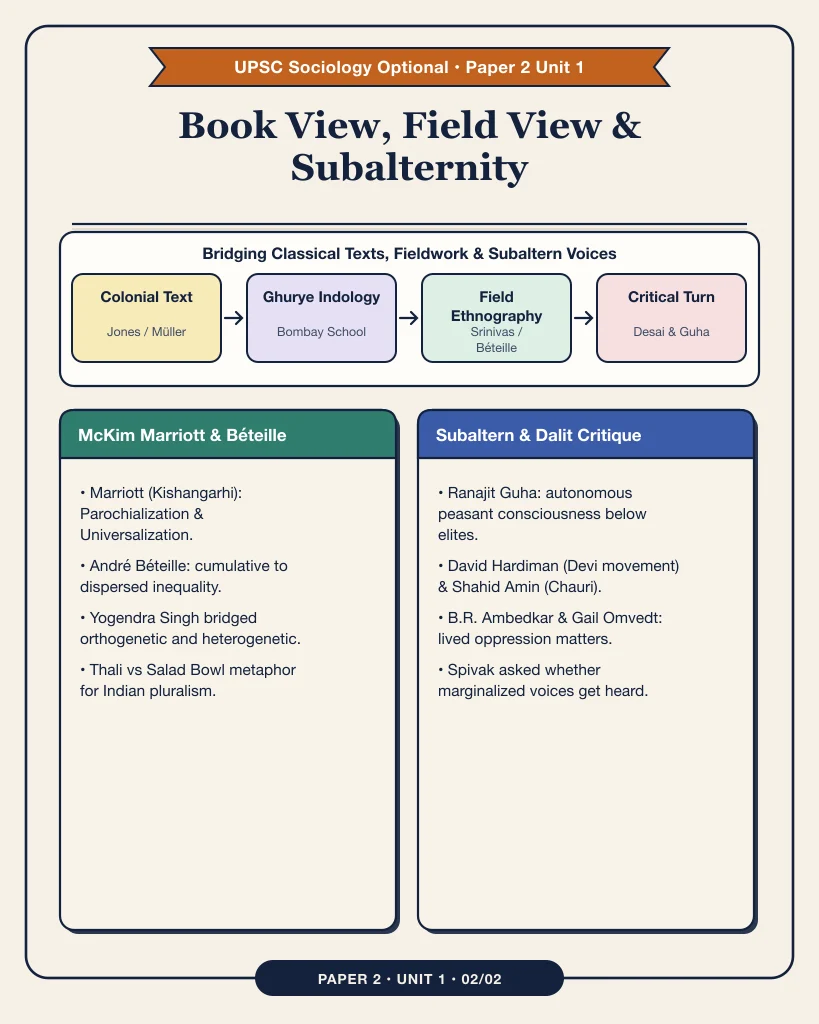 Thinkers2 min read
M. N. Srinivas: Sanskritization, Dominant Caste aur Field View
M. N. Srinivas ke field view, Sanskritization, Westernization aur Dominant Caste concepts ko UPSC Paper 2 answer writing ke liye detail mein samjho.
Padho →