Social Movements: Smelser Strain, Resource Mobilisation & New Social Movements
Indian social movements sirf protest nahi, identity, resources aur state power ka struggle hain. Chipko se Narmada Bachao aur hashtag activism tak, NFHS-5, PLFS aur NCRB data movement context ko sharp banate hain.
📑 Quick Jump: Contents (4) & Syllabus Chapters
Social Movements: Strain, Resources aur Identity ka Triad
Social movements ko samajhne ke liye ek simple question kaafi useful hai: log collective action kyun karte hain, aur kab woh ek movement ka form le leta hai? Sociology mein iska answer ek hi theory se nahi milta. Smelser ka value-added model strain, structural conduciveness, generalized belief aur precipitating factors ko jodkar batata hai ki crisis se movement ka emergence kaise hota hai. Lekin India jaisi society mein sirf strain enough nahi hota; resources, organisation, leadership aur political opportunity bhi equally important hain. Isi liye Resource Mobilisation Theory movement ko irrational outburst nahi, balki strategic collective action ke roop mein dekhti hai.
India ke context mein social movements ka scope aur bhi layered hai. Chipko Movement ne environment ko livelihood aur gender justice se joda; Narmada Bachao Andolan ne displacement, development aur rehabilitation par state ko question kiya; anti-corruption, farmers’ mobilisations, student protests aur digital hashtag activism ne dikhaya ki movement ab streets se screens tak shift ho chuka hai. New Social Movements theory, especially Alain Touraine aur Alberto Melucci ke through, yeh samjhati hai ki post-industrial societies mein struggle sirf wages ya class redistribution par nahi, balki identity, autonomy, lifestyle, dignity aur recognition par bhi hota hai.
UPSC Sociology ke liye yeh topic high-value isliye hai kyunki Paper 1 mein theory-base aur Paper 2 mein Indian examples dono ek saath aate hain. Relative deprivation, Merton aur Aberle se samajh aata hai ki log absolute poverty se nahi, comparative injustice se bhi mobilise hote hain. M.S.A. Rao ki classification Indian movements ko agrarian, tribal, peasant, ethnic, religious aur reformist categories mein map karti hai. Contemporary India mein NFHS-5, PLFS, NCRB, ASER, Xaxa Committee, Sachar Committee aur NITI MPI jaise data sources social grievances ka empirical base dete hain. Is chapter ka core puzzle yahi hai: kya movements resource, grievance ya identity se generate hote hain, ya in teenon ka intersection unhe durable बनाता hai?
Thinkers aur Theoretical Framework
1) Robert K. Merton ne Social Theory and Social Structure mein strain aur anomie ko highlight kiya. Unka logic tha ki jab culturally prescribed goals aur institutional means mein gap hota hai, to deviance ya collective protest ho sakta hai. Social movements ko yahan blocked opportunities aur relative grievances ke context mein dekha ja sakta hai. Merton ka contribution yeh hai ki unhone structural pressure ko center stage diya, lekin unka model largely individual adaptation par focused tha.
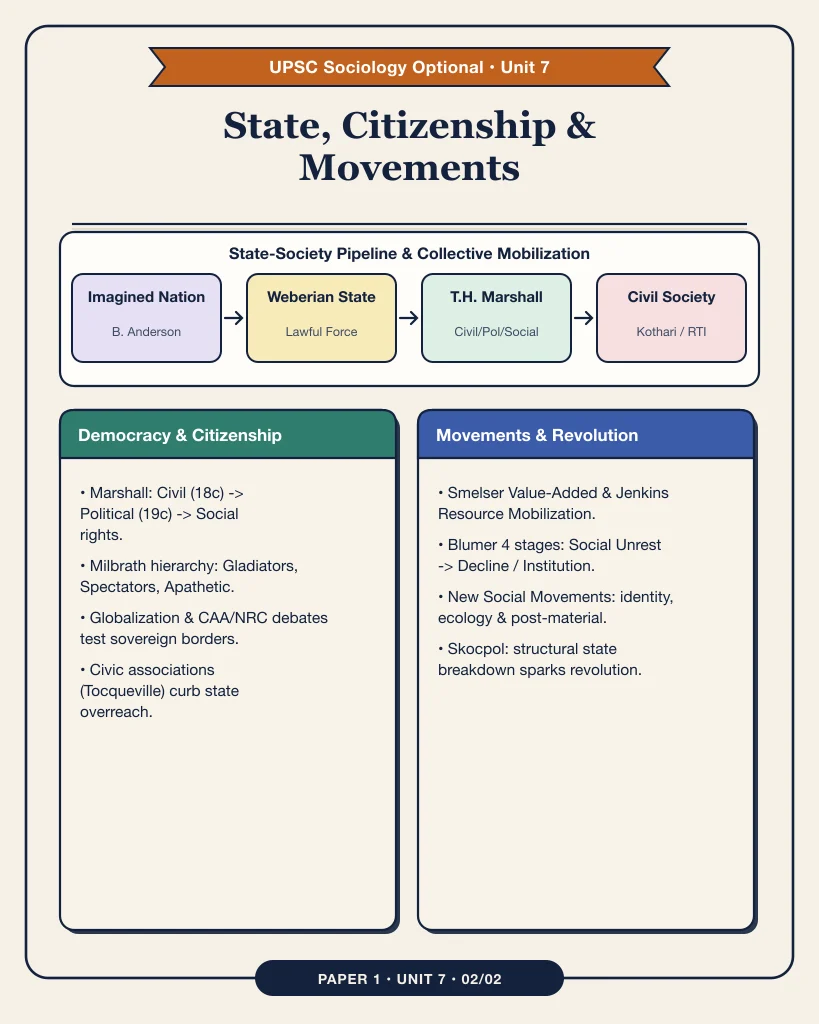
2) Neil J. Smelser ne Theory of Collective Behavior mein value-added theory diya. Unke hisaab se movement ek six-step process se emerge hota hai: structural conduciveness, structural strain, generalized belief, precipitating factors, mobilization for action, aur social control. Smelser ka strength yeh hai ki woh movement emergence ko process ke roop mein explain karte hain. Weakness yeh hai ki woh culture, identity aur long-term organisation ko relatively underplay karte hain.
3) Dwight McDonald / Ted Robert Gurr / James C. Davies type relative deprivation approach se idea milta hai ki actual deprivation se zyada important perceived gap hota hai between expected and achieved conditions. Merton aur Aberle ke framework mein relative deprivation social comparison aur frustrated expectations ko explain karta hai. Gurr ki Why Men Rebel is line ka classic text hai. Indian setting mein this helps explain peasant distress, youth unemployment, caste humiliation aur regional neglect-based mobilisations.
4) Charles Tilly aur McAdam Resource Mobilisation approach ko strengthen karte hain. Tilly ki From Mobilization to Revolution aur McAdam ki political process ideas batati hain ki movement tab successful hota hai jab organisation, leadership, networks, framing aur political opportunity available ho. Yahan grievance sufficient nahi; resources crucial hain. India mein NGOs, unions, student networks, media, legal aid, and transnational advocacy networks yeh role play karte hain.
5) Alain Touraine aur Alberto Melucci New Social Movements theory ke key thinkers hain. Touraine ki The Voice and the Eye aur Melucci ki Nomads of the Present mein movements ko post-industrial society ke struggles of identity, autonomy and self-determination ke roop mein dekha gaya. Traditional class conflict ke beyond, yeh movements gender, environment, ethnicity, sexuality aur cultural rights ko foreground karte hain. Chipko ko environmentalism + local subsistence + women’s agency ke angle se, aur Narmada Bachao ko displacement + rights + development critique ke angle se read kiya ja sakta hai.
Analytical contrast: Smelser tells us how collective behavior starts; Resource Mobilisation tells us how it sustains; New Social Movements tells us what it is fighting for. UPSC answer mein inhe rivalry nahi, sequential and complementary frameworks ki tarah present karna best strategy hai.
| Aspect | Smelser & Strain Model | Resource Mobilisation + NSM |
|---|---|---|
| Core cause | Structural strain aur generalized belief | Resources, networks, identity, political opportunity |
| Unit of analysis | Collective behavior ke stages | Organisations, leadership, frames aur constituency |
| Key focus | Why protest erupts | How movement organizes and what it demands |
| Indian example | Spontaneous unrest, local agitation, price rise protests | Chipko, NBA, anti-CAA mobilisations, hashtag activism |
Indian Data, Reports aur Case Evidence
India mein social movements ko purely ideological lens se padhna insufficient hai; empirical context zaroori hai. NFHS-5 data gender inequality, anaemia, child marriage, nutrition deficits aur reproductive health gaps dikhata hai—yeh sab many movements ke lived grievances ko structure karte hain, especially women’s health, dignity and autonomy-based mobilisations. PLFS regularly labour force participation, unemployment aur informalisation ko map karta hai; youth unemployment aur precarious work movements ke undercurrent ko samajhne mein help karta hai. NCRB crime data, especially caste violence, crimes against women aur marginalised communities ke records, protest politics ke safety and justice dimensions ko sharpen karta hai.
ASER reports learning gaps aur schooling quality ko reveal karte hain. Education-linked student movements aur digital campaigns ko explain karne mein yeh useful hai. Tribal displacement aur forest rights context mein Xaxa Committee (2014) ne adivasi deprivation, land alienation aur governance failure ko explicitly document kiya. Sachar Committee ne Muslim deprivation in education, employment aur access to public services ko highlight kiya; isne civil society mobilisations aur rights-based advocacy ko intellectual basis diya. NITI MPI multidimensional poverty ke regional and social concentration ko show karta hai, jo deprivation-based protest politics ko explain karta hai.
Case studies mein Chipko Movement ek iconic example hai jahan Garhwal ki women ne forest protection ko livelihood, fuelwood access aur ecological justice se joda. Yahan environmental movement gendered labour ke saath intersect karti hai. Narmada Bachao Andolan ne Sardar Sarovar project ke against displacement, rehabilitation, consultation rights aur environmental cost ko issue banaya. Medha Patkar, Baba Amte aur local adivasi communities ne policy discourse ko redefine kiya. Supreme Court and rehabilitation litigation ne bhi movement ko institutional arena diya.
Contemporary example ke liye digital hashtag activism dekhiye: #MeTooIndia, #SaveAarey, #JusticeFor..., #FarmersProtest jaise campaigns ne issue framing, agenda-setting aur networked solidarity ko expand kiya. Lekin trolls, misinformation, platform bias aur surveillance isko constrain bhi karte hain. Thus, Indian movements are not merely protest episodes; they are data-embedded social responses to inequality, recognition deficit and state-market power.
🔑 Relative Deprivation
Jab log apni actual condition ko apni expected ya comparable group condition se kam samajhte hain, tab grievance aur mobilisation banti hai.
Limitations aur Nuanced Synthesis
Har theory ki apni blind spots hain. Smelser ka model process ko neat stages mein divide karta hai, lekin real movements linear nahi hote; they are messy, fragmented and often emotionally charged. Resource Mobilisation Theory ka limitation yeh hai ki woh organisation aur strategy par excessive emphasis dekar moral outrage, spontaneity aur symbolic politics ko underestimate kar sakti hai. Isse movements kabhi-kabhi NGO-centric ya elite-driven bhi lagne lagte hain.
New Social Movements theory ne identity, culture aur post-materialist concerns ko important banaya, but critics kehte hain ki yeh Western post-industrial societies ke liye zyada suitable hai. India mein class, caste, tribe aur agrarian distress ab bhi central hain. Isliye sirf NSM lens se padhne par we may miss land conflict, wage issues, bonded labour aur structural violence. Similarly, relative deprivation theory grievance ko explain karti hai, but mobilisation ko automatic assume kar leti hai. Many deprived groups protest nahi karte because repression, fragmentation, social isolation or fear high hota hai.
Yahan Gramsci ki hegemony, Bourdieu ka symbolic power, और T.K. Oommen ka identity-centered perspective useful supplement provide karte hain. Oommen Indian movements mein ethnicity, region, religion aur caste ko central consider karte hain. Also, social movements often mix old and new logics: Chipko mein subsistence + ecology; NBA mein development critique + constitutional rights; digital activism mein identity + network effects + platform capitalism.
Best synthesis for UPSC: movements are generated by strain, sustained by resources, and animated by identity and dignity claims. In India, the most convincing answers are those that integrate structure, agency and culture together rather than choosing only one theory.
Answer kaise likhein
- Smelser ke according structural strain, generalized belief aur triggering event collective action ko activate karte hain.
- Merton/Aberle/Gurr relative deprivation ko explain karte hain: actual nahi, perceived inequality mobilisation ka core hota hai.
- Tilly, McAdam aur resource mobilisation theorists organisation, leadership, networks aur political opportunity ko decisive maante hain.
- Touraine aur Melucci ke New Social Movements identity, dignity, autonomy, environment aur recognition ko centre mein laate hain; India mein Chipko, Narmada aur hashtag activism iska proof hain.
Is Blog Se Jude Syllabus Chapters
Every Unit Note + Topic-Wise PYQ Mapped (English + Hinglish)
Paper 1 (10 Units) aur Paper 2 (15 Units) — Complete structured notes, thinkers, mind maps & 597 solved PYQs ek saath.
Khud ko test karo
Is post se 3 sawal
0 / 3 attempted
1. Smelser ke value-added theory mein kaunsa element directly collective action ko trigger karta hai?
2. New Social Movements theory ka central emphasis kya hai?
3. Chipko Movement ko best kaise classify kiya ja sakta hai?
FAQ
Aksar poochhe jaane wale sawaal
- Smelser aur Resource Mobilisation mein main difference kya hai?
- Smelser movement emergence ko strain and stages se explain karta hai, jabki Resource Mobilisation movement ki organisation, leadership aur strategy par focus karta hai.
- Melucci aur Touraine ko Indian context mein kaise use karein?
- Inhe identity, dignity, autonomy aur environmental justice based movements jaise Chipko, NBA, women’s movements aur digital activism se link karein.
- Relative deprivation ka Indian example kya hai?
- Youth unemployment, caste discrimination, regional neglect aur displacement se linked grievance relative deprivation ke strong examples hain.
UPSC PYQs
Is topic ke Previous Year Questions
- 2025 · P1
How can you assess the significance of social movements in the digital era? Explain. (10 marks)
- 2024 · P2
Analyse the interconnected triangle between environmental movements, extractive development, and tribal identity (e.g., Niyamgiri, Hasdeo). (20 marks)
- 2024 · P1
Underline the role of social media in contemporary social movements and describe its challenges. (10 marks)
- 2023 · P2
In the face of global climate concerns, contextualize the relevance of the Chipko Movement and its Gandhian livelihood ethics. (10 marks)
Roz ke Sociology notes Telegram pe paao
Daily current affairs, PYQ linkages aur direct mentorship support Telegram par.
Related
Aur padho
- Paper 2 IndiaOWL BLOGP2
Social Movements in Modern India: Farmers, Dalit, Women & Environmental Movements (Paper 2 Notes + PYQs)
4 min readSocial Movements in Modern India: Farmers, Dalit, Women & Environmental Movements (Paper 2 Notes + PYQs)
Paper 2, Unit 13 (Social Movements) is one of the highest-scoring segments of the UPSC Sociology Optional syllabus because it bridges classical sociological theory with contemporary Indian reality—from MSP protests and Dalit digital...
Padho → - Paper 2 India8 min read
Environmental Movements in India: Chipko, Narmada & Ramachandra Guha’s Ecology
Chipko se Narmada tak environmental movements ne bataya ki ecology sirf forest issue nahi, livelihood, adivasi rights aur state power ka sawal hai. NFHS-5, PLFS aur NCRB data se inequality aur displacement ka lens aur strong hota hai.
Padho → 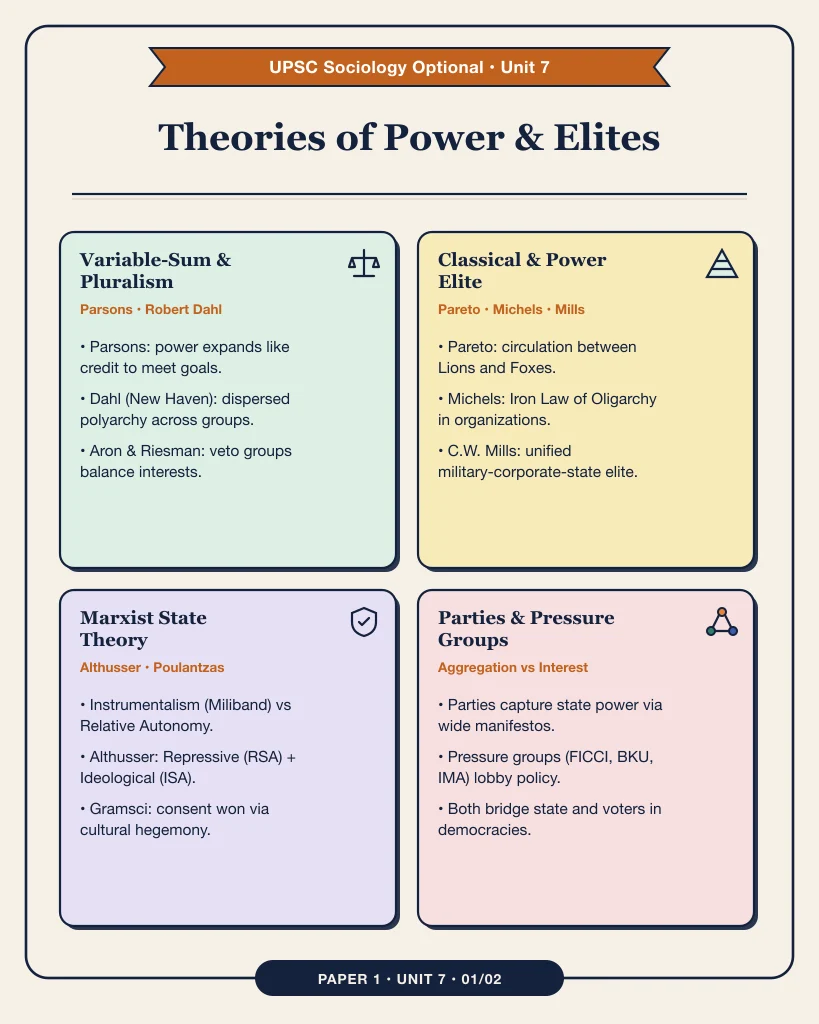 Paper 1 Concepts8 min read
Sociological Theories of Power: Weber, Parsons, C.W. Mills & Steven Lukes
Power sirf force nahi, meaning aur consent bhi hai. NFHS-5, PLFS aur NCRB dikhate hain ki India me power inequalities caste, gender aur state machinery me kaise kaam karti hain.
Padho →