Sociological Theories of Power: Weber, Parsons, C.W. Mills & Steven Lukes
Power sirf force nahi, meaning aur consent bhi hai. NFHS-5, PLFS aur NCRB dikhate hain ki India me power inequalities caste, gender aur state machinery me kaise kaam karti hain.
📑 Quick Jump: Contents (10) & Syllabus Chapters
- Sociological Theories of Power: ek conceptual puzzle
- Key thinkers: power ko kaise samjhen?
- 1) Max Weber: domination and legitimacy
- 2) Talcott Parsons: power as variable-sum
- 3) C.W. Mills: power elite aur zero-sum dominance
- 4) Steven Lukes: three dimensions of power
- 5) Gramsci and Foucault: hegemony and biopower
- Analytical contrast
- Indian data aur empirical relevance
- Critique aur synthesis
Sociological Theories of Power: ek conceptual puzzle
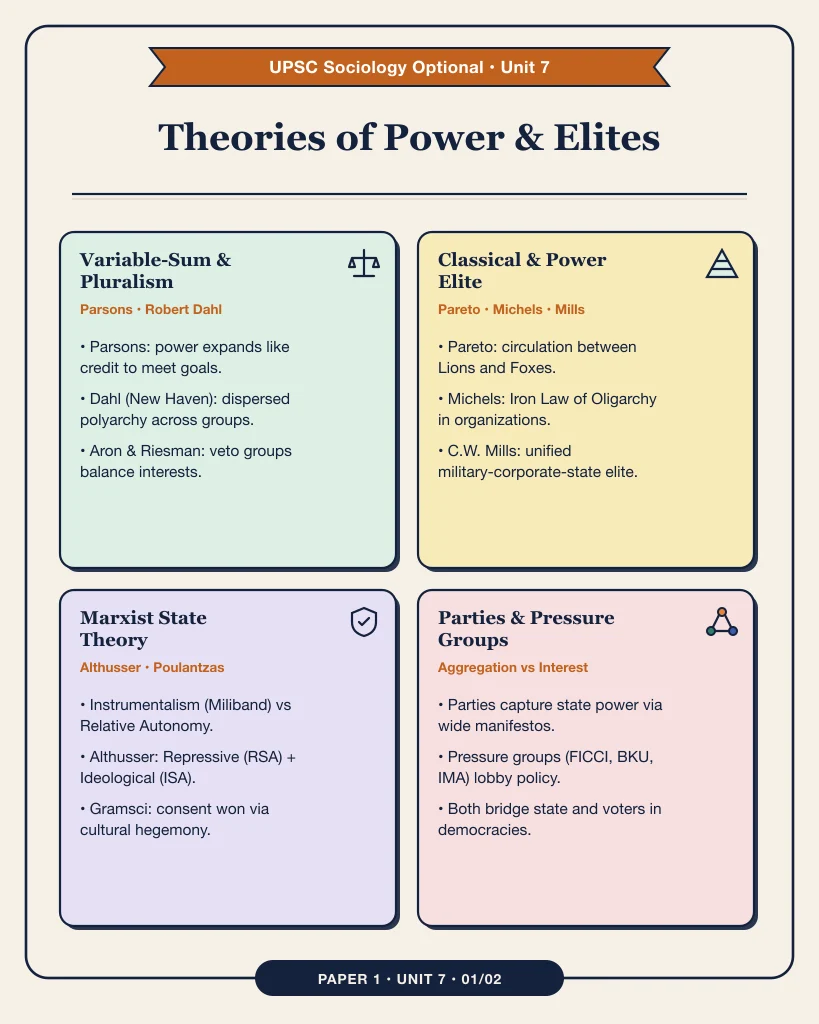
Power sociology ka core question hai: kya power sirf coercion aur domination hai, ya phir woh consent, legitimacy, agenda-setting aur everyday discipline ke through bhi operate karti hai? UPSC Sociology Optional me yeh topic isliye crucial hai kyunki yeh political, economic aur cultural institutions ko ek saath connect karta hai. Weber se lekar Lukes tak aur Gramsci se Foucault tak, power ka meaning continuously expand hota gaya hai. Ek taraf classical tradition power ko observable decision-making aur resource control ke roop me dekhti hai; doosri taraf critical theories batati hain ki power kabhi-kabhi invisible hoti hai, kyunki woh desires, norms aur categories of thought ko shape karti hai.
Indian context me yeh debate aur bhi relevant ho jata hai. Caste hierarchy, patriarchy, communal mobilization, bureaucratic authority, digital surveillance, welfare targeting aur police power—sabhi jagah power ke multiple faces dikhte hain. NFHS-5 women autonomy, child nutrition, aur decision-making me persistent inequality dikhata hai; PLFS labor force participation aur informalization ko highlight karta hai; NCRB crime data gendered vulnerability aur state response ke limits batata hai. Isse clear hota hai ki power ko sirf State vs citizen frame me samajhna insufficient hai.
Sociological analysis ka conceptual puzzle yeh hai: agar power zero-sum hai, to ek group ka gain doosre ka loss hoga; agar variable-sum hai, to cooperative power-building aur institutional legitimacy possible hai. Parsons isko social order ke perspective se dekhta hai, Weber domination ke legitimacy basis par focus karta hai, C.W. Mills elite dominance ko expose karta hai, Lukes hidden and ideological dimensions ko add karta hai, Gramsci hegemony ke through consent explain karta hai, aur Foucault disciplinary biopower ke zariye bodies aur populations par micro-power ko foreground karta hai. India jaisi stratified democracy me in sab theories ka synthesis hi best analytical lens provide karta hai.
Key thinkers: power ko kaise samjhen?
1) Max Weber: domination and legitimacy
Weber ke liye power (Macht) ka matlab hai apni will ko resistance ke bawajood impose kar pana. Lekin Weber ko sirf coercion ke lens se padhna incomplete hoga; unka deeper contribution domination (Herrschaft) aur legitimacy hai. In Economy and Society, Weber power ko rational-legal, traditional, aur charismatic authority ke forms me analyze karte hain. Isliye bureaucracy unke liye modern power ka central instrument hai. Weberian lens me state power ka legitimacy structure decisive hota hai: log isliye obey karte hain kyunki authority ko legitimate maana jata hai.
2) Talcott Parsons: power as variable-sum
Parsons power ko zero-sum nahi maanta. Unke system theory me power ek generalized medium hai jo collective goals achieve karne me help karti hai. The Social System aur later essays me Parsons power ko institutional coordination aur value consensus se jodte hain. Yahan power ka positive-sum/variable-sum logic important hai: agar institutions legitimize karen, to power social order aur integration produce kar sakti hai. Critics kehte hain ki Parsons conflict, domination aur inequality ko underplay karta hai.
3) C.W. Mills: power elite aur zero-sum dominance
C. Wright Mills ki The Power Elite sociological power analysis ka classic text hai. Mills ke hisaab se US society me military, corporate aur political elites ek interlocking ruling structure banate hain. Power yahan zero-sum hai: elite gain ka matlab masses ki relative exclusion. Mills ka strength structural inequality expose karna hai, especially jab formal democracy ke piche real decision-making concentrated ho. India ke context me yeh lens political-business nexus, crony capitalism, aur elite capture ko samjhne me useful hai.
4) Steven Lukes: three dimensions of power
Lukes ki Power: A Radical View power theory ka breakthrough hai. First face me observable decision-making; second face me agenda-setting; third face me deepest form: preferences ko shape karna so that dominated groups apne hi interest against act karen. Yeh ideological agenda-setting aur consent production ka theory hai. Lukes, Bachrach & Baratz se aage jaakar batate hain ki non-decisions bhi power ka outcome hote hain.
5) Gramsci and Foucault: hegemony and biopower
Antonio Gramsci ke Prison Notebooks me hegemony ka concept batata hai ki ruling class sirf force se nahi, consent aur common sense construct karke rule karti hai. Isse Lukes ki third face aur richer ho jati hai. Michel Foucault ki Discipline and Punish aur The History of Sexuality power ko sovereign command se shift karke disciplinary power aur biopower ke roop me dikhati hain. Power yahan institutions, surveillance, exams, classification, healthcare, and normalization ke through bodies aur populations ko manage karti hai.
Analytical contrast
Weber legitimacy par focus karte hain; Parsons integration par; Mills domination par; Lukes hidden ideological control par; Gramsci consent via hegemony par; aur Foucault microphysics of power par. UPSC answer me yeh contrast dikhana high value add deta hai, kyunki aap show karte hain ki power ek linear concept nahi, balki layered social relation hai.
| Aspect | Zero-sum Power | Variable-sum Power |
|---|---|---|
| Core idea | Ek actor ka gain often doosre actor ka loss | Power collective coordination se sabko benefit de sakti hai |
| Key thinker | Weber, C.W. Mills, Lukes (critical dimension) | Parsons |
| Focus | Domination, exclusion, elite capture, hidden control | Integration, legitimacy, goal-attainment, social order |
| Indian relevance | Caste hierarchy, patriarchal control, crony power, agenda-setting in media-politics | Legitimate bureaucracy, welfare coordination, constitutional governance |
Indian data aur empirical relevance
India me power ko abstract theory ki tarah nahi, lived inequality ki tarah padhna chahiye. NFHS-5 ke indicators batate hain ki women’s decision-making, nutrition, anemia, domestic violence reporting, aur fertility outcomes me sharp inequalities exist karti hain. Yeh sirf health data nahi, balki household power relations ka mirror hai. Jahan women ki autonomy low hai, wahan symbolic and material power dono constrained hote hain.
PLFS repeatedly dikhata hai ki labor force participation, especially women ki participation, low aur unequal hai. Iska sociological meaning yeh hai ki economic dependence power asymmetry ko reproduce karti hai. Informality aur unpaid care work women ko public sphere se exclude karti hai, jo Lukes ke third face of power se link hota hai—preferences aur choices pe social conditioning.
NCRB data gendered violence, custodial vulnerabilities, aur under-reporting ki problem ko foreground karta hai. State coercion aur institutional trust ke बीच gap yahan clearly visible hai. Agar Weberian legitimacy weak ho, to formal authority compliance to produce kar sakti hai, trust nahi. Isi tarah, police, prisons aur local administration par Foucaultian disciplinary lens laga sakte hain.
Caste power ko samajhne ke liye Xaxa Committee reports, Sachar Committee Report, aur later NITI Aayog Multidimensional Poverty Index useful hain. Sachar ne Muslims ki socio-economic backwardness aur institutional exclusion ko empirically document kiya; Xaxa panel ne tribal marginalization, land alienation, displacement aur governance deficits ko highlight kiya. NITI MPI poverty ko income se aage multidimensional deprivation ke रूप में dikhata hai, jo powerlessness ka proxy hai.
Ethnographic studies bhi crucial hain. André Béteille ka caste-power analysis, M.N. Srinivas ki dominant caste theory, aur Uma Chakravarti ka Brahmanical patriarchy framework yeh batate hain ki power kin social categories me embedded hoti hai. Reservation politics, manual scavenging, land relations, aur communal mobilization me Gramscian hegemony aur Mills-style elite capture dono kaam karte dikhte hain.
Judicial and policy examples bhi matter karte hain. Supreme Court ke decisions on privacy, dignity, and equality—jaise Puttaswamy judgment—show karte hain ki state surveillance aur individual autonomy ke बीच balance important hai. Similarly, Nirbhaya case ke baad legal reforms ne women’s safety discourse ko reshape kiya, but NCRB trends suggest institutional response and social control remain uneven. Isliye Indian evidence ek layered power map provide karta hai: family, caste, market, state, media, and digital platforms sab power circulate karte hain.
🔑 Hegemony
Aisa domination jisme ruling group sirf force se nahi, balki consent aur common sense bana kar rule karta hai.
Critique aur synthesis
In theories ki sabse badi limitation yeh hai ki koi ek theory power ke sab dimensions ko fully capture nahi karti. Weber legitimacy aur authority ko center me rakhte hain, but everyday cultural domination ko limited depth se samajhte hain. Parsons social order par focus karke conflict aur structural inequality ko soften kar deta hai, isliye uspar conservative bias ka critique hota hai. Mills elite concentration ko expose karte hain, but kabhi-kabhi unka model over-structural ho jata hai aur local resistances, social movements aur fragmented power relations ko underplay karta hai.
Lukes ne power theory ko revolutionize kiya, lekin third face of power par yeh critique hota hai ki hidden preferences ko empirically prove karna difficult hai. Har consent ko false consciousness keh dena reductionism ban sakta hai. Gramsci is problem ko partially solve karte hain by showing that consent active manufacture hota hai, not merely imposed. Lekin Gramsci bhi class lens me heavily anchored rehte hain.
Foucault ki strength micro-power aur institutions ki analysis hai, but unke framework me resistance ka collective political project kabhi-kabhi diffuse ho jata hai. Agar power har jagah hai, to agency ka status kya hai? Yeh major critique hai. Isliye best answer synthesis me hota hai: Weber explain karta hai authority; Mills explain karta hai elite concentration; Lukes explain karta hai agenda-setting; Gramsci explain karta hai consent; Foucault explain karta hai discipline and biopower.
UPSC ke liye nuanced conclusion yeh hona chahiye ki power na to purely zero-sum hai, na purely variable-sum. Democratic institutions me legitimate coordination possible hai, but unequal societies me power often asymmetric aur hidden hoti hai. India me caste, class, gender aur religion intersect karke power ko multi-layered banate hain. Hence, a robust sociological analysis must integrate structure, ideology, institution, and everyday practice.
Answer kaise likhein
- Weber: power = resistance ke bawajood will impose karna; legitimacy aur authority forms ko analyze karo.
- Parsons: power variable-sum ho sakti hai; social order aur goal-attainment me useful medium.
- Mills + Lukes: elite capture aur hidden agenda-setting democracy ke piche real domination ko expose karte hain.
- Gramsci aur Foucault ko add karke show karo ki consent, hegemony, discipline aur biopower se modern power operate karti hai.
Is Blog Se Jude Syllabus Chapters
Every Unit Note + Topic-Wise PYQ Mapped (English + Hinglish)
Paper 1 (10 Units) aur Paper 2 (15 Units) — Complete structured notes, thinkers, mind maps & 597 solved PYQs ek saath.
Khud ko test karo
Is post se 3 sawal
0 / 3 attempted
1. Which thinker is most associated with the concept of hegemony?
2. Steven Lukes’ third dimension of power refers to:
3. Which pairing is correct?
FAQ
Aksar poochhe jaane wale sawaal
- Weber aur Mills me main difference kya hai?
- Weber power ko authority and legitimacy ke framework me dekhte hain, jabki Mills elite concentration aur interlocking ruling groups par focus karte hain.
- Lukes ki third face of power kya hai?
- Yeh symbolic and ideological control hai jahan dominant groups preferences, perceptions aur agenda ko shape kar dete hain, so dominated people apne interests ke against act karte hain.
- Gramsci aur Foucault ko power theory me kaise use karen?
- Gramsci consent aur hegemony explain karte hain; Foucault discipline, surveillance aur biopower. Dono hidden power mechanisms ko deepen karte hain.
UPSC PYQs
Is topic ke Previous Year Questions
- 2025 · P1
What would you identify as the similarities and differences in the elite theories of Mosca, Michels and Pareto? Discuss their main/crucial issues. (10 marks)
- 2025 · P1
Are pressure groups a threat to or a necessary element of democracy? Explain with suitable illustrations. (10 marks)
- 2024 · P1
Discuss the dimensions of power in the construction and maintenance of social hierarchies in a society. (10 marks)
- 2023 · P1
What, according to Robert Michels, is the iron law of oligarchy? Do lions and foxes in Vilfred Pareto's theory, essentially differ from each other? Substantiate. (10 marks)
Roz ke Sociology notes Telegram pe paao
Daily current affairs, PYQ linkages aur direct mentorship support Telegram par.
Related
Aur padho
- Paper 1 Concepts1 min read
Max Weber: Bureaucracy, Ideal Types aur Iron Cage of Rationality
UPSC IAS/IPS administration ke context mein Max Weber ke Ideal Type of Bureaucracy, 3 Authority types aur Robert Merton ke dysfunction critique ko samjho.
Padho → 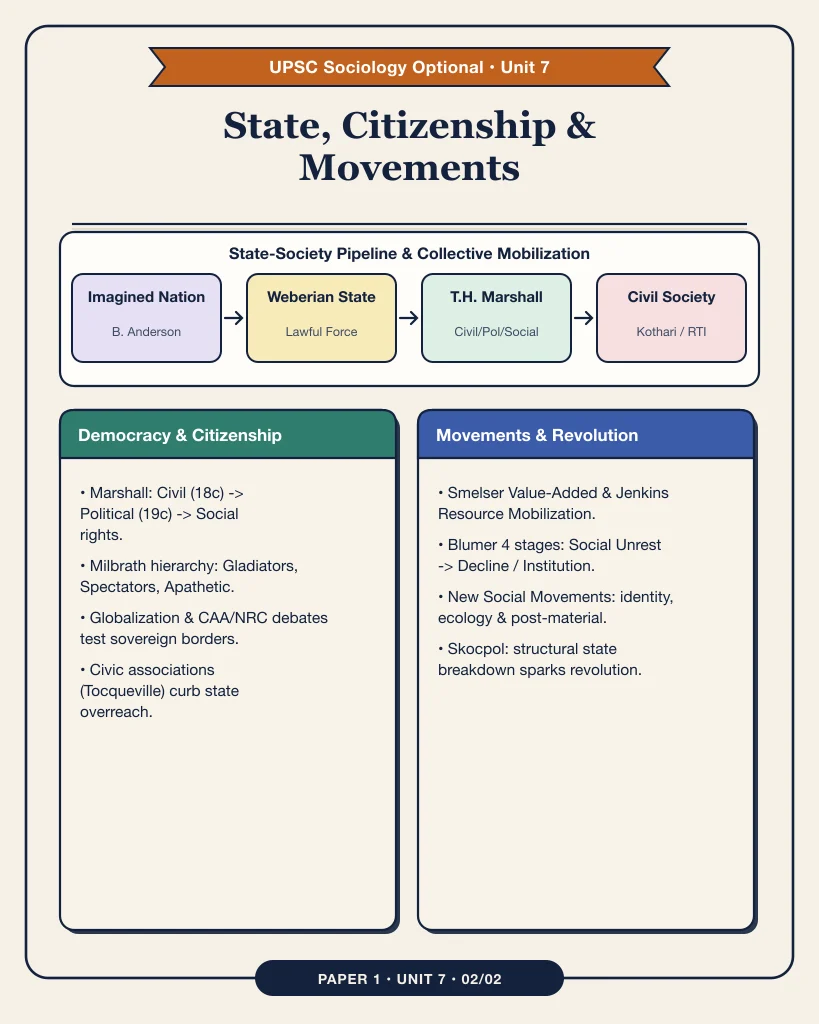 Paper 1 Concepts8 min read
Social Movements: Smelser Strain, Resource Mobilisation & New Social Movements
Indian social movements sirf protest nahi, identity, resources aur state power ka struggle hain. Chipko se Narmada Bachao aur hashtag activism tak, NFHS-5, PLFS aur NCRB data movement context ko sharp banate hain.
Padho →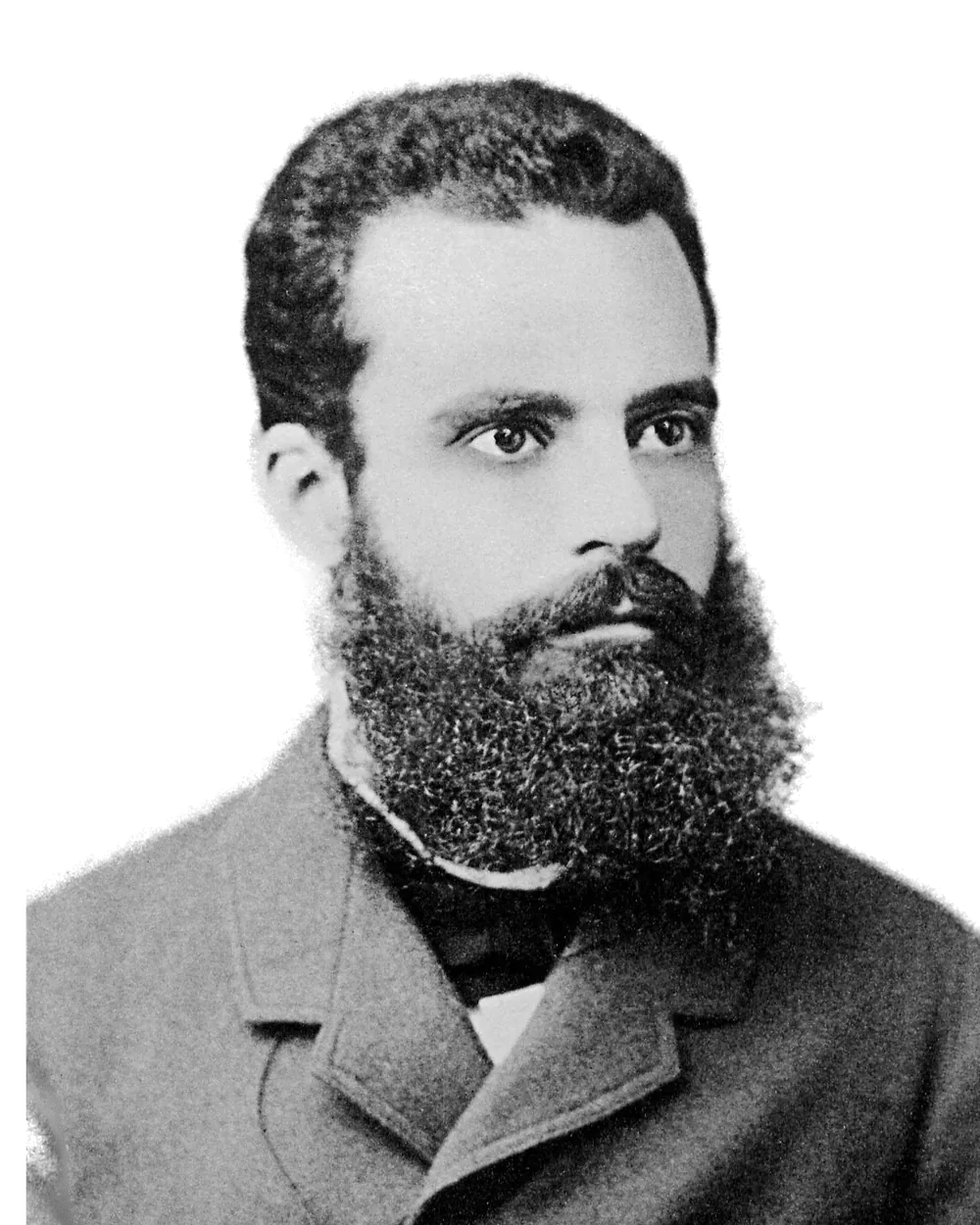 Thinkers8 min read
Vilfredo Pareto: Lions, Foxes, Residues & Circulation of Elites in India
Pareto ka elite theory India me upper-caste Congress dominance se OBC/regional elites ke rise tak samajhne ka lens deta hai. NFHS-5, PLFS aur NCRB data power shift ko reveal karte hain.
Padho →