Cultural Lag, Tech Change & Castells Network Society in India’s Digital Age
India me AI, deepfakes aur platform economy ne social change ko super-fast kiya, par law, norms aur access abhi bhi slow hain. Oxfam ke mutabik women internet gap 33% tak hai—classic cultural lag ka live case.
📑 Quick Jump: Contents (4) & Syllabus Chapters
Conceptual Puzzle: Tech Fast, Society Slow?
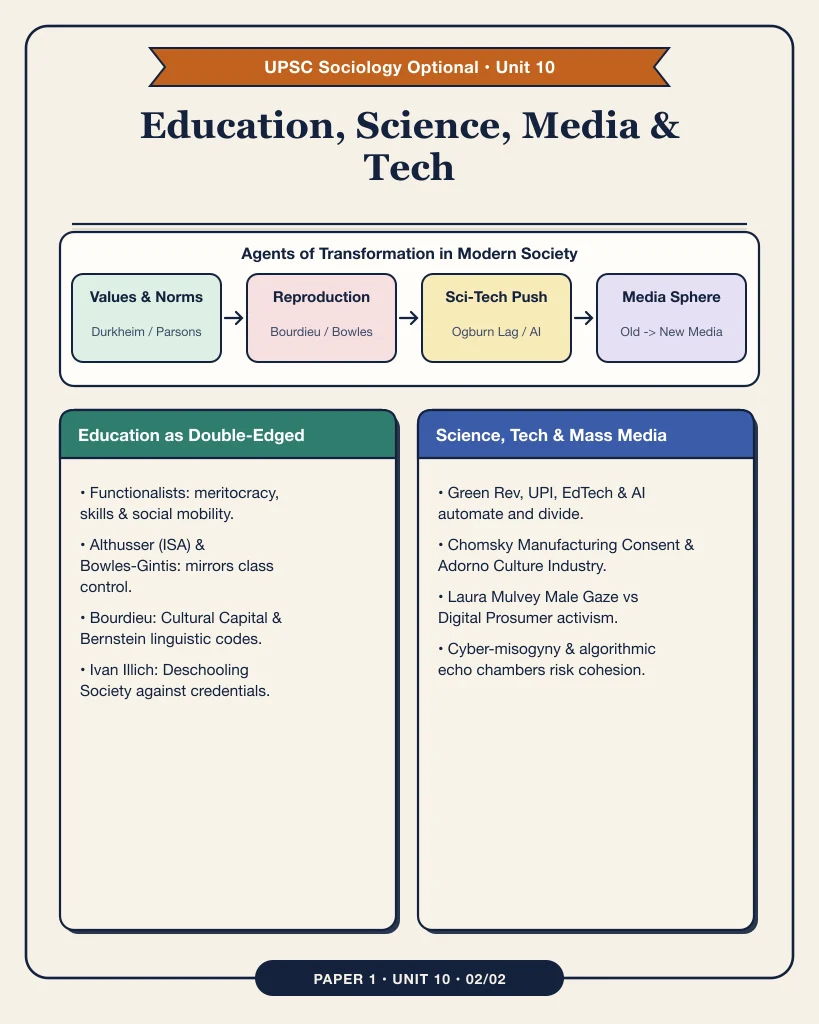
India ka digital age ek classic sociological puzzle present karta hai: technology ka pace exponential hai, par institutions, law, norms aur everyday practices utni speed se adapt nahi karte. W.F. Ogburn ne is gap ko Cultural Lag kaha—jab material culture, jaise AI, smartphones, platforms, biometric systems ya deepfakes, non-material culture, jaise law, ethics, education, family norms aur administrative regulation se aage nikal jata hai. India me yeh lag visible hai: ek taraf UPI, Aadhaar-based delivery, OTT, gig work aur AI tools; doosri taraf cyber law, data protection literacy, digital consent, gender safety aur platform accountability ka slow response.
Is transition ko aur deepen karne ke liye Manuel Castells ka Network Society lens bahut useful hai. Castells ke mutabik contemporary society me power, production aur identity networks ke through organize hote hain, na ki sirf territory ya factory-based industrial order ke through. India me digital platforms, mobile internet, social media, state databases aur algorithmic governance ne ek naya social structure banaya hai—jahan inclusion bhi hai aur exclusion bhi. Jis citizen ke paas phone, data, literacy aur digital confidence hai, wahi network me fully participate kar pata hai.
Par network society universally accessible nahi hai. Oxfam India ke Digital Inequality findings ke hisaab se women internet access gap abhi bhi around 33% tak hai, jo gendered digital divide ko show karta hai. Rural-urban divide, caste hierarchy, language barrier, disability access, aur device ownership inequality bhi same story ka part hain. Isliye India ka digital change sirf modernization nahi, balki unequal modernization bhi hai.
Sociology Optional me is topic ki value yeh hai ki aap isse structural change, social stratification, gender, state, law aur culture sabke saath connect kar sakte ho. Paper 1 me theory; Paper 2 me India-specific digital inequality, governance aur social consequences. Deepfakes, online misinformation, gig precarity aur algorithmic bias jaise issues Ogburn aur Castells dono ko contemporary relevance dete hain.
Thinkers: Theory se Indian Reality tak
1) W.F. Ogburn Ogburn sociology me technology aur social change ke relation ko samajhne ke liye foundational thinker hain. Unki classic work Social Change with Respect to Culture and Original Nature (1922) me concept of Cultural Lag diya gaya. Ogburn ke according material culture change jaldi hoti hai, while non-material culture—values, norms, law, family patterns—slow adapt karti hai. India me AI-generated deepfakes, facial recognition, predictive policing, fintech fraud aur platform economy material innovations hain; lekin legal safeguards, forensic capacity aur public awareness abhi incomplete hai. Deepfake scams aur non-consensual synthetic media cultural lag ka sharp example hain.
2) Manuel Castells Castells ne The Rise of the Network Society me argue kiya ki contemporary capitalism informationalism par based hai. Power flows through networks, nodes, and flows of information. India me digital public infrastructure, platform-mediated labor, e-governance and social media politics Castells ke thesis ko strongly support karte hain. Par Castells ke framework se yeh bhi dikhta hai ki network society neutral nahi hoti; jo log nodes ke bahar hain, woh marginalize ho jate hain. Hence, digital inclusion becomes a new social question.
3) Anthony Giddens Giddens ki structuration theory ke through hum dekh sakte hain ki technology sirf structure impose nahi karti; agents bhi technology ko shape karte hain. India me users WhatsApp ko community coordination, political mobilization aur family networks ke liye repurpose karte hain. Isliye digital change deterministic nahi, reciprocal hai. Giddens ka lens helps explain how local agency global tech ko vernacularize karti hai.
4) Zygmunt Bauman Bauman ke liquid modernity ideas bhi relevant hain. Digital life me relationships, jobs, identities aur attention patterns fluid ho gaye hain. Gig workers, content creators, migrant users aur app-based consumers unstable and flexible conditions me operate karte hain. This creates speed, but also insecurity and anxiety. Bauman yahan normative critique provide karte hain.
5) Amartya Sen Sen ka capability approach digital inequality ko sirf access issue nahi, freedom issue banata hai. Internet access tabhi meaningful hai jab education, language, safety, device control aur agency ho. Women, Dalits, Adivasis and poor households ke liye digital access often constrained capability hoti hai. Thus, inequality is not just about connection; it is about real freedom to use connection.
In thinkers ka contrast clear hai: Ogburn technology-norm gap explain karte hain; Castells networked power structure dikhate hain; Giddens agency-structure mediation batate hain; Bauman insecurity and fluidity; Sen substantive inclusion and capability. Together, they give a nuanced sociological toolkit for India’s digital age.
| Aspect | Ogburn: Cultural Lag | Castells: Network Society |
|---|---|---|
| Core idea | Material culture non-material culture se fast change karti hai | Society networks, flows aur informationalism ke through organize hoti hai |
| Power pattern | Mismatch creates friction, confusion and maladjustment | Power nodes aur network control ke through operate karti hai |
| Indian example | Deepfakes, AI scams, cyber law ka slow response | UPI, social media mobilization, platform governance |
| Policy implication | Legal, ethical aur educational adaptation speed up karni chahiye | Digital inclusion, network access aur algorithmic accountability ensure karni chahiye |
Indian Evidence: Data, Reports aur Cases
India me cultural lag aur network society dono ka best empirical reading multiple datasets se hota hai. NFHS-5 ne household level par digital access aur gendered capability gaps ko highlight kiya—women’s phone ownership, internet use aur digital autonomy many states me men se lower rahi. Yeh sirf device gap nahi, social control gap bhi hai, kyunki phone access often family surveillance, mobility restrictions aur patriarchal monitoring se linked hota hai.
PLFS data labor market transformation dikhata hai, especially gig, platform aur informal digital work ke context me. App-based delivery, ride-hailing aur online micro-work ne employment ko flexible kiya, but security, benefits aur collective bargaining ko weaken bhi kiya. Isse Castells ke networked labor aur Bauman ke precarious modernity dono relevant hote hain. Digital work formal/informal boundary ko blur karta hai.
NCRB cybercrime trends—online fraud, identity theft, stalking, impersonation aur image-based abuse—show karte hain ki technology adoption ke saath social deviance bhi evolve ho rahi hai. Deepfake audio-video manipulations aur phishing scams ko legal system hamesha timely address nahi kar pa raha. Yeh classic Ogburnian lag hai: innovation rapid, regulation delayed.
ASER reports repeatedly indicate ki learning outcomes aur digital learning access me stark inequality hai. Rural students ke paas device, stable internet aur guided usage ka access uneven hai. Pandemic era me yeh divide aur visible hua, jab online schooling ne upper strata ko advantage diya but poor households ko exclusion me push kiya.
Digital divide par Oxfam India ke analysis ne women internet gap ko around 33% show kiya—this is crucial for gender sociology. Is gap ka matlab sirf online entertainment se exclusion nahi, balki information, financial services, telemedicine, education aur political voice se bhi partial exclusion hai.
Committee and policy level par Justice B.N. Srikrishna Committee ne data protection concerns raise kiye, aur Digital Personal Data Protection Act, 2023 ne privacy architecture ko strengthen karne ki koshish ki. Par enforcement, literacy aur grievance redressal abhi bhi uneven hai. Puttaswamy judgment (2017) ne privacy ko fundamental right maana, jo digital governance ke normative framework ke liye landmark hai.
Ethnographic and field studies bhi important hain: urban poor, gig workers, women users aur Adivasi communities par studies ne dikhaya ki digital access often mediated, shared, borrowed aur constrained hota hai. In contexts me network society inclusion ke saath surveillance, exploitation aur dependency bhi create karti hai. Isliye Indian evidence strongly supports a dual thesis: digital technology empowerment bhi hai aur inequality amplifier bhi.
🔑 Cultural Lag
Jab technology/material culture faster evolve karti hai aur law, norms, values ya institutions us pace se adapt nahi karte.
Critique: Limitations aur Nuance
Ogburn aur Castells dono powerful frameworks hain, but unki limitations bhi hain. Ogburn ka cultural lag model kabhi-kabhi too linear lagta hai, jaise society hamesha technology ke piche chalti hai. Reality me adaptation messy, uneven aur negotiated hoti hai. India me same tech different social groups ke liye different meanings rakhti hai: for some it is empowerment, for others surveillance or coercion. Hence, lag universal nahi, stratified hai.
Castells ka network society framework global information flows ko brilliantly explain karta hai, but it can underplay persistent material inequalities—land, caste, labor precarity, gender violence, and state capacity. India me digital power sirf network access se nahi, social power se bhi determined hoti hai. Agar caste hierarchy offline strong hai, to online spaces bhi often reproduce it. Algorithms bias ko neutralize nahi karte; kabhi-kabhi amplify karte hain.
Counter-thinkers me Evgeny Morozov ya Shoshana Zuboff important hain. Morozov warns against techno-utopianism; Zuboff’s surveillance capitalism reminds us that platforms users ko commodity bana sakti hain. In the Indian context, data extraction, targeted persuasion and behavioral manipulation important concerns hain. Similarly, feminist scholars ne show kiya hai ki digital access ka matlab actual agency nahi hota, because household control, online harassment and reputational policing continue.
Isliye best sociological synthesis yeh hai: India’s digital age ko neither pure liberation nor pure disaster ke roop me dekhna chahiye. It is a contradictory process where cultural lag, network power, capability deficits, and unequal social structures coexist. A high-scoring answer should show that digital change is not just technological change; it is social reordering with winners and losers.
Answer kaise likhein
- Ogburn se explain karo ki AI, deepfakes aur platform tech ne law aur norms se faster change create kiya hai.
- Castells se dikhाओ ki India me power networked form me work karti hai—UPI, social media, gig platforms, e-governance.
- NFHS-5, PLFS, NCRB, ASER aur Oxfam data se digital divide, women gap aur labor precarity substantiate karo.
- Critical conclusion do: digital age empowerment bhi hai, exclusion bhi; policy ko inclusion, regulation aur digital literacy dono par focus karna chahiye.
Is Blog Se Jude Syllabus Chapters
Every Unit Note + Topic-Wise PYQ Mapped (English + Hinglish)
Paper 1 (10 Units) aur Paper 2 (15 Units) — Complete structured notes, thinkers, mind maps & 597 solved PYQs ek saath.
Khud ko test karo
Is post se 3 sawal
0 / 3 attempted
1. W.F. Ogburn ke according cultural lag kya hai?
2. Castells ke network society thesis ka central focus kya hai?
3. Women internet gap 33% ka significance kya hai?
FAQ
Aksar poochhe jaane wale sawaal
- Cultural lag aur technological determinism me kya difference hai?
- Cultural lag gap ko highlight karta hai between fast tech change and slow institutional adaptation; technological determinism too often assumes technology automatically drives all social change.
- Castells ka network society India ke liye kyun relevant hai?
- Because India me digital platforms, mobile internet, data networks aur algorithmic governance power, labor aur identity ko reshape kar rahe hain.
- Is topic ko Paper 1 aur Paper 2 dono me kaise use karein?
- Paper 1 me Ogburn, Castells, Giddens, Bauman, Sen use karo; Paper 2 me NFHS-5, PLFS, NCRB, ASER, Oxfam aur Indian policy cases add karo.
UPSC PYQs
Is topic ke Previous Year Questions
- 2025 · P1
Do you think that law has been able to abolish child labour in India? Comment. (10 marks)
- 2024 · P1
Do you think that the constitutional provisions for women have led to their uplift? Give reasons for your answer. (10 marks)
- 2023 · P1
Critically examine the roles of science and technology in social change. (10 marks)
- 2023 · P1
Examine the role of science and technology in addressing age-old taboos and superstitions. (10 marks)
Roz ke Sociology notes Telegram pe paao
Daily current affairs, PYQ linkages aur direct mentorship support Telegram par.
Related
Aur padho
 Paper 1 Concepts9 min read
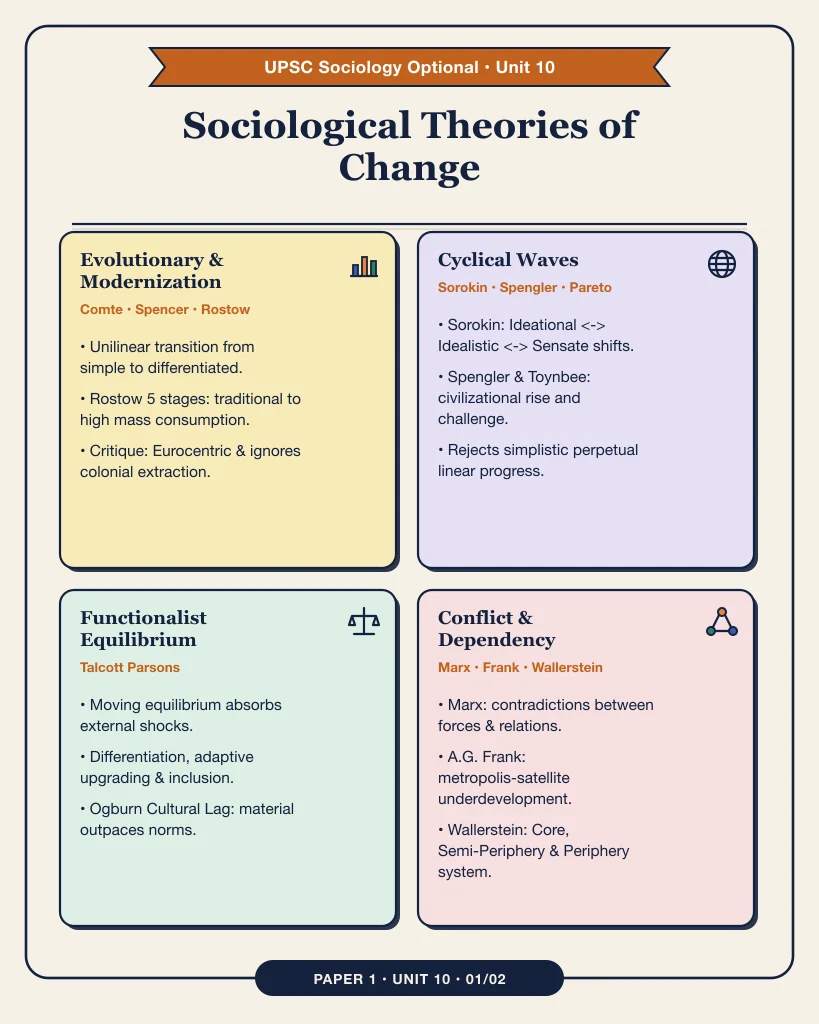
Modernization vs Dependency & World-Systems Theory: Rostow, Frank, Wallerstein
Rostow ki linear growth story vs Frank-Wallerstein ki structural dependency debate ka UPSC-ready analysis. India, Global South tech imports aur vaccine politics se theory ko ground par samjho.
Padho →