Modernization vs Dependency & World-Systems Theory: Rostow, Frank, Wallerstein
Rostow ki linear growth story vs Frank-Wallerstein ki structural dependency debate ka UPSC-ready analysis. India, Global South tech imports aur vaccine politics se theory ko ground par samjho.
📑 Quick Jump: Contents (4) & Syllabus Chapters
Introduction
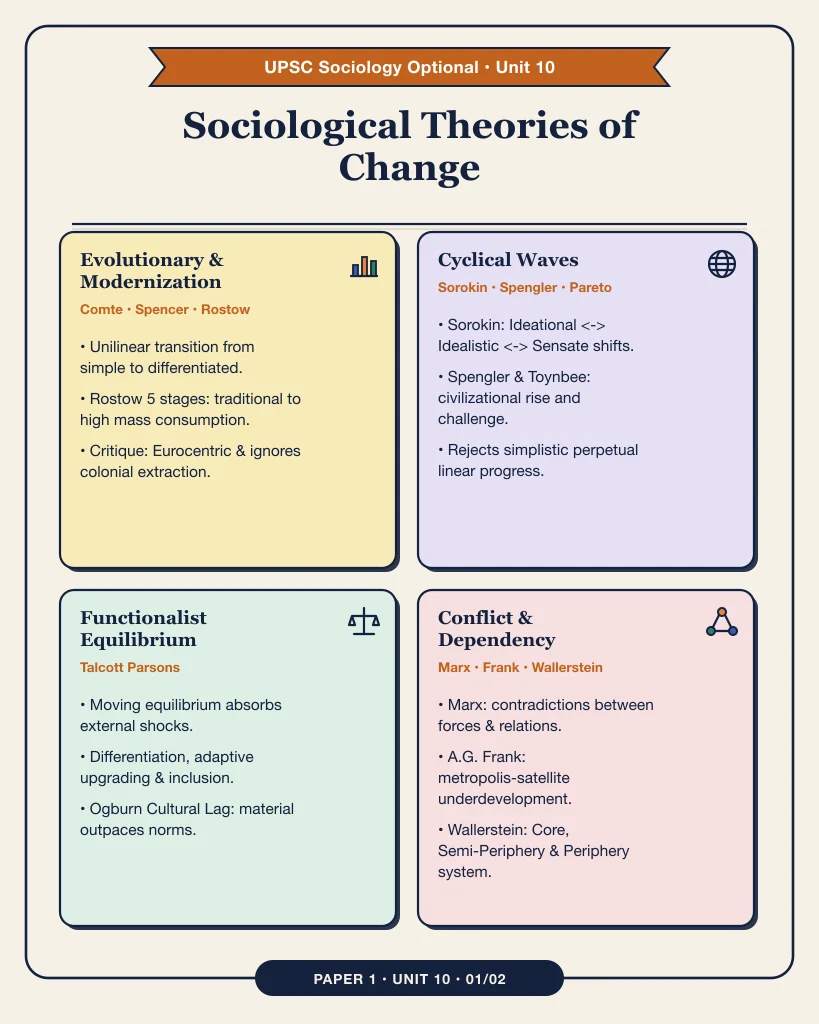
Modernization theory aur Dependency/World-Systems theory development ko do opposite lenses se samjhati hain. W.W. Rostow ke liye societies ek linear path follow karti hain: traditional society se take-off, then drive to maturity, and finally age of high mass consumption. Is frame mein underdevelopment ek temporary stage hai, jise capital accumulation, infrastructure, education, and industrialization se overcome kiya ja sakta hai. Lekin Latin America aur Global South ke experiences ne is optimistic model ko challenge kiya. A.G. Frank ne bola ki underdevelopment koi pre-modern stage nahi, balki capitalism ke expansion ka by-product hai: “development of underdevelopment.” Samir Amin ne is argument ko deepen karte hue unequal exchange aur peripheral accumulation ko highlight kiya. Immanuel Wallerstein ne ise World-Systems Theory mein systematize kiya—Core, Semi-periphery, aur Periphery ek single capitalist world-economy ke parts hain, jahan value drain structurally built-in hota hai.
Indian context mein yeh debate highly relevant hai. India ne Planning, Green Revolution, liberalization, IT boom, PLI schemes, aur digital public infrastructure ke through modernization ka strong push diya. Phir bhi PLFS unemployment patterns, NFHS-5 nutrition gaps, and regional inequality dikhate hain ki growth ka fruit uniformly distribute nahi hua. NCRB data repeatedly agrarian distress, suicide patterns, aur gendered vulnerability ko signal karta hai. Oxfam aur WIL reports wealth concentration aur top-heavy growth ko underline karte hain. Global South tech-vaccine politics mein bhi dependency visible hai: semiconductors, APIs, cloud platforms, and vaccine patents largely core economies ke control mein rahe. COVID-19 ke time vaccine access, patent debates, and supply chain asymmetry ne Wallerstein ko suddenly contemporary bana diya.
Is topic ka UPSC value yeh hai ki aap theory ko abstract definitions tak limit na rakhein. Mains answer mein aapko show karna hai ki modernization approaches state-led transformation explain karti hain, but dependency/world-systems explain why unequal insertion into global capitalism can reproduce hierarchies even during growth.
Thinkers and Core Arguments
W.W. Rostow: Rostow ki classic book The Stages of Economic Growth: A Non-Communist Manifesto (1960) modernization theory ka most famous version hai. Unke according all societies five stages se गुजरती hain—traditional society, preconditions for take-off, take-off, drive to maturity, and age of high mass consumption. Yeh model teleological hai: development ka endpoint Western-style industrial capitalism hai. Sociology/Development Studies mein Rostow ka merit yeh hai ki woh institutions, savings, investment, and infrastructure ko growth ke engines ke roop mein highlight karta hai. Lekin criticism yeh hai ki yeh Eurocentric aur ahistorical hai. It assumes all countries can replicate Europe’s path, while colonial history, unequal trade, and global power asymmetry ko underplay karta hai.
A.G. Frank: Andre Gunder Frank ki Capitalism and Underdevelopment in Latin America (1967) ne modernization paradigm ko blunt challenge diya. Frank ke hisaab se underdevelopment endogenous nahi, exogenous capitalist penetration ka result hai. Metropolis-satellite relation mein surplus peripheral regions se extract hota hai, jisse local development block hota hai. Iska matlab yeh nahi ki poor countries “behind” hain; balki they are structurally incorporated into a system that produces dependency. Frank ka emphasis historical colonialism, plantation economies, and export-oriented extraction par hai. India ke liye yeh relevant hai because colonial deindustrialization aur cash-crop orientation ne indigenous accumulation ko weaken kiya.
Samir Amin: Amin ne Accumulation on a World Scale aur Unequal Development mein dependency debate ko Marxist political economy ke saath deepen kiya. Unka key concept unequal exchange hai: core and periphery ke beech trade apparently voluntary hota hai, but value terms unequal hote hain because wages, productivity, and monopoly power are unequal. Amin ne delinking ka idea diya—peripheral countries ko selective disengagement and autonomous development strategies adopt karni chahiye. India ke context mein yeh argument import dependence, technology licensing, and commodity dependence par apply hota hai. Amin ka contribution yeh hai ki woh simple “do not trade” nahi bolte; instead they stress strategic autonomy and domestic surplus control.
Immanuel Wallerstein: Wallerstein ki The Modern World-System (1974 onwards) ne world-systems analysis ko formalize kiya. Unke framework mein Core countries high-tech, high-profit, and strong states hain; Periphery raw materials aur cheap labor provide karti hai; Semi-periphery buffer zone ke रूप mein work karti hai, sometimes exploiting the periphery while being exploited by the core. World economy ek integrated historical system hai, not a collection of separate national economies. Wallerstein ka strength structural explanation hai, but critics kehte hain ki it can over-deterministically reduce agency and national policy space.
Contrast in one line: Rostow says development is a linear internal climb; Frank says underdevelopment is produced by capitalist penetration; Amin says unequal exchange locks in dependency; Wallerstein says this is a world-system with hierarchical zones. UPSC answer mein inko opposed but cumulative lenses ki tarah present karna best hota hai—modernization explains aspiration and state policy, while dependency/world-systems explain persistent inequality within global capitalism.
| Aspect | Modernization Theory | Dependency / World-Systems Theory |
|---|---|---|
| Basic view of development | Linear, stage-wise progression from traditional to modern society | Development and underdevelopment are relational and structurally linked |
| Main unit of analysis | Nation-state internal institutions, values, investment, productivity | Global capitalist system, core-periphery hierarchy, unequal exchange |
| Role of external factors | Secondary; focus on domestic reforms and modernization | Primary; colonialism, trade, monopoly, capital flows shape outcomes |
| Policy implication | Industrialization, savings, education, infrastructure, social change | Autonomous development, strategic state role, delinking/selective integration |
Indian Data and Empirical Anchors
India ka experience is debate ko test-bed banata hai. NFHS-5 dikhata hai ki aggregate development ke baad bhi malnutrition, anaemia, stunting, and gender disparities persist karte hain. Yeh prove karta hai ki mere GDP growth se social modernization automatically guarantee nahi hoti. PLFS repeatedly youth unemployment and low female labour force participation ko highlight karta hai, jo modernization theory ke smooth transition claims ko complicate karta hai. High-tech sectors mein growth ke saath informalization bhi continue hai, especially gig work and precarious service employment.
NCRB data agrarian distress aur social vulnerability ko foreground karta hai—farmer suicides, debt stress, aur uneven regional patterns indicate karte hain ki market integration sabko equal benefit nahi deti. Isko Frank/Amin lens se padhein to rural surplus extraction, low bargaining power, aur unequal terms of trade clearly visible hote hain. ASER reports schooling enrollment improve hone ke baad bhi foundational learning gaps ko show karti hain. Isse modernization ka “education leads to automatic mobility” assumption weak hota hai.
Policy debate mein NITI Aayog’s Multidimensional Poverty Index (MPI) important hai because it shows that poverty reduction is multi-dimensional, not just income-based. But MPI decline ke saath bhi regional inequality aur consumption divergence persist karte hain. Yeh reminder hai ki poverty reduction and structural transformation same cheez nahi hain. Oxfam aur World Inequality Lab (WIL) reports India mein wealth concentration aur top income shares ko highlight karte hain. Jab elite concentration badhti hai, tab development ke gains core-like urban enclaves tak simit ho sakte hain, while peripheries remain under-served.
Real case studies bhi important hain. Green Revolution ne Punjab-Haryana mein productivity rise diya, but eastern and rain-fed India mein uneven outcomes aaye—this fits a semi-periphery type internal hierarchy. IT and Global Capability Centers ne India ko global value chains mein semi-peripheral positioning di: high-skill services export hue, but semiconductors, advanced hardware, and proprietary platforms largely external control mein rahe. COVID-19 vaccine politics ne India ko aapasi contradiction mein रखा: domestic capacity (Serum Institute, Bharat Biotech) strong tha, yet raw materials, patents, and global supply chains ne vulnerability create ki. Patents, TRIPS debate, and vaccine nationalism ne Wallerstein ka core dominance aur Amin ka unequal exchange sharp bana diya.
Sachar Committee report yaad dilati hai ki minority deprivation sirf individual deficit nahi, systemic exclusion bhi hai. Similarly Xaxa Committee tribal dispossession and extraction ko highlight karti hai, jo dependency lens ke liye highly relevant hai. Ek strong sociology answer yeh dikhata hai ki India neither pure modernization success story hai nor total dependency case—rather it is a hybrid formation where domestic reforms and global hierarchies interact.
🔑 Unequal Exchange
Core aur periphery ke beech trade mein prices aur wages structurally unequal hote hain, jisse value peripheral countries se core economies ki taraf transfer hoti rehti hai.
Critique and Nuanced Synthesis
Dependency aur World-Systems theory ki sabse badi strength yeh hai ki yeh global power asymmetry ko center mein rakhti hain. Lekin inki limitations bhi important hain. Pehle, kabhi-kabhi yeh frameworks national agency, state capacity, and internal class conflict ko underplay kar dete hain. Har underdevelopment ko external capitalism se explain karna excessive determinism ban sakta hai. Second, yeh models technological upgrading aur selective catching-up ko sufficiently explain nahi karte. East Asian developmental states—South Korea, Taiwan, Singapore—show karte hain ki state-led industrial policy, education, export discipline, and geopolitical strategy se semi-periphery se upward mobility possible hai.
Modernization theory ki criticism bhi equally strong hai. Rostow ka model Eurocentric aur linear hai; it ignores colonialism, unequal exchange, and environmental limits. Ismein culture and values ko over-emphasize karne ka risk hai, while power and history ko underplay kiya jata hai. It assumes that all societies can travel the same path, but actual development paths are path-dependent and conflict-ridden.
Best synthesis kya hai? A balanced sociology answer yeh argue karegi ki modernization theory intra-societal transformation ko explain karti hai—education, urbanization, bureaucratic rationality, technological diffusion—while dependency/world-systems theory inter-societal inequality ko explain karti hai. India ke case mein state-led modernization, democratic mobilization, and welfare expansion real achievements hain, but global value chain dependence, technology imports, patent regimes, and internal regional inequality show that development is uneven and externally constrained. Thus, no single theory is sufficient. A mature analysis uses modernization for growth mechanisms and dependency/world-systems for structural limits. यही nuanced synthesis examiner ko impress karti hai.
Answer kaise likhein
- Rostow development ko linear stages mein dekhta hai; Frank aur Amin ke liye underdevelopment capitalism ka by-product hai.
- Wallerstein world-economy ko core, semi-periphery, periphery mein divide karke structural inequality explain karta hai.
- India ka experience show karta hai ki growth possible hai, but unequal: NFHS-5, PLFS, NCRB aur Oxfam/WIL data social stratification ko reveal karte hain.
- Tech, semiconductors, APIs aur vaccine politics Global South ki dependency ko show karte hain; hence autonomy, capability-building and strategic integration are crucial.
Is Blog Se Jude Syllabus Chapters
Every Unit Note + Topic-Wise PYQ Mapped (English + Hinglish)
Paper 1 (10 Units) aur Paper 2 (15 Units) — Complete structured notes, thinkers, mind maps & 597 solved PYQs ek saath.
Khud ko test karo
Is post se 3 sawal
0 / 3 attempted
1. Rostow ki kitab ka correct title kya hai?
2. ‘Development of Underdevelopment’ kis thinker se linked hai?
3. Wallerstein ke world-systems framework mein India zyada kis category mein fit hota hai?
FAQ
Aksar poochhe jaane wale sawaal
- Rostow aur Wallerstein mein main difference kya hai?
- Rostow linear internal growth model deta hai, jabki Wallerstein global capitalist system ki hierarchical structure se development explain karta hai.
- Frank ka ‘development of underdevelopment’ kya mean karta hai?
- Iska matlab hai ki capitalism aur colonial linkages poor countries ko develop nahi, balki underdeveloped banate hain through surplus extraction.
- India ko dependency theory se kaise read karein?
- India mein uneven regional growth, technology imports, patent dependence aur wealth concentration dikhate hain ki growth ke bawajood structural dependency बनी रहती है.
UPSC PYQs
Is topic ke Previous Year Questions
- 2025 · P1
What do you understand by sustainable development? Discuss the elements of sustainable development as proposed in the UNDP's Sustainable Development Goals Report-2015. (10 marks)
- 2024 · P1
Critically examine the relevance of development planning in India. (10 marks)
- 2024 · P1
Discuss various theories of Social Change. Explain the limitations of unilinear theories of social change. (10 marks)
- 2023 · P1
Assess critically A. G. Frank's 'theory of development of underdevelopment’. (10 marks)
Roz ke Sociology notes Telegram pe paao
Daily current affairs, PYQ linkages aur direct mentorship support Telegram par.
Related
Aur padho
 Paper 1 Concepts8 min read
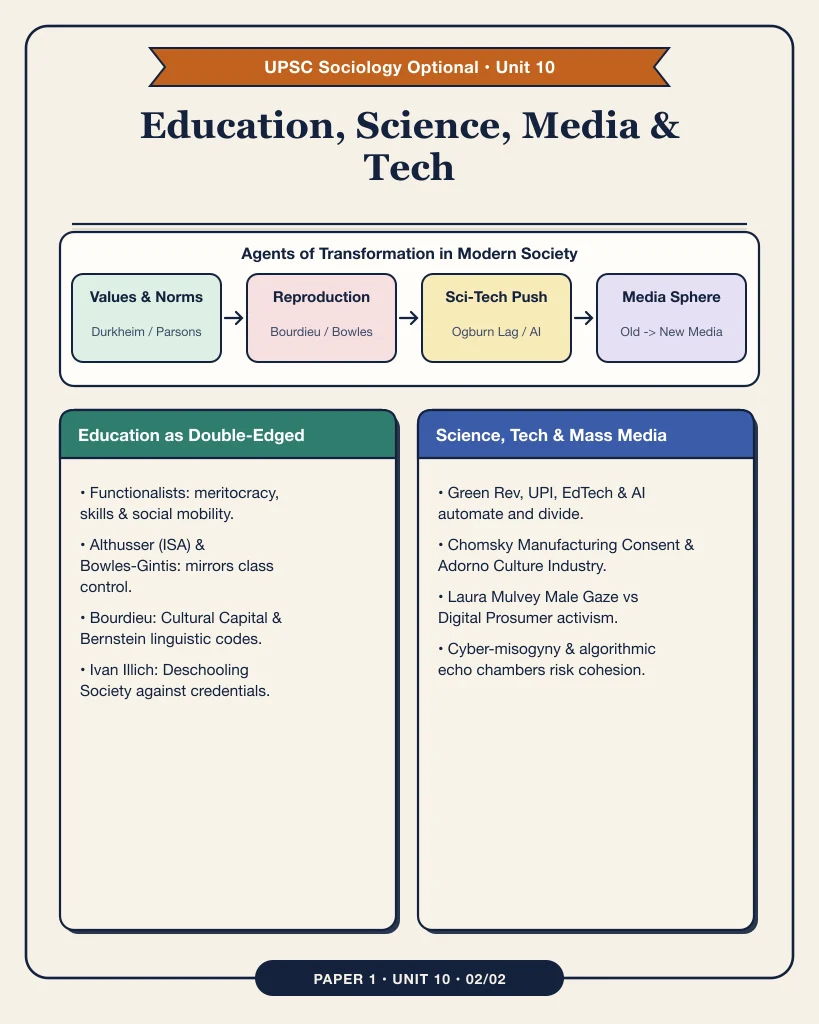
Cultural Lag, Tech Change & Castells Network Society in India’s Digital Age
India me AI, deepfakes aur platform economy ne social change ko super-fast kiya, par law, norms aur access abhi bhi slow hain. Oxfam ke mutabik women internet gap 33% tak hai—classic cultural lag ka live case.
Padho →