Social Mobility: Sorokin, Goldthorpe, Bourdieu Cultural Capital & Indian Reality
Social mobility sirf income ka shift nahi, power aur status ka bhi khel hai. Sorokin se Bourdieu tak, aur India mein ASER, NFHS-5, PLFS, Xaxa-Sachar se dikhता hai ki SC/ST/Muslim mobility ab bhi uneven hai.
📑 Quick Jump: Contents (4) & Syllabus Chapters
Social Mobility: Concept ka core puzzle
Social mobility sociology ka woh key concept hai jo batata hai ki society mein log ek social position se doosri position tak kaise move karte hain. Kya child apne parent se higher status, better occupation, aur zyada respect achieve kar sakta hai? Ya caste, class, gender, region aur community uske life chances ko lock kar dete hain? Yehi conceptual puzzle UPSC Sociology Optional ke liye bahut important hai, kyunki India jaisi stratified society mein mobility ka question sirf economic progress ka nahi, balki social justice, equality of opportunity, aur democratic citizenship ka bhi hai.
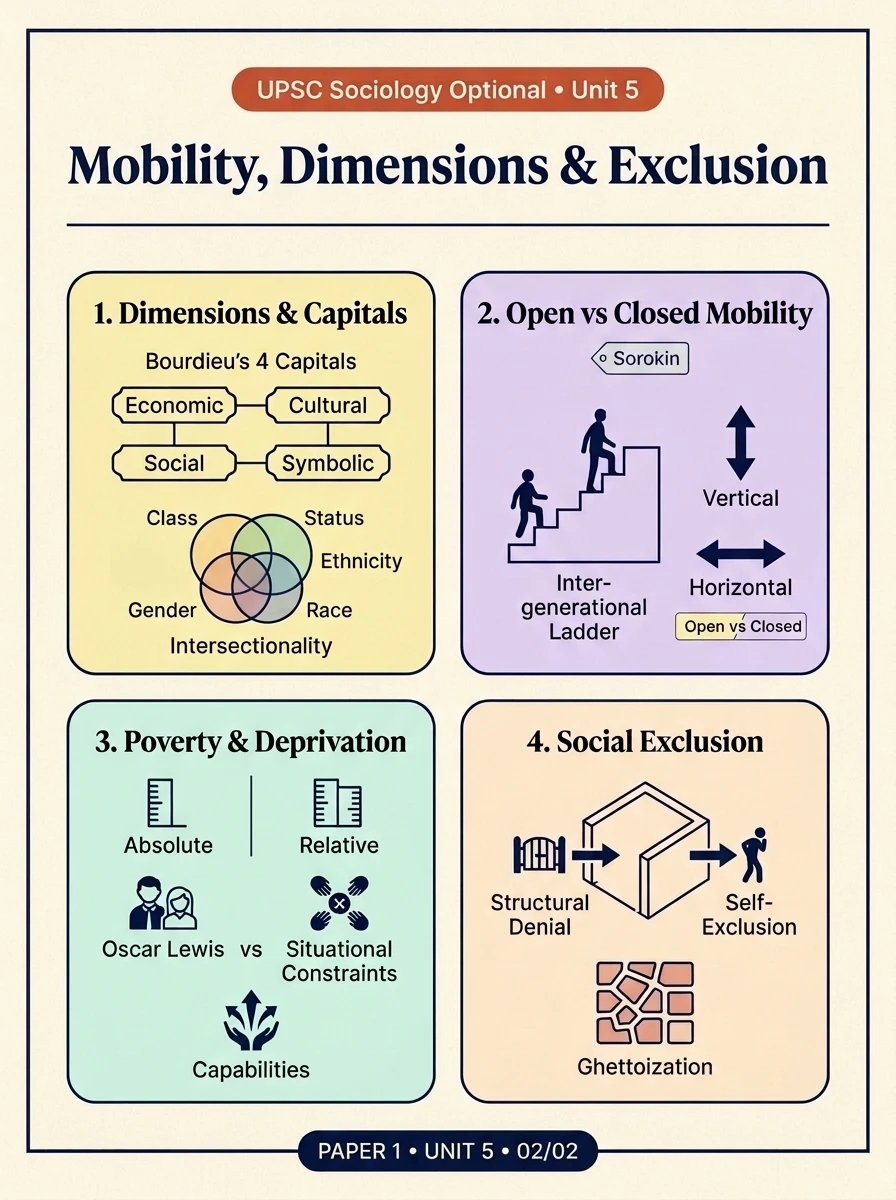
Mobility ko samajhne ke liye pehle vertical aur horizontal distinction zaroori hai. Vertical mobility mein status ladder par upward ya downward movement hota hai; horizontal mobility mein same status ke andar position shift hota hai, jaise ek district se doosre district transfer. Inter-generational mobility parent-child comparison hai, jabki intra-generational mobility ek hi individual ke lifetime mein change ko capture karti hai. Raymond Boudon, Pitirim A. Sorokin, John Goldthorpe, aur Ralph Turner jaise thinkers ne is concept ko different angles se explain kiya. Sorokin ne mobility ko modern society ka defining feature maana; Goldthorpe ne class mobility aur mobility tables ke through inequality ko measure kiya; Bourdieu ne bataya ki economic capital ke saath cultural capital aur social capital bhi mobility decide karte hain.
India mein mobility ka issue aur bhi complex hai. Constitutional promises, reservations, education expansion, urbanization, digital economy aur welfare schemes ne new opportunities create ki hain. Lekin caste-based exclusion, school quality gaps, informal labor, gendered restrictions aur unequal access to networks ab bhi strong barriers hain. Asher et al. ki World Bank/NBER-linked research ne dikhaya ki SC/ST aur Muslim groups ki intergenerational mobility upper castes aur some other groups ke mukable substantially lower hai. Iska matlab hai ki talent aur effort ke bawajood life chances uneven remain karte hain.
Is topic ko padhte waqt simple “more education = more mobility” formula se aage jaana hoga. UPSC answer mein aapko show karna hoga ki mobility is not only an individual story; it is a structural outcome shaped by institutions, discrimination, markets, family, and policy. India mein social mobility ka study actually equality of opportunity aur social reproduction ke बीच ki tension ko expose karta hai.
Thinkers aur theoretical contrast
Pitirim A. Sorokin mobility studies ke foundational thinker maane jaate hain. Unki classic book Social and Cultural Mobility (1927) me unhone mobility ko social life ka normal feature bataya. Sorokin ke liye mobility do types ki thi: vertical aur horizontal. Vertical mobility society ke hierarchy structure ko reveal karti hai—upar ya neeche movement. Horizontal mobility location ya role change ko dikhati hai without rank change. Sorokin ka big contribution ye tha ki unhone mobility ko purely individual achievement nahi, balki social structure ka product maana. Unka macro-sociological lens hume batata hai ki open societies mein mobility zyada hoti hai, closed societies mein less.
John H. Goldthorpe ne mobility research ko empirical and comparative direction di. Unki works, especially Social Mobility and Class Structure in Modern Britain (with Llewellyn, Payne) aur later mobility studies, class positions, relative mobility, aur chance equality par focus karti hain. Goldthorpe ke framework mein class origin aur class destination compare karke dekha jaata hai ki mobility genuine hai ya sirf structural expansion ka result. Unka core insight: absolute mobility kabhi economic expansion ki wajah se badh sakti hai, lekin relative mobility unchanged reh sakti hai. UPSC ke liye ye distinction goldmine hai, because India mein middle-class expansion ke baad bhi unequal class reproduction ho sakta hai.
Pierre Bourdieu mobility ko deeper cultural lens se samjhate hain. Unki key texts Distinction, Outline of a Theory of Practice, aur Reproduction in Education, Society and Culture me ye argue kiya gaya ki schools meritocratic dikhte hain, but actually dominant classes ka cultural capital reward karte hain. Cultural capital = language style, tastes, manners, educational familiarity; social capital = networks and connections; economic capital = money and assets. Bourdieu ke according, jis family ke paas high cultural capital hota hai, uske children institutions me better perform karte hain. India mein English proficiency, private schooling, coaching culture aur urban habitus is theory ko strongly support karte hain.
Ralph Turner ne sponsored vs contest mobility ka distinction diya. Contest mobility mein open competition hoti hai—everyone can strive, ladder open hai. Sponsored mobility mein elites ya gatekeepers select karte hain aur ‘best’ candidates ko move karte hain. Indian context mein recruitment, elite schools, coaching, recommendation networks aur professional gatekeeping often sponsored mobility ke elements dikhate hain. Competition apparent hoti hai, lekin resources unequal hote hain.
Andre Beteille India ke liye crucial bridge thinker hain. Unki works on caste, class aur power batati hain ki mobility simple linear process nahi. India mein caste status aur class advantage interlock karte hain. Beteille ka comparative realism aapko answer mein structural nuance deta hai: modernity ne opportunities kholi hain, but caste hierarchy fully dissolve nahi hui. Isliye India mein mobility ko pure modernization theory se nahi samjha ja sakta.
Analytical contrast yeh hai: Sorokin structure of movement samjhate hain, Goldthorpe measurement aur class chances samjhate hain, Bourdieu reproduction aur cultural advantage samjhate hain, Turner gatekeeping ka logic samjhate hain, aur Beteille Indian caste-class synthesis provide karte hain. UPSC answer mein in sab ko ek line mein jodna highest value create karta hai.
| Aspect | Contest Mobility | Sponsored Mobility |
|---|---|---|
| Core idea | Open competition; individuals move up through merit and performance. | Institutions/elites select and push preferred candidates upward. |
| Selection logic | Rules are formally universal; success depends on contest outcomes. | Gatekeepers, patronage, and elite screening dominate. |
| Indian example | Civil services exam, competitive scholarships, entrance tests. | Elite schools, coaching filters, recommendation-based opportunities. |
| Critical issue | Looks egalitarian but often hides unequal preparation resources. | Can reproduce privilege under a meritocratic mask. |
Indian evidence: mobility ka ground reality
India mein social mobility ka empirical picture mixed hai. Asher et al. ki mobility research, jise World Bank/NBER-linked work ke roop mein widely cited kiya jaata hai, ye dikhati hai ki SC/ST aur Muslim households ki intergenerational mobility upper-caste groups ke mukable kaafi lower hai. Iska matlab parent-child occupation/income/status transition mein structural barriers persistent hain. Ye finding Bourdieu aur Goldthorpe dono ke framework ko Indian context mein validate karti hai.
NFHS-5 (2019-21) hume social mobility ke prerequisites samajhne mein help karti hai. Education, nutrition, women’s health, marriage age aur fertility patterns me sharp disparities dikhte hain. Jab girls ki schooling incomplete ho, anaemia high ho, aur early marriage persist kare, to intra-generational aur inter-generational mobility dono slow ho jaati hain. Mobility sirf jobs ka issue nahi; health and human capital ka bhi issue hai.
PLFS data labour market segmentation ko expose karta hai. India ka employment structure still highly informal hai, aur informality low wages, lack of social security aur occupational stuckness create karti hai. A worker ka agriculture se construction ya casual labour mein shift hona horizontal mobility nahi, aksar precarious survival move hota hai. Isliye mobility ko “employment change” ke roop mein mechanically read nahi karna chahiye.
ASER reports school learning gaps ko highlight karti hain. Basic reading aur arithmetic outcomes rural children mein uneven hain, jo class/caste based educational reproduction ko strengthen karta hai. Private tuition, digital access aur English-medium advantage ek new cultural capital hierarchy create karte hain. Ye Bourdieu ka direct Indian echo hai.
Policy and legal layer mein Xaxa Committee ne tribal deprivation aur exclusion ko underline kiya. Sachar Committee ne Muslims ke education, employment aur access gaps ko documented kiya. NITI Aayog’s Multidimensional Poverty Index bataata hai ki deprivation multiple dimensions mein concentrated hai. Mobility ka base jab deprivation-heavy ho, to upward movement limited hota hai.
Judicially, Indra Sawhney v. Union of India (1992) ne reservations aur social justice ka framework strengthen kiya, aur later creamy layer logic ne internal differentiation ko recognize kiya. M. Nagaraj aur Jarnail Singh cases ne affirmative action ke constitutional contours define kiye. Ye rulings social mobility ko legal support deti hain, but outcome automatic nahi hota.
Ethnographic studies bhi important hain. Dalit middle class formation, reservation-enabled first-generation education, and tribal migration studies show that mobility often involves identity negotiation, stigma, and boundary crossing. Oxfam India reports on inequality, and WIL-style labour studies, repeatedly point to wealth concentration and precarious work. Overall, Indian evidence suggests mobility exists, but it is uneven, segmented, and deeply mediated by caste, religion, gender, region, and school quality.
🔑 Social Mobility
Ek social position se doosri position tak movement, chahe status, class, occupation, income ya power mein ho.
Critical evaluation aur synthesis
Social mobility theory par sabse pehla limitation ye hai ki kai models Western class societies ke liye developed hue the. Sorokin aur Goldthorpe useful hain, but Indian reality mein caste status, ritual hierarchy aur social exclusion ko fully capture karna unke frameworks ke liye hard ho jata hai. Sirf occupation change dekhne se social mobility ka complete picture nahi milta, because a Dalit engineer may still face discrimination in marriage, housing, and workplace networks. Isliye mobility ka ‘status’ dimension bhi equally important hai.
Second, Bourdieu ka cultural capital framework strong hai, but agar usse overly deterministic bana diya jaaye to human agency, state policy aur collective resistance underplay ho sakte hain. India mein reservations, scholarships, mid-day meal, school expansion, and welfare transfers ne real openings create ki hain. Pure reproduction thesis se mobility gains explain nahi honge.
Third, Turner ka contest vs sponsored distinction helpful hai, lekin empirical reality often hybrid hoti hai. Indian institutions mein written exams contest show karte hain, but coaching, English fluency, digital access, and networks sponsored advantages create karte hain. Thus, competition formally open, substantively unequal ho sakti hai.
Nuanced synthesis yeh hai: social mobility na purely individual effort hai, na completely structural lock-in. It is a field of struggle where opportunity, inheritance, discrimination, and policy interact. UPSC answer mein best approach ye hoga ki aap Sorokin se structure, Goldthorpe se measurement, Bourdieu se reproduction, Turner se selection logic, aur Indian thinkers/data se contextual grounding den. Final conclusion mein ye argue kiya ja sakta hai ki India needs both equality of opportunity and equality of capabilities to make mobility meaningful.
Answer kaise likhein
- Sorokin ke according mobility vertical aur horizontal ho sakti hai; inter-generational aur intra-generational distinction analysis ko sharpen karti hai.
- Goldthorpe class mobility ko origin-destination comparison aur relative mobility ke through measure karte hain; absolute growth aur real equality alag cheezein hain.
- Bourdieu ke cultural capital, social capital aur habitus se explain hota hai ki schools aur labour markets meritocracy ke saath reproduction bhi karte hain.
- India mein Asher study, NFHS-5, PLFS, ASER, Sachar aur Xaxa dikhate hain ki SC/ST/Muslim aur tribal groups ki mobility uneven hai.
Is Blog Se Jude Syllabus Chapters
Every Unit Note + Topic-Wise PYQ Mapped (English + Hinglish)
Paper 1 (10 Units) aur Paper 2 (15 Units) — Complete structured notes, thinkers, mind maps & 597 solved PYQs ek saath.
Khud ko test karo
Is post se 3 sawal
0 / 3 attempted
1. Which thinker is most directly associated with the distinction between contest and sponsored mobility?
2. Bourdieu’s concept most directly linked to family-based educational advantage is:
3. Inter-generational mobility refers to:
FAQ
Aksar poochhe jaane wale sawaal
- Sorokin ne social mobility ko kaise classify kiya?
- Unhone mobility ko mainly vertical aur horizontal categories mein divide kiya, aur social movement ko society ki openness ka indicator maana.
- Bourdieu ka cultural capital Indian education ko kaise explain karta hai?
- English, schooling style, manners, networks aur familiarity with institutions higher achievement aur smoother mobility mein convert ho jaati hai.
- India mein mobility ko kaunse factors sabse zyada limit karte hain?
- Caste discrimination, uneven schooling, informal labour, gender norms, regional inequality, aur unequal social capital mobility ko constrain karte hain.
UPSC PYQs
Is topic ke Previous Year Questions
- 2024 · P1
What is social mobility? Critically examine the classification of ‘closed' and 'open' models of social stratification. (10 marks)
- 2023 · P1
Do you think that the boundary line between ethnicity and race is blurred? Justify your answer. (10 marks)
- 2022 · P1
Discuss social mobility in open and closed system. (10 marks)
- 2022 · P1
How do sociologists construct gender in their analysis on social inequality? (10 marks)
Roz ke Sociology notes Telegram pe paao
Daily current affairs, PYQ linkages aur direct mentorship support Telegram par.
Related
Aur padho
- Paper 1 ConceptsOWL BLOGP1
Social Stratification & Mobility for UPSC Sociology: Marx, Weber, Davis-Moore & Gender Dimensions
4 min readSocial Stratification & Mobility for UPSC Sociology: Marx, Weber, Davis-Moore & Gender Dimensions
Unit 5 of Paper 1 is arguably the highest-yielding section in the entire Sociology optional syllabus, forming the analytical backbone for understanding inequality across societies. Whether you are decoding classical class conflict or...
Padho → 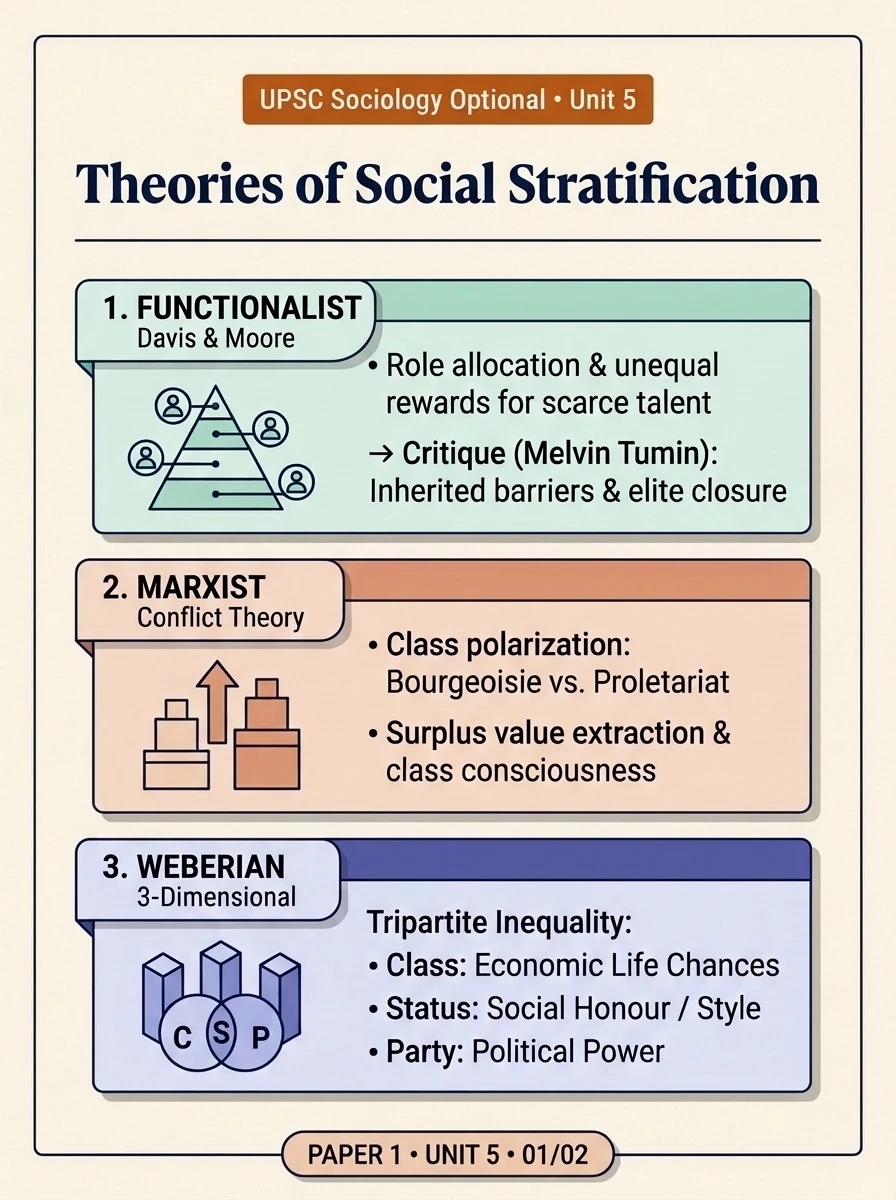 Paper 1 Concepts9 min read
Social Capital (Putnam, Bourdieu, Coleman) Explained Through Indian SHGs & Alumni Networks
Social capital samjho Putnam-Bourdieu-Coleman lens se: SHGs ne women solidarity badhayi, jabki corporate alumni/referral networks kabhi-kabhi exclusionary ho jaate hain. NFHS-5, PLFS aur NRLM data se UPSC-ready analysis.
Padho →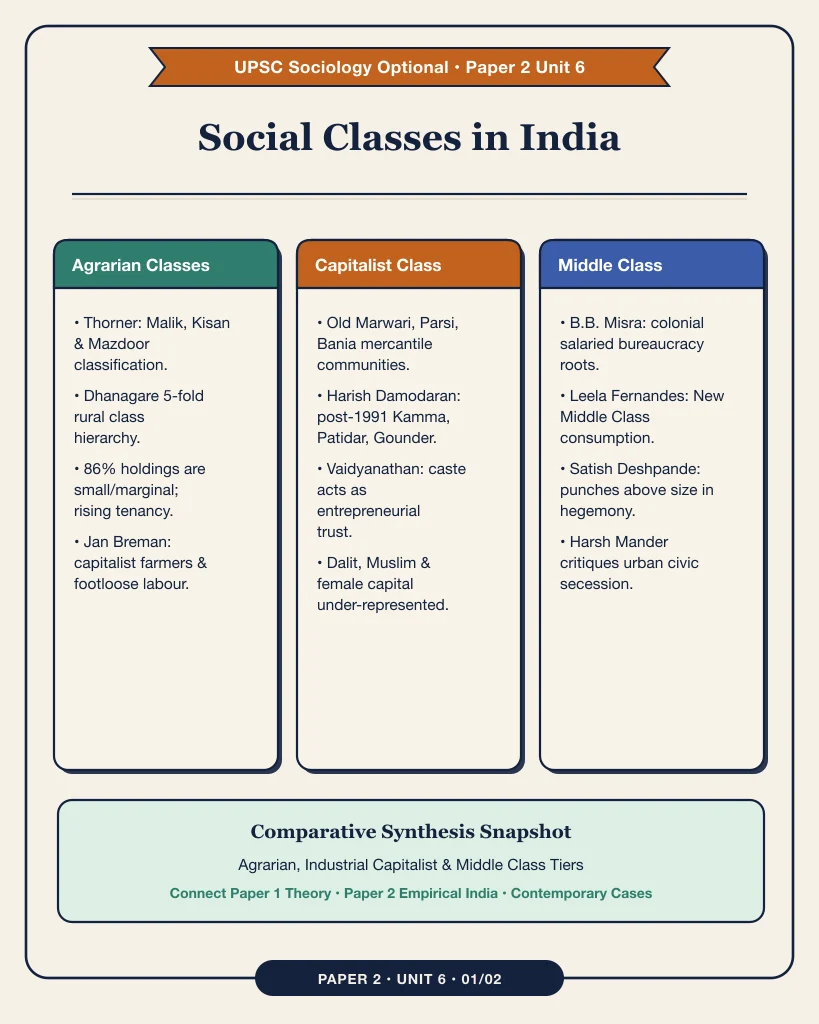 Paper 2 India2 min read
Indian Middle Class ka Rise: Consumerism, Caste Privilege aur Social Mobility
Naya Indian middle class kitna meritocratic hai? Satish Deshpande, André Béteille, Leela Fernandes aur Dipankar Gupta ke lenses se Paper 2 analysis.
Padho →