Davis-Moore Functionalism vs Melvin Tumin & Marx on Social Inequality
Davis-Moore kehte hain inequality functional hai; Tumin aur Marx bolte hain inherited privilege unjust aur dysfunctional. Oxfam/WIL ke hisab se India ka top 1% 40.1% wealth control karta hai.
📑 Quick Jump: Contents (9) & Syllabus Chapters
- Conceptual Puzzle: Inequality Functional Hai Ya Unjust?
- Thinkers and Core Arguments
- 1) Kingsley Davis & Wilbert E. Moore
- 2) Melvin Tumin
- 3) Karl Marx
- 4) Melvin Tumin + Marx: Converging Critique
- 5) Web/Power and Indian Relevance
- Indian Evidence: Inequality Beyond Theory
- Critical Assessment and Nuanced Synthesis
Conceptual Puzzle: Inequality Functional Hai Ya Unjust?
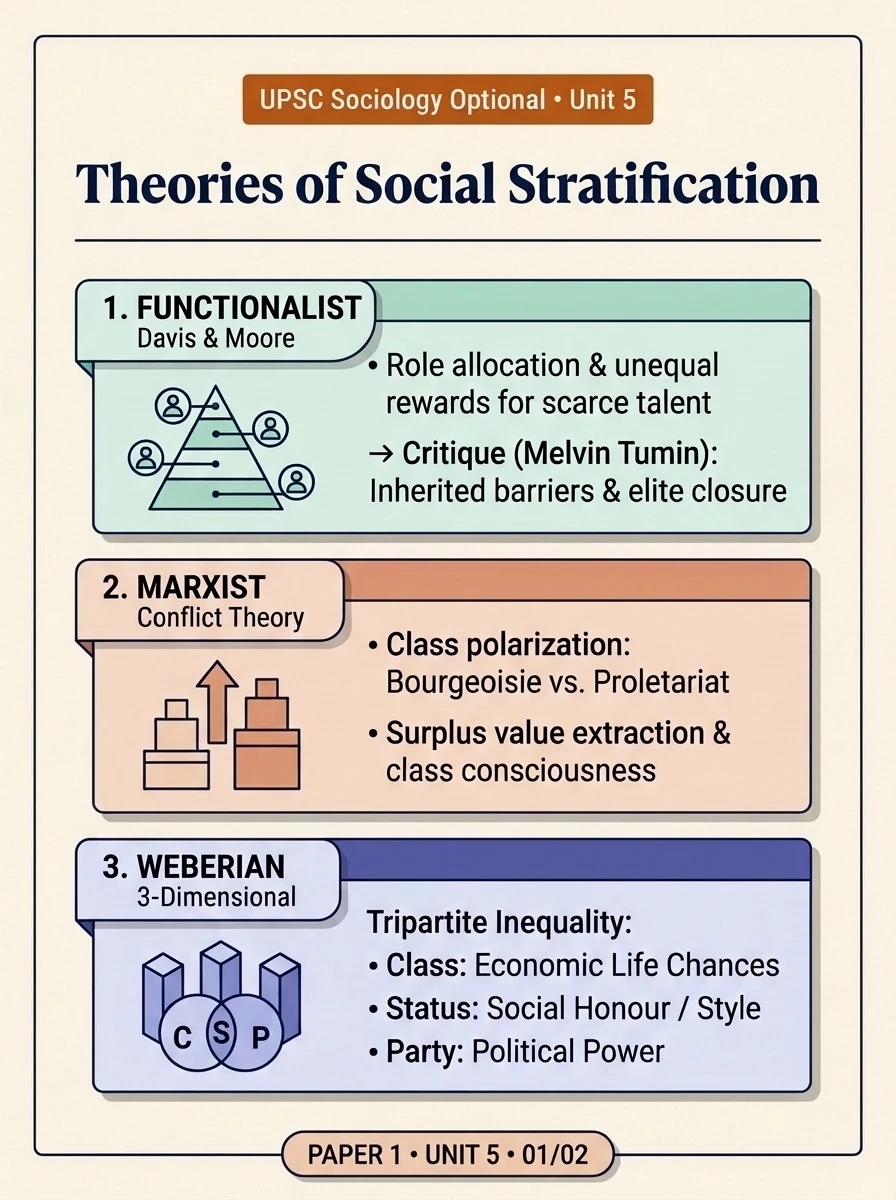
Social inequality sociology ka evergreen debate hai: kya hierarchy society ko efficient banati hai, ya woh inherited privilege ko legitimize karke domination ko reproduce karti hai? Kingsley Davis aur Wilbert E. Moore ne 1945 me argue kiya ki stratification “functionally necessary” hai, because every society ko kuch important roles ke liye differential rewards dene padte hain. Unke according, difficult skills, long training, aur high responsibility wale positions ko attract karne ke liye higher rewards zaroori hain. Is theory me inequality ek motivational mechanism ban jati hai.
Lekin Melvin Tumin ne 1953 me is thesis ko sharply challenge kiya. Usne kaha ki Davis-Moore selection, talent, aur opportunity ko overestimate karta hai, aur inherited privilege ko normalise karta hai. Agar education, caste, class, gender ya race ke basis par access unequal ho, toh “talent” actually social background ka outcome ban jata hai. Isliye inequality ka ek major dysfunction hota hai: it blocks merit, wastes human potential, and reproduces advantage.
Marxist perspective is debate ko aur deeper level par le jati hai. Karl Marx ke liye inequality functional nahi, balki class domination ka structural result hai. “Surplus value”, “class exploitation”, aur “alienation” dikhate hain ki capitalist society rewards contribution se nahi, ownership se organize hoti hai. Hence stratification is not neutral social need; it is power-laden.
Indian context me ye debate aur relevant ho jati hai because India me inequality sirf income tak limited nahi hai; caste, gender, region, religion, landownership aur education sab interlock karte hain. Oxfam India / World Inequality Lab ke estimates ke according, India ka top 1% roughly 40.1% wealth hold karta hai—ye data functional necessity se zyada concentration of privilege ko indicate karta hai. NFHS-5, PLFS, NCRB aur ASER jaise datasets dikhate hain ki opportunities ab bhi highly uneven distributed hain. UPSC ke liye is topic ka core tension ye hai: kya inequality society ko run karne ka tool hai, ya social justice ke path me sabse bada obstacle?
Thinkers and Core Arguments
1) Kingsley Davis & Wilbert E. Moore
Their classic essay “Some Principles of Stratification” (1945) is the foundation of the functionalist view of inequality. They argue that no society can survive without role differentiation. Important positions—doctor, engineer, judge, civil servant, scientist—require long training, rare skills, and social responsibility. If all jobs were rewarded equally, people may not invest effort in difficult tasks. Hence differential rewards are necessary to ensure role allocation and efficiency. In their framework, stratification is not accidental but a mechanism of social order. The strength of this argument is that it explains why societies attach prestige and pay to certain occupations. However, it assumes a fair competition system, which is rarely true in real societies.
2) Melvin Tumin
Tumin’s essay “Some Principles of Stratification: A Critical Analysis” (1953) is the most famous rebuttal. He says social stratification is not merely a neutral reward system; it produces dysfunctions. First, unequal access to education, networks, and resources blocks talented people from lower strata. Second, inherited privilege makes “merit” socially constructed. Third, stratification creates resentment, social conflict, and status anxiety. Tumin directly punctures the Davis-Moore assumption that the most important jobs always get the highest rewards by necessity. He shows that reward systems often reflect power, not function. For UPSC, Tumin is crucial because he transforms the debate from “why inequality exists” to “who benefits from inequality.”
3) Karl Marx
Marx does not explain inequality as functional necessity but as a product of mode of production and class relations. In “Das Kapital” and “The Communist Manifesto”, he argues that the bourgeoisie owns the means of production while the proletariat sells labour power. Inequality is thus built into exploitation. For Marx, stratification is not just unequal reward; it is structural coercion. His concepts of surplus value, class struggle, and alienation help explain why inequality persists even when societies claim meritocracy. In India, Marxist analysis is especially useful for understanding labour precarity, agrarian distress, informalisation, and accumulation at the top.
4) Melvin Tumin + Marx: Converging Critique
Though Tumin is not Marxist in the strict sense, both converge on one key point: stratification reproduces privilege. Tumin focuses on dysfunctions within social systems; Marx focuses on domination embedded in economic structure. Together they challenge functionalist neutrality.
5) Web/Power and Indian Relevance
A modern Indian sociology lens also uses M.N. Srinivas, who showed how caste hierarchy adapts through Sanskritization and Dominant Caste politics. This is important because it shows inequality is not only economic; it is socially reproduced through status mobility claims. So, while Davis-Moore offers a macro-functional explanation, Tumin and Marx expose the hidden costs and power structures behind “legitimate” inequality.
| Aspect | Davis-Moore Functionalism | Tumin + Marx Critique |
|---|---|---|
| Basic assumption | Inequality is necessary to motivate people for important roles. | Inequality often reflects inherited privilege and domination. |
| View of stratification | A functional mechanism for role allocation and social efficiency. | A dysfunctional system that blocks talent and reproduces power. |
| Source of rewards | Higher rewards go to difficult, scarce, and socially vital positions. | Rewards are shaped by class power, ownership, and unequal access. |
| Indian reading | Can be used to justify differential incentives in administration and professions. | Explains caste-class barriers, elite capture, and unequal mobility in India. |
Indian Evidence: Inequality Beyond Theory
Indian empirical reality Davis-Moore ke optimistic claim ko challenge karti hai. Oxfam India / World Inequality Lab estimates show that India’s top 1% holds around 40.1% of national wealth, indicating extreme concentration rather than broadly distributed rewards. Agar inequality truly sirf functional incentive hoti, toh itna sharp concentration of assets and opportunity expect nahi kiya ja sakta tha. Ye pattern rentier advantage, inherited capital, and policy capture ki taraf point karta hai.
NFHS-5 household data aur health indicators caste, gender aur class differences ko reveal karte hain. Maternal health, child nutrition, anaemia, sanitation, and institutional delivery outcomes me sharp gaps dikhte hain, especially among SC/ST and poorer households. Ye show karta hai ki “equal opportunity” formal slogan hai, actual social reproduction unequal hai.
PLFS labour data India ki informal economy ko highlight karta hai. Large share of workforce informal, low-wage, and without social security hai. This weakens the functionalist idea that rewards naturally flow to essential work. In reality, essential jobs—construction, care work, sanitation, delivery, and farm labour—often remain underpaid.
NCRB reports also indirect inequality ko show karte hain: social vulnerability, crime exposure, custodial violence, and underreporting among marginalized groups. Dalit and Adivasi communities often face disproportionate violence and institutional discrimination, suggesting inequality is not just about income but social power.
ASER reports repeatedly show learning gaps between rural and urban children, and between first-generation learners and privileged households. Education, which Davis-Moore assumes as a meritocratic filter, in India often functions as a sorting mechanism of privilege.
On the structural side, Xaxa Committee reports on tribal issues note displacement, land alienation, and weak access to health and education, while the Sachar Committee (2006) documented relative deprivation among Muslims in schooling, employment, and representation. These reports are crucial because they show group-based inequality is institutionalized.
Judicial and policy debates also matter. Supreme Court jurisprudence on affirmative action, reservations, and creamy layer has recognized that formal equality cannot erase historical disadvantage. Cases like Indra Sawhney (1992) strengthened the idea that equality of opportunity must be backed by compensatory justice.
Case studies add life to theory: manual scavenging shows how stigmatized labour is inherited and socially enforced; urban elite schools show how network capital converts into status reproduction; and agrarian distress in caste-dominated rural India reveals that land and dignity remain unequal. Thus Indian data strongly support Tumin and Marx over a pure Davis-Moore reading.
🔑 Inherited privilege
A social advantage passed through family, caste, class, or network position, making inequality persist across generations rather than reflecting pure merit.
Critical Assessment and Nuanced Synthesis
Davis-Moore ka biggest limitation ye hai ki it assumes a fair, open, and mobile society. But real societies me opportunity structurally unequal hoti hai. It ignores how elite families, caste networks, private schooling, property ownership, and gendered labor markets shape access to “important” positions. It also overstates the idea that high rewards always signal high functional importance. In many cases, speculative finance, celebrity culture, or inherited wealth yields far higher returns than nursing, teaching, sanitation, or farm labour—positions actually essential for social reproduction.
Tumin’s critique stronger hai because it exposes dysfunctions of inequality. Still, Tumin ne bhi stratification ke deeper political economy ko fully theorize nahi kiya. Yahan Marx useful ho jata hai. Marx shows that inequality is not merely a sorting problem; it is rooted in ownership, exploitation, and class power. Yet Marx alone bhi Indian society ko fully explain nahi karta, because caste has its own autonomous logic. This is where Indian sociologists like M.N. Srinivas, André Béteille, and Surinder Jodhka become relevant: they show that class and caste intersect, and social mobility is often blocked by ritual hierarchy as much as by economic structure.
A mature UPSC answer should therefore avoid one-line rejection or blind acceptance. Better synthesis: inequality may perform limited coordination functions in complex societies, but in stratified and unequal contexts it more often becomes self-reproducing, exclusionary, and politically captured. In India, when 40.1% wealth is concentrated in the top 1%, when caste barriers remain visible in education and labour, and when informal workers remain underprotected, inequality cannot be defended as merely functional. It becomes a problem of justice, capability deprivation, and democratic legitimacy.
Answer kaise likhein
- Davis-Moore ke अनुसार stratification role allocation aur motivation ke liye functional hai, but ye meritocracy assume karta hai.
- Tumin dikhata hai ki inequality talent ko block karti hai, inherited privilege reproduce karti hai, aur social dysfunction create karti hai.
- Marx ke अनुसार inequality class exploitation, surplus extraction aur ownership relations ka outcome hai, not neutral necessity.
- Indian data—Oxfam/WIL wealth concentration, NFHS-5, PLFS, ASER, Xaxa, Sachar—prove karti hai ki inequality structural aur intergenerational hai.
Is Blog Se Jude Syllabus Chapters
Every Unit Note + Topic-Wise PYQ Mapped (English + Hinglish)
Paper 1 (10 Units) aur Paper 2 (15 Units) — Complete structured notes, thinkers, mind maps & 597 solved PYQs ek saath.
Khud ko test karo
Is post se 3 sawal
0 / 3 attempted
1. Davis and Moore’s original essay was published in which year?
2. Which statement best captures Tumin’s critique?
3. Which Indian evidence most directly supports a critique of inherited privilege?
FAQ
Aksar poochhe jaane wale sawaal
- Davis-Moore theory ka core claim kya hai?
- Society me important roles ko fill karne ke liye differential rewards aur inequality functionally necessary hoti hai.
- Tumin ne Davis-Moore ko kaise challenge kiya?
- Tumin ne kaha ki stratification talent ko block karti hai, inherited privilege ko legitimize karti hai, aur social dysfunction create karti hai.
- Marx is debate me kya add karta hai?
- Marx inequality ko class exploitation, ownership, surplus value, aur power relations se explain karta hai.
UPSC PYQs
Is topic ke Previous Year Questions
- 2025 · P1
Does the structural-functionalist perspective on social stratification promote a status quo? Give reasons for your answer. (10 marks)
- 2025 · P1
Compare capability deprivation approach with that of social capital deprivation in understanding chronic poverty. (10 marks)
- 2025 · P1
ls the social stratification theory gender-blind? Elucidate. (10 marks)
- 2024 · P1
Discuss the dimensions of power in the construction and maintenance of social hierarchies in a society. (10 marks)
Roz ke Sociology notes Telegram pe paao
Daily current affairs, PYQ linkages aur direct mentorship support Telegram par.
Related
Aur padho
- Paper 1 ConceptsOWL BLOGP1
Social Stratification & Mobility for UPSC Sociology: Marx, Weber, Davis-Moore & Gender Dimensions
4 min readSocial Stratification & Mobility for UPSC Sociology: Marx, Weber, Davis-Moore & Gender Dimensions
Unit 5 of Paper 1 is arguably the highest-yielding section in the entire Sociology optional syllabus, forming the analytical backbone for understanding inequality across societies. Whether you are decoding classical class conflict or...
Padho → 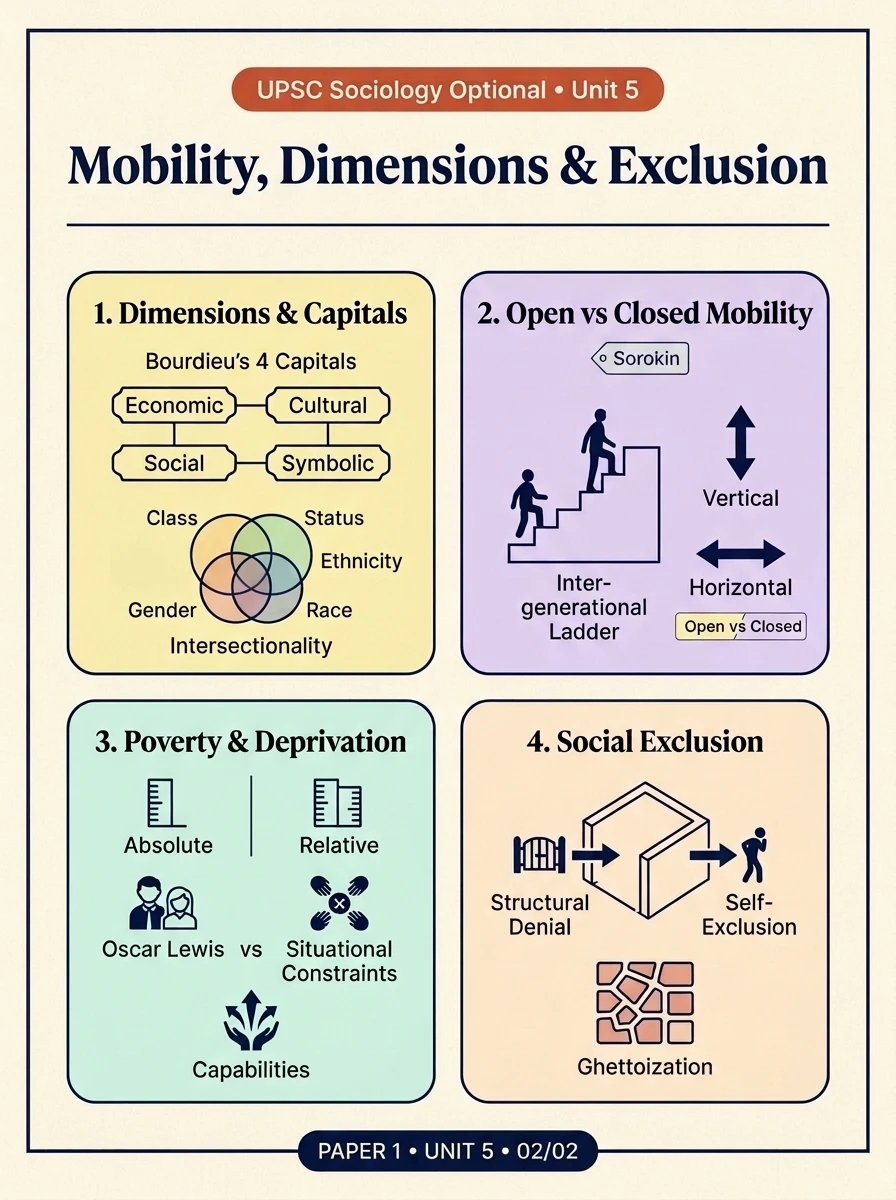 Current Affairs Link9 min read
Multidimensional Poverty vs Extreme Wealth Inequality: Sen, Townsend & NITI MPI
India ne 2013-23 me 24.82 crore logon ko multidimensional poverty se bahar nikala, phir bhi top-1% wealth concentration extreme hai. Sen, Townsend aur NITI MPI ko compare karke exam-ready clarity pao.
Padho →- Paper 1 Concepts9 min read
Social Mobility: Sorokin, Goldthorpe, Bourdieu Cultural Capital & Indian Reality
Social mobility sirf income ka shift nahi, power aur status ka bhi khel hai. Sorokin se Bourdieu tak, aur India mein ASER, NFHS-5, PLFS, Xaxa-Sachar se dikhता hai ki SC/ST/Muslim mobility ab bhi uneven hai.
Padho →